The Deepest South by Horne Gerald;
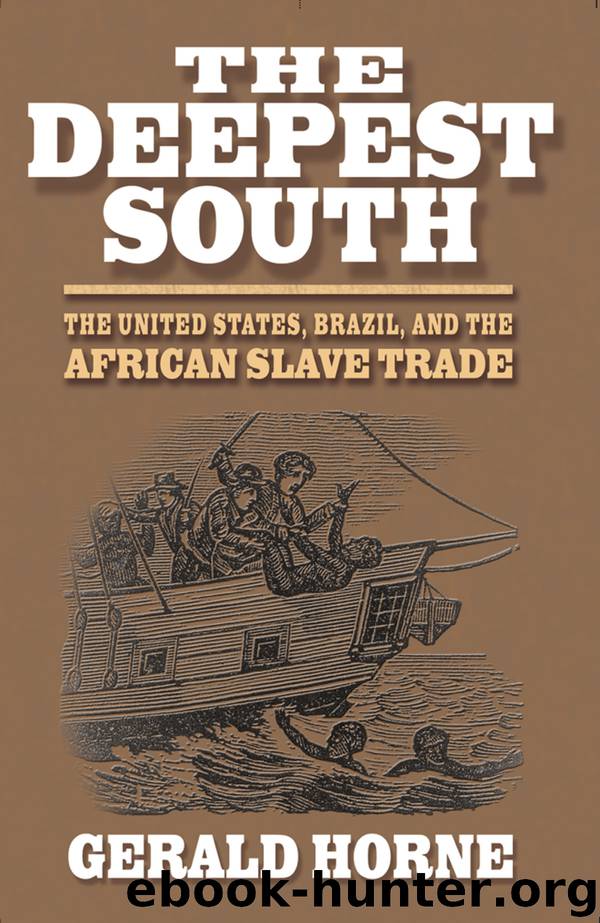
Author:Horne, Gerald;
Language: eng
Format: epub
Publisher: New York University Press
Published: 2007-08-22T16:00:00+00:00
10
Confederates to Brazil
The post–Civil War South was not a congenial place for those who held the African Slave Trade dear. Inevitably this also had an impact on Brazil, now sporting the once coveted but currently uncomfortable crown of being the heavyweight champion of slavery. Two simple cases of how Washington dealt with slavery in Brazil illustrate how the demise of this institution in North America undermined its continuation in South America. On 1 July 1862, William Harris, a U.S. national, died without a will in Bahia. The U.S. Consul there complained ineffectually that Brazil “interfered” in the administering of his estate so that all his property including “even a poor slave girl” was “sold”; the “authorities sent their armed police after her and she too was put up and sold at auction.” But what seemed to upset him most was that “not a cent has ever reached the heirs of Mr. Harris who live in the city of New York” [emphasis-original].1 Certainly no meaningful protest ensued.
But by 1868, times had changed. As William Seward—who acquiesced in the Harris case—explained, “a Portuguese subject Bernadino de Souza Pinto residing in the city of Recife, in Brazil, had a slave named José who was induced to run away to New York on board of the United States brig schooner. . . . [The] American Consul . . . refused to take the necessary steps” to retrieve him, to which his owner objected. Figuratively thrusting out his chest as he bestrode his high horse, Seward explained to the representative of this embittered loser of valuable property that “slavery is not only unknown here but is forbidden and disallowed. . . . no law of the United States forbids slaves in foreign ports from the use of merchant vessels in foreign ports . . . from enjoying rights of asylum in the United States.”2
The annihilation of the CSA and the undermining of their “Copperhead” allies did not magically end the role of U.S. nationals in the African Slave Trade. In August 1865, months after guns had been stilled in North America, familiar news was coming from Luanda: “two American whaling ships . . . on the coast with . . . 800 slaves.”3 In July 1865, the “Bark Dahomey” purchased in Lisbon, then transferred to New York, was in and out of Havana and suspected of slaving—though “the owners have never been in the slave business.”4 Then there was “the arrest” in Philadelphia after Lincoln’s murder “of a Portuguese slaver and blockade runner named John Celestina who was suspected of being connected with the conspiracy to murder the leading officers of the Government.”5 Just as the existence of slavery in Brazil had given an enormous boost to the ambitions of the CSA, the demise of the CSA was correspondingly a detriment for this slave nation; yet the continued existence of African slavery in Latin America, even after it had been extinguished in North America, would continue to provide a base for remnants of the Slave South and their allies.
Download
This site does not store any files on its server. We only index and link to content provided by other sites. Please contact the content providers to delete copyright contents if any and email us, we'll remove relevant links or contents immediately.
| Africa | Americas |
| Arctic & Antarctica | Asia |
| Australia & Oceania | Europe |
| Middle East | Russia |
| United States | World |
| Ancient Civilizations | Military |
| Historical Study & Educational Resources |
Cat's cradle by Kurt Vonnegut(15365)
Pimp by Iceberg Slim(14522)
4 3 2 1: A Novel by Paul Auster(12405)
Underground: A Human History of the Worlds Beneath Our Feet by Will Hunt(12101)
The Radium Girls by Kate Moore(12036)
Wiseguy by Nicholas Pileggi(5795)
The Fire Next Time by James Baldwin(5454)
Perfect Rhythm by Jae(5413)
American History Stories, Volume III (Yesterday's Classics) by Pratt Mara L(5312)
Paper Towns by Green John(5196)
Pale Blue Dot by Carl Sagan(5013)
A Higher Loyalty: Truth, Lies, and Leadership by James Comey(4967)
The Mayflower and the Pilgrims' New World by Nathaniel Philbrick(4509)
The Doomsday Machine by Daniel Ellsberg(4493)
Killers of the Flower Moon: The Osage Murders and the Birth of the FBI by David Grann(4451)
The Sympathizer by Viet Thanh Nguyen(4398)
Too Much and Not the Mood by Durga Chew-Bose(4353)
The Borden Murders by Sarah Miller(4330)
Sticky Fingers by Joe Hagan(4208)
