The Barbarians by Grace Cole
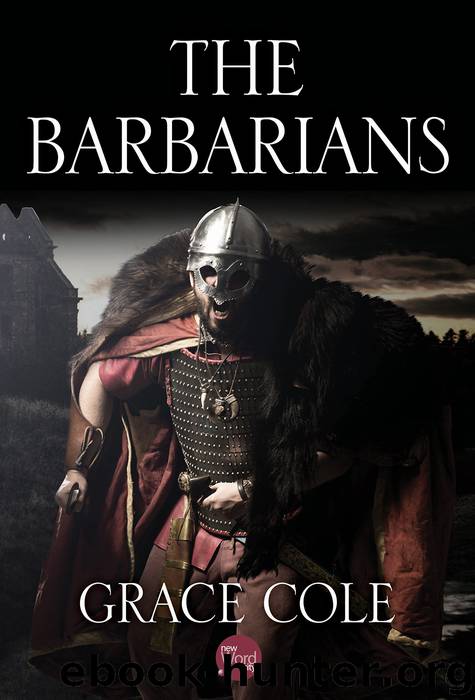
Author:Grace Cole [Grace Cole]
Language: eng
Format: epub, azw3
Tags: History/Europe/Medieval
ISBN: 9781640191235
Publisher: New Word City, Inc.
Published: 2018-01-01T16:00:00+00:00
Across the English Channel, at least some aspects of civilization were advancing a good deal faster than in the wilds of Britain.
Here, the influence of Roman society was already transforming the barbarians – not into Romans, but into something new. It happened first and decisively in Gaul, the former Roman province that was turning into what is now France.
By the end of the seventh century, kings from the line of Clovis I – known to history as the Merovingian kings – had degenerated into feeble fops whose specialty was feuding and intrigue. Their impotence as monarchs spurred the growth of feudalism in France, with the provincial barons effectively ruling vast areas of the country.
What remained of centralized power in the realm was assumed by a hereditary line of nobles called Mayors of the Palace. They controlled the treasury, held title to the land, and had the power to grant royal favors while the kings were mere figureheads. One of these mayors, Pepin of Herstal, united the fractured kingdom at the end of the seventh century and took the title Duke and Prince of the Franks. Pepin’s death in 714 touched off a struggle among his heirs that broke into civil war, but ended with the victory of his son Charles Martel, who proved to be an able king who would reform and modernize the government, and whose grandson, Charlemagne, would more than double the size of the kingdom and establish its permanence in the European continent.
Charles Martel’s strong suit was battle; his surname meant “the Hammer,” and he earned it in a series of military campaigns fought throughout his reign. He perfected a tactic that had been long used in the Eastern Empire but was new to the West: a surprise attack on the enemy, followed by a feigned retreat. When the adversary’s troops attempted pursuit, Charles would regroup his men, turn them around, and attack again. The maneuver, which required perfect timing by the general and iron discipline among the soldiers, was highly effective, allowing Charles not only to expand his territory but to keep both rival rulers and his fractious nobles under control.
In conjunction with his military might, Charles’s diplomacy was shrewd and effective. He acknowledged the nominal rule of the Merovingian kings, in exchange for their affirmation of his mayoralty. He supported the efforts of the elderly British monk Boniface, whose Benedictines were efficiently spreading Frankish influence along with Christianity far past the Rhine. Charles also won alliances with important Church prelates by donating land for abbeys and monasteries. Once he had pacified his Frankish territory, he took on the Saxons to the west and the Alemanni – a confederation of Germanic tribes - to the north, moving his borders into Belgium and Bavaria.
The greatest threat Charles faced was from Spain – and from a powerful new enemy: the rapidly expanding forces of Islam. While the Eastern Empire in Constantinople had for a century prevented the Muslims from advancing on the West, the Moors of North Africa
Download
This site does not store any files on its server. We only index and link to content provided by other sites. Please contact the content providers to delete copyright contents if any and email us, we'll remove relevant links or contents immediately.
| Africa | Americas |
| Arctic & Antarctica | Asia |
| Australia & Oceania | Europe |
| Middle East | Russia |
| United States | World |
| Ancient Civilizations | Military |
| Historical Study & Educational Resources |
Room 212 by Kate Stewart(5121)
The Crown by Robert Lacey(4817)
Endurance: Shackleton's Incredible Voyage by Alfred Lansing(4783)
The Iron Duke by The Iron Duke(4356)
The Rape of Nanking by Iris Chang(4213)
Joan of Arc by Mary Gordon(4110)
Killing England by Bill O'Reilly(4001)
Say Nothing by Patrick Radden Keefe(3986)
I'll Give You the Sun by Jandy Nelson(3447)
Shadow of Night by Deborah Harkness(3368)
Hitler's Monsters by Eric Kurlander(3343)
Mary, Queen of Scots, and the Murder of Lord Darnley by Alison Weir(3210)
Blood and Sand by Alex Von Tunzelmann(3205)
Eleanor & Park by Rainbow Rowell(3174)
Darkest Hour by Anthony McCarten(3133)
Margaret Thatcher: The Autobiography by Thatcher Margaret(3082)
Book of Life by Deborah Harkness(2939)
Red Famine: Stalin's War on Ukraine by Anne Applebaum(2934)
The One Memory of Flora Banks by Emily Barr(2863)
