Syriza in Power by Costas Douzinas
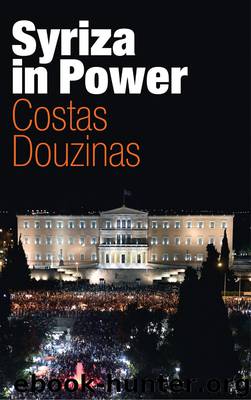
Author:Costas Douzinas
Language: eng
Format: epub
Publisher: John Wiley & Sons, Inc.
Published: 2017-08-31T16:00:00+00:00
8.3 The Left (melancholy)
Recent debates about Greece in the international Left have been characterized by a somewhat infantile leftism. Grexit – a return to the drachma and even an exit from the EU – has turned into the litmus test of radicalism. A ‘left-o-meter’ has been invented and is rigorously applied. Whoever does not accept Grexit as the holy grail of left correctness is denounced as a ‘traitor’. This kind of attack used to be standard fare of Marxism in the internecine struggles of the twentieth century. The repeated theoretical failures and political defeats of the last fifty years, however, should have taught the Left that, instead of quoting Marx or repeating soothing mantras, it is more important to work out what Marx would have said today in the difficult situation of contemporary Greece and Europe. This involves an analysis of the concrete situation, an understanding of the balance of forces and a correct assessment of the international environment.
The Grexit and ‘rupture or assimilation’ arguments are the contemporary form of the old reform or revolution debate. The only difference is that ‘revolution’ cannot mean today the storming of the Bastille or the taking of the Winter Palace. Power can no longer be approached as a substance held by a small group of capitalists and politicians; nor is it exercised from a grand centre, the conquest of which radically alters the situation. Power is decentred, plural and capillary, it operates at all levels of personal, social and political relations. It does not take hold of people formed outside its circuit in order to subjugate them. On the contrary, power produces subjects, including radical subjects, attitudes and behaviours. Behavioural discipline and control is more important, therefore, than old-style ideology critique. If someone follows the behavioural diktats of advanced capitalist economy – borrowing, consuming, competing for benefits and favours with others – she acts within the systemic parameters irrespective of ideological commitments. Radical change cannot take place, therefore, in an apocalyptic event or moment. It is a long and complex peripeteia full of successes and failures, advances and retreats, small victories intertwined with defeats.
The doctrinaire Left, Marxist or not, has been stuck to a centralized and outdated conception of power, despite its theoretical and tactical limitations. It chooses to speak to the converted. Whether in the university hall or in the public square, this type of Left has been repeating old beliefs and clichés. The academic Left avoids testing its arguments against those who disagree. The politically active ultra-Left, similarly, sets its unquestioned theoretical stall and judges reality accordingly. If the world does not follow the theoretical prescriptions, so bad for the world. It is as if the Left is not interested in power but in the purity of its beliefs. This leads to ‘left melancholy’ and the ‘narcissism of small differences’, attitudes characterizing those who brought the government down after the July 2015 agreement and then left to form the Popular Unity splinter group. Many had been senior ministers. They chose to abandon the responsibility of running the country in order to keep pure hearts and beautiful souls.
Download
This site does not store any files on its server. We only index and link to content provided by other sites. Please contact the content providers to delete copyright contents if any and email us, we'll remove relevant links or contents immediately.
| Africa | Americas |
| Arctic & Antarctica | Asia |
| Australia & Oceania | Europe |
| Middle East | Russia |
| United States | World |
| Ancient Civilizations | Military |
| Historical Study & Educational Resources |
Room 212 by Kate Stewart(5293)
The Crown by Robert Lacey(4942)
Endurance: Shackleton's Incredible Voyage by Alfred Lansing(4935)
The Iron Duke by The Iron Duke(4483)
The Rape of Nanking by Iris Chang(4340)
Joan of Arc by Mary Gordon(4229)
Say Nothing by Patrick Radden Keefe(4147)
Killing England by Bill O'Reilly(4118)
I'll Give You the Sun by Jandy Nelson(3568)
Shadow of Night by Deborah Harkness(3495)
Hitler's Monsters by Eric Kurlander(3480)
Eleanor & Park by Rainbow Rowell(3435)
Blood and Sand by Alex Von Tunzelmann(3316)
Mary, Queen of Scots, and the Murder of Lord Darnley by Alison Weir(3304)
Darkest Hour by Anthony McCarten(3237)
Margaret Thatcher: The Autobiography by Thatcher Margaret(3173)
Book of Life by Deborah Harkness(3045)
Red Famine: Stalin's War on Ukraine by Anne Applebaum(3036)
The One Memory of Flora Banks by Emily Barr(2961)
