Scandinavia and the Great Powers in the First World War by Michael Jonas;
Author:Michael Jonas;
Language: eng
Format: epub
Publisher: Bloomsbury UK
Notes
Chapter 1
1 For a different variant of what is known as the ‘driftwood theory’ in Finland; cf. Ilkka Herlin: Suomi-neidon menetetty kunnia – ajopuuteorian historia, in: Päiviö Tommila (ed.): Historiantutkijan muotokuva, Helsinki: Suomen Historiallinen Seura, 1998, 199–238.
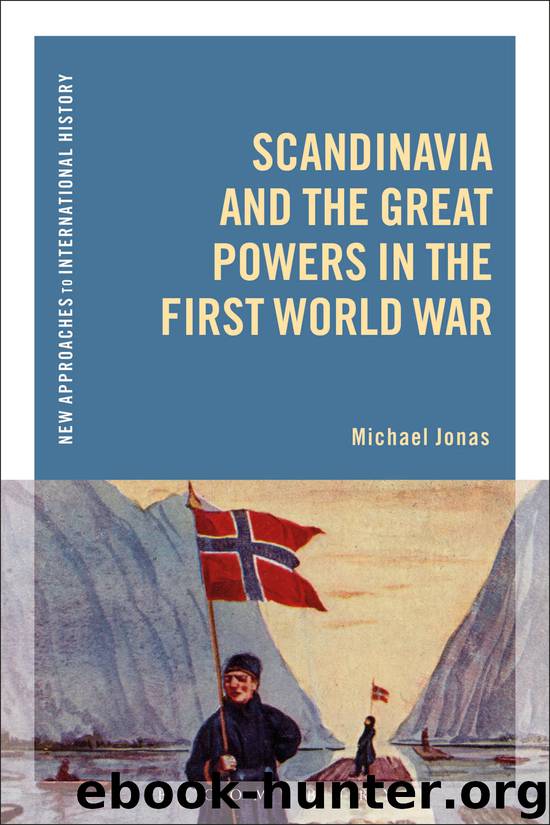
2 While the first postcard ‘Ils flottent dans tous les sens’ (Émile Dupuis, 1916) is reproduced on the front cover, the entire series can be found at the digital services of Bibliothèque municipale de Lyon, section: Humour allié, URL: http://numelyo.bm-lyon.fr/f_view/BML:BML_0401400101Res454732_002_0033 [17 October 2017].
3 Patrick Salmon: Scandinavia and the Great Powers, 1890-1914, Cambridge: CUP, 1997.
4 Cf. the historiographic impulse given recently by, for example Simon Larsson/Marja Jalava/Pertti Haapala: Introduction: Nordic Historiography: From Methodological Nationalism to Empirical Transnationalism, in: idem (eds.): Making Nordic Historiography: Connections, Tensions and Methodology, 1850-1970, New York: Berghahn, 2017, 1–24. For a useful recent collection of essays and analyses, albeit within persistently national-historiographical parameters, see Claes Ahlund (ed.): Scandinavia in the First World War. Studies in the War Experiences of the Northern Neutrals, Lund: Nordic Academic Press, 2012, 9–56, especially the excellent, truly inter-Scandinavian introduction by Rolf Hobson, Tom Kristiansen, Nils Arne Sørensen and Gunnar Åselius.
5 Karen Fog Olwig: Narrating deglobalization: Danish perceptions of a lost empire, Global Networks 3 (2003), 207–22, with reference to the basic arguments of the urban anthropologist Ulf Hannerz: Transnational Connections: Culture, People, Places, London: Routledge, 1996. See as well the excellent introduction of Magdalena Naum and Jonas M. Nordin: Situating Scandinavian Colonialism, in: idem (eds.): Scandinavian Colonialism and the Rise of Modernity: Small Time Agents in a Global Arena, New York: Springer, 2013, 3–16.
6 For want of a better term, ‘Age of the World Wars’ has its shortcomings, in any case. Like the related conception ‘interwar period’, it robs the two decades between the end of the First World War and the beginning of the Second of their qualitative independence and thus teleologically reduces the whole period to a cluster of wars, crises, and violence; Cf. Bruno Thoß: Die Zeit der Weltkriege – Epochen als Erfahrungseinheit? in: Bruno Thoß and Hans-Erich Volkmann (eds.): Erster Weltkrieg – Zweiter Weltkrieg. Ein Vergleich, Paderborn, 2002, 7–30; Belinda Davis: Experience, Identity, and Memory: The Legacy of World War I, Journal of Modern History 75 (2003), 111–31. Alternatives to these interpretations are suggested in Patrick Cohrs: The Unfinished Peace after World War I: America, Britain and the Stabilisation of Europe, 1919-1932, Cambridge, 2006, 1–19; see also Adam Tooze: The Deluge: The Great War and the Remaking of Global Order, 1916-1931, London, 2014, 19–30.
7 ‘Unremembered history’, a conception by Bacon and Renaissance historiography, strongly criticized by R. G. Collingwood: The Idea of History, ed. with an introduction by Jan van der Dussen, (Oxford: OUP, 1994, rev. ed.), 58, who assumed that the historian’s task only extended to the reconstruction of history.
8 Stefan Troebst: What’s in a Historical Region? A Teutonic Perspective, European Review of History 10 (2003), 173–88; Riccardo Bavaj: Was bringt der ‘Spatial Turn’ der Regionalgeschichte? Ein Beitrag zur Methodendiskussion. Westfälische Forschungen 56 (2006), 457–84; cf. as well the global historical
Download
This site does not store any files on its server. We only index and link to content provided by other sites. Please contact the content providers to delete copyright contents if any and email us, we'll remove relevant links or contents immediately.
| Africa | Americas |
| Arctic & Antarctica | Asia |
| Australia & Oceania | Europe |
| Middle East | Russia |
| United States | World |
| Ancient Civilizations | Military |
| Historical Study & Educational Resources |
Room 212 by Kate Stewart(5289)
The Crown by Robert Lacey(4940)
Endurance: Shackleton's Incredible Voyage by Alfred Lansing(4931)
The Iron Duke by The Iron Duke(4472)
The Rape of Nanking by Iris Chang(4329)
Joan of Arc by Mary Gordon(4217)
Say Nothing by Patrick Radden Keefe(4146)
Killing England by Bill O'Reilly(4116)
I'll Give You the Sun by Jandy Nelson(3561)
Shadow of Night by Deborah Harkness(3483)
Hitler's Monsters by Eric Kurlander(3478)
Eleanor & Park by Rainbow Rowell(3431)
Blood and Sand by Alex Von Tunzelmann(3312)
Mary, Queen of Scots, and the Murder of Lord Darnley by Alison Weir(3303)
Darkest Hour by Anthony McCarten(3234)
Margaret Thatcher: The Autobiography by Thatcher Margaret(3173)
Book of Life by Deborah Harkness(3043)
Red Famine: Stalin's War on Ukraine by Anne Applebaum(3032)
The One Memory of Flora Banks by Emily Barr(2959)
