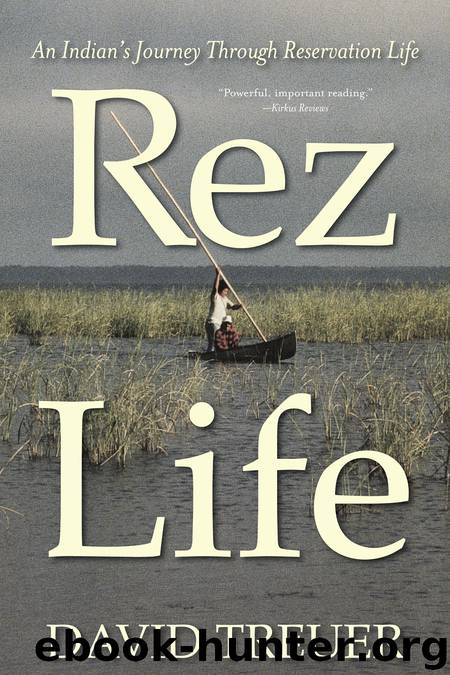
Rez Life by David Treuer
Author:David Treuer
Language: eng
Format: epub, azw3
Publisher: Grove/Atlantic, Inc.
Published: 2012-01-18T16:00:00+00:00
Russell Bryan and Helen (Bryan) Johnson near their home in Squaw Lake, 1981
Courtesy Helen (Bryan) Johnson
5
We saw the new Morongo Casino, Resort, and Spa rise up like a monolith, like the Colossus of Rhodes, from the foothills of the Coachella Valley north and west of Palm Springs. It was visible from fifteen miles away, a solid, angular, basalt-colored spire jutting from the valley scree, looking more like an ancient artifact than a new luxury destination. It’s not often that casinos can be described as beautiful or impressive in a “not Vegas” way, but the Morongo Tower was. Even though its architectural elements blend in with the desert, we found ourselves wondering how it got there. Some conspiracy theorists believe that space aliens may have built the pyramids at Giza, and the same feeling attends the spectacle of the Morongo Tower rising from the Palm Springs desert. Casinos like this—though perhaps not quite as nice—rise all across the American landscape. They rise from swamps, suburbs, deserts, and forests. They perch on cliffs and look out over lakes.
The presence of the Morongo Tower is even more amazing when you remember that, historically at least, Indian reservations are a great place to be poor if you are Indian—and a fantastic place to get rich if you’re not. It is only recently that this pattern is being reversed. For centuries, privateers, government officials, railroad barons, timber magnates, prospectors, and mining companies have made a mint exploiting Native land and resources while the Indians for whom reservations were created have gotten poorer and poorer.
After we’d checked in, and with a weird kind of pride of ownership (the Morongo Band of Mission Indians who own the Morongo casino aren’t my tribe, after all), I said to the valet, as I would say to a butler in my own mansion, “The bags, please.”
As the elevator gushed up toward the seventeenth floor and the desert dwindled below us, I looked at my wife, who resembles a Native American Gwen Stefani with smoky eyes and a tongue ring and tattoos, and I marveled that we (Indians, that is) actually own all this—not my wife, of course, but this casino. We own it when we are really expected to be only two things, dead or poor. But gaming has become big news—if not the news—about Indians in the last decade and a half: Indian gaming brought in $25 billion dollars in 2006, compared with the $12 billion generated in Las Vegas. I thought to myself as I settled into our room, which was as beautiful as the tower that encased it, “I just might win after all.”
It is odd to think you can strike it rich at an Indian casino and that Indian casinos have made a few (not many) Indians rich themselves. This is especially odd because, originally, the reservations were more or less set up to be poor—and if that wasn’t the intent, it surely was the effect. While the Delaware might have gotten a reservation in exchange for fighting the British, and the Dakota because they defeated the U.
Download
This site does not store any files on its server. We only index and link to content provided by other sites. Please contact the content providers to delete copyright contents if any and email us, we'll remove relevant links or contents immediately.
| Anthropology | Archaeology |
| Philosophy | Politics & Government |
| Social Sciences | Sociology |
| Women's Studies |
Cecilia; Or, Memoirs of an Heiress — Volume 1 by Fanny Burney(32558)
The Great Music City by Andrea Baker(32019)
Cecilia; Or, Memoirs of an Heiress — Volume 2 by Fanny Burney(31956)
Cecilia; Or, Memoirs of an Heiress — Volume 3 by Fanny Burney(31942)
We're Going to Need More Wine by Gabrielle Union(19046)
All the Missing Girls by Megan Miranda(16028)
Pimp by Iceberg Slim(14507)
For the Love of Europe by Rick Steves(14121)
Bombshells: Glamour Girls of a Lifetime by Sullivan Steve(14075)
Talking to Strangers by Malcolm Gladwell(13370)
Norse Mythology by Gaiman Neil(13365)
Fifty Shades Freed by E L James(13241)
Mindhunter: Inside the FBI's Elite Serial Crime Unit by John E. Douglas & Mark Olshaker(9343)
Crazy Rich Asians by Kevin Kwan(9292)
The Lost Art of Listening by Michael P. Nichols(7506)
Enlightenment Now: The Case for Reason, Science, Humanism, and Progress by Steven Pinker(7313)
The Four Agreements by Don Miguel Ruiz(6765)
Bad Blood by John Carreyrou(6621)
Weapons of Math Destruction by Cathy O'Neil(6280)
