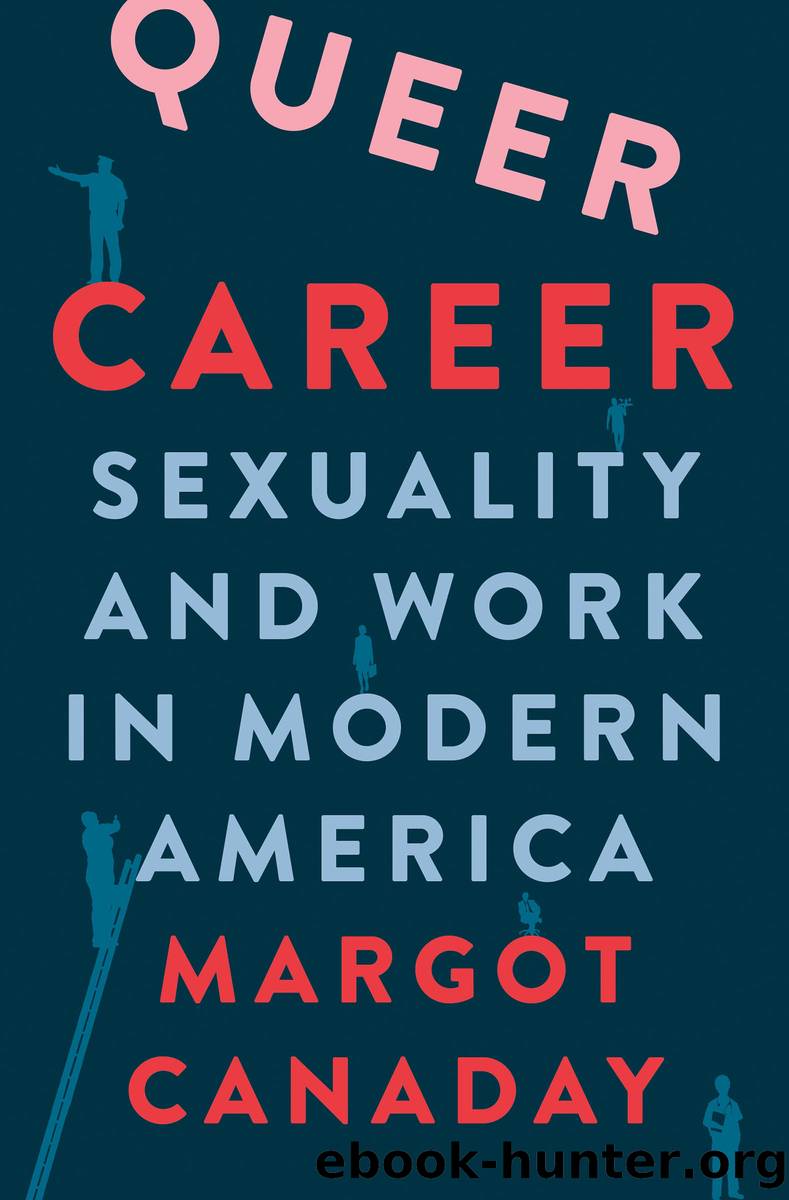
Queer Career by Margot Canaday
Author:Margot Canaday
Language: eng
Format: epub
Publisher: Princeton University Press
Published: 2022-09-05T00:00:00+00:00
If the 1970s were the years when the professions began to move toward greater openness, an opposite shift was occurring in many blue-collar settings. In prior decades, gay men and lesbians, as well as some trans men and trans women, had been surprisingly open in factory jobs, kept safe in part by a strong industrial economy that made blue-collar jobs relatively plentiful. Queer people of color, as well as white lesbians, had also been protected by the reality that they would not be promoted within the factories in which they worked. Yet by the late 1960s and increasingly through the 1970s, manufacturing jobs began their precipitous and irreversible decline.60 Simultaneously, both social movement and government pressure began to force employment sectors that had excluded women and racial minorities to open up some opportunities, as well as to create pathways for women and racial minorities to become supervisors and managers.61 This confluence was dangerous for sexual minorities in factory jobs. An African American man who worked on the line in Detroit associated an increasingly hostile environment for gays in his plant with both the politics of gay liberation and the sudden appearance of African Americans as supervisors on the factory floor.62 His white gay coworker concurred that the situation at work became more difficult after gay liberation; he was more hassled then.63
Gay men across racial lines thus began to disappear from blue-collar jobs. In contrast to sociological studies conducted in the 1950s that associated overt homosexuality with craft, operative, manufacturing, and low-level clerical and service jobs, sociologists in the 1970s noted the paucity of gay men in manual occupations.64 According to Joseph Harry and William DeVall, male homosexuals were opting out of blue-collar work âbecause they anticipate greater discrimination from blue-collar workers than from workers in other occupational strata,â and because of the âgreater homophobia found among blue-collar workers.â65 That rising hostility was likely associated with the perceived demands of gay liberation (and relatedly, feminism) at a time when straight men felt their own economic prospects growing more circumscribed in the manufacturing sector. This trend was also connected to the gradual decline of the fairy/trade paradigm that had, since the early twentieth century, enabled masculine men to be in close proximity to effeminate men, and even have sexual contact with them, without it endangering their own sense of normalcy.66 Yet while the sexual negotiation had undoubtedly become more complex, physical relationships between straight and gay male factory workers were still commonplace in the 1970sâone factory worker discovered a âwhole underground where tricks were madeâ at his plant. Sex between men occurred most often in âthe rest room, the parking lot, or other secluded place[s].â The exchange of money was an increasingly crucial part of these encounters. Paying gay men for sex enabled their straight-identified partners âto clearly demonstrate, at least to themselves, that they were not gay.â67 So did expressions of aggression and violence toward gays, which became a more pronounced element of blue-collar culture.
As a result of such violence, the
Download
This site does not store any files on its server. We only index and link to content provided by other sites. Please contact the content providers to delete copyright contents if any and email us, we'll remove relevant links or contents immediately.
Cecilia; Or, Memoirs of an Heiress — Volume 1 by Fanny Burney(32558)
The Great Music City by Andrea Baker(32019)
Cecilia; Or, Memoirs of an Heiress — Volume 2 by Fanny Burney(31956)
Cecilia; Or, Memoirs of an Heiress — Volume 3 by Fanny Burney(31942)
We're Going to Need More Wine by Gabrielle Union(19046)
All the Missing Girls by Megan Miranda(16029)
Pimp by Iceberg Slim(14508)
For the Love of Europe by Rick Steves(14121)
Bombshells: Glamour Girls of a Lifetime by Sullivan Steve(14076)
Talking to Strangers by Malcolm Gladwell(13370)
Norse Mythology by Gaiman Neil(13365)
Fifty Shades Freed by E L James(13241)
Mindhunter: Inside the FBI's Elite Serial Crime Unit by John E. Douglas & Mark Olshaker(9343)
Crazy Rich Asians by Kevin Kwan(9292)
The Lost Art of Listening by Michael P. Nichols(7506)
Enlightenment Now: The Case for Reason, Science, Humanism, and Progress by Steven Pinker(7313)
The Four Agreements by Don Miguel Ruiz(6765)
Bad Blood by John Carreyrou(6621)
Weapons of Math Destruction by Cathy O'Neil(6280)
