Queer Budapest, 18731961 by Anita Kurimay;
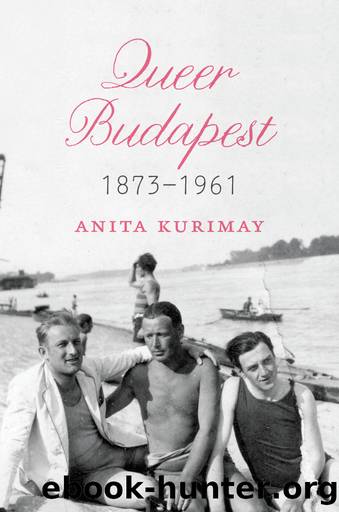
Author:Anita Kurimay; [Kurimay, Anita]
Language: eng
Format: epub
Tags: HIS000000 History / General
Publisher: University of Chicago Press
Published: 2020-10-14T00:00:00+00:00
1919
7
1
1920
10
*
1921
16
1
1922
25
3
1923
35
6
1924
61
5
1925
48
6
1926
27
10
1927
41
13
1928
40
9
1929
37
8
1930
*
7
1931
9
5
1932
33
5
1933
*
9
1934
*
7
1935
32
6
1936
35
8
1937
24
7
1938
32
8
1939
3040
6
1940
40
6
1941
62
3
1942
56
2
1943
*
7
1944
*
1
1945
5
2
* Index volumes are missing or incomplete.
When and how were people actually prosecuted in the courts for âunnatural fornicationâ? The Criminal District Courts tended to pursue the charges of homosexuality on the recommendations of the public prosecution office.64 In general, men were apprehended by the âhomosexual squadâ in public venues, lavatories, city parks, and public baths, where men would engage in what were considered to be âunnaturalâ acts, ranging from having sex with another man to the âinappropriateâ touching of another manâs genitals. Similar to most countries that criminalized male homosexuality, different Hungarian courts and legal scholars had varying understandings of how âunnatural fornicationâ should be defined.65 Nevertheless, considering that, in most cases, throughout the entire interwar period, there were no arguments between the judges, the defense, and the public prosecutors about the parameters of âunnatural fornication,â it is likely that there was a tacit understanding within the judicial system about what actions would fulfill the conditions of âunnatural fornication.â This is supported by the fact that, between 1918 and 1940, those accused of âunnatural fornicationâ rarely contested the charges on the basis of ânot meeting the criteria of Paragraph 241.â It seems highly likely that the police only filed charges against those men who had incontestably committed acts of âunnatural fornication.â66
In the great majority of cases during this period, charges were made against working-class men and men with low social and economic status. Overwhelmingly, these men were born outside of Budapest, mainly in rural areas and in small towns. They had all moved to the capital for work. Almost all of them performed some form of manual labor.67 Not surprisingly, men with the means to conduct their sexual encounters in private were greatly underrepresented. In terms of marital status, about 80 percent (or four out of five men) were unmarried.68 Most men were Roman Catholic, as were most of the Hungarian countryside. Along with Catholics, Jewish men were slightly overrepresented among the accused.69 The ages of the men varied between seventeen and the mid-sixties, with the majority being in their twenties and thirties.70 In sum, most men who were accused of homosexuality between 1918 and 1940 were of rural origin and, similar to their international counterparts, in their twenties and thirties, working class, and unmarried. As such, the nature of the prosecution of queer men in Budapest highlights a transnational urban pattern during the interwar era, where young working-class men were disproportionately overrepresented in cases with charges of homosexuality.71
During the 1920s the charges for consensual public homosexual acts ranged from a financial penalty to a few weeks in the lightest form of confinement. Considering that according to the penal code if the accused were found guilty of âunnatural fornication,â the punishment was up to one year, it is noteworthy that the courts rarely assigned a sentence of more than ten days or more than a few weeks for consensual sex.72 In fact, if men had no prior criminal history, in the majority of cases, the courts often suspended the punishment.
Download
This site does not store any files on its server. We only index and link to content provided by other sites. Please contact the content providers to delete copyright contents if any and email us, we'll remove relevant links or contents immediately.
| Anthropology | Archaeology |
| Philosophy | Politics & Government |
| Social Sciences | Sociology |
| Women's Studies |
Cecilia; Or, Memoirs of an Heiress — Volume 1 by Fanny Burney(32660)
The Great Music City by Andrea Baker(32625)
Cecilia; Or, Memoirs of an Heiress — Volume 2 by Fanny Burney(32027)
Cecilia; Or, Memoirs of an Heiress — Volume 3 by Fanny Burney(32008)
We're Going to Need More Wine by Gabrielle Union(19123)
All the Missing Girls by Megan Miranda(16424)
Pimp by Iceberg Slim(14714)
For the Love of Europe by Rick Steves(14665)
Bombshells: Glamour Girls of a Lifetime by Sullivan Steve(14153)
Norse Mythology by Gaiman Neil(13476)
Talking to Strangers by Malcolm Gladwell(13475)
Fifty Shades Freed by E L James(13308)
Mindhunter: Inside the FBI's Elite Serial Crime Unit by John E. Douglas & Mark Olshaker(9454)
Crazy Rich Asians by Kevin Kwan(9363)
The Lost Art of Listening by Michael P. Nichols(7569)
Enlightenment Now: The Case for Reason, Science, Humanism, and Progress by Steven Pinker(7374)
The Four Agreements by Don Miguel Ruiz(6854)
Bad Blood by John Carreyrou(6689)
Weapons of Math Destruction by Cathy O'Neil(6393)
