Punished for Dreaming by Bettina L. Love
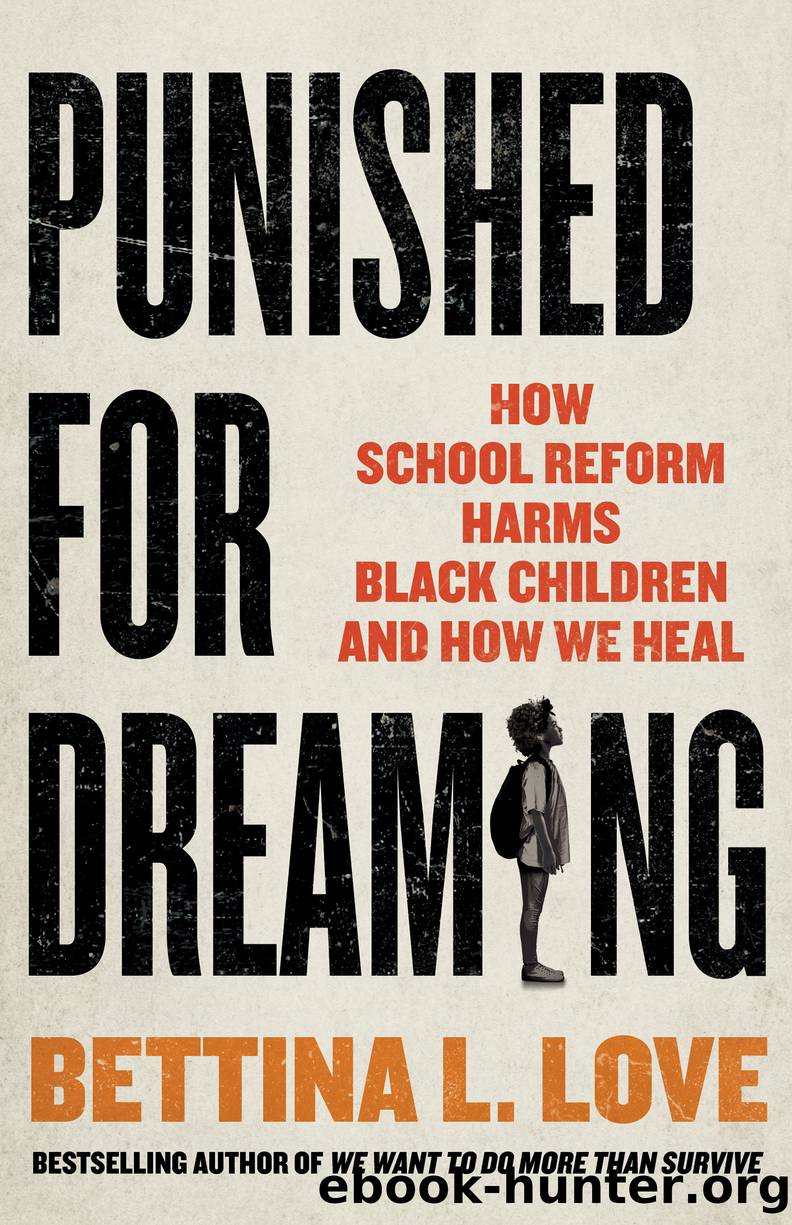
Author:Bettina L. Love
Language: eng
Format: epub
Publisher: St. Martin's Publishing Group
8
WHITE PHILANTHROPY
âKnowledge Is Power, Power Is Moneyâ
I first learned of Harriett Ball almost twenty years ago while taking a class with Asa Hilliard, the renowned educational psychologist. One day, he showed us a video of an older Black woman in Houston who rapped for her elementary school students. She used the music not only to teach the students but to inspire them to love learning. Dr. Hilliard called her a master teacher, and he was right. She was captivating. She was six foot one, had long, bright red fingernails, and was blessed with a heavenly singing voice that evoked undeniable strength, Southern beauty, and the love of a God-fearing Black woman. Her passion and her affection for her students were infectious.
Ball had a singular talent for harnessing Black culture in the classroom to drive instruction. The proof of her skills was that her students excelled. She stressed that teachers should not simply sit behind their desks and lecture; they needed to create lessons that embraced the many ways in which students learnâwhat she called a âmultisensory, mnemonic, whole-body teaching technique.â1 Ball had the clout to teach in this innovative way because she could in fact do it all. She could sing, write music, play the piano, and draw. She stressed the pursuit of educational excellence, and her teaching style matched her goal. Ball would tell her students: âYou gotta read, baby, read. You gotta read, baby, read. The more you read, the more you know, âcause knowledge is power, power is money, and I want it.â
In 1992, two young White men, David Levin and Mike Feinberg, entered the teaching profession through Teach for America; they were straight out of college, inexperienced, and struggling as new teachers. They happened to be placed in Ballâs school, and they asked her to mentor them. Ballâs son, Paul Franks, and daughter, Pamela Franks, remember Levin and Feinberg at their childhood home, sitting at their motherâs feet while learning her teaching methods and songs. âHe was a young White guy, couldnât have been no more than 25 years old,â Paul told me, speaking about Levin. âShe told me he was family, a teacher she was working with.â Paul said that Levin âwas frustrated with the kids, that they couldnât learn, couldnât sit down, but he would pass Mrs. Ballâs class, and all the kids were learning, paying attention, and he heard the music.â Pamela referred to herself as her motherâs test pupil; Ball would try out songs and timetable memorization chants with her before they got to her classroom. Ball would tell her daughter that she was making her into a âhuman cheat sheet,â knowing that her songs and chants would store important information in Pamelaâs brain in a way that she could easily access and use. When I was interviewing Paul and Pamela, their love for their mother was palpable; they revere her and want her legacy known.
After two years of learning Ballâs methods, songs, and teaching practices, Levin and Feinberg opened their own school, calling it the Knowledge Is Power Program, or KIPP.
Download
This site does not store any files on its server. We only index and link to content provided by other sites. Please contact the content providers to delete copyright contents if any and email us, we'll remove relevant links or contents immediately.
| Anthropology | Archaeology |
| Philosophy | Politics & Government |
| Social Sciences | Sociology |
| Women's Studies |
Cecilia; Or, Memoirs of an Heiress — Volume 1 by Fanny Burney(32558)
The Great Music City by Andrea Baker(32020)
Cecilia; Or, Memoirs of an Heiress — Volume 2 by Fanny Burney(31956)
Cecilia; Or, Memoirs of an Heiress — Volume 3 by Fanny Burney(31942)
We're Going to Need More Wine by Gabrielle Union(19049)
All the Missing Girls by Megan Miranda(16031)
Pimp by Iceberg Slim(14509)
For the Love of Europe by Rick Steves(14124)
Bombshells: Glamour Girls of a Lifetime by Sullivan Steve(14077)
Talking to Strangers by Malcolm Gladwell(13371)
Norse Mythology by Gaiman Neil(13370)
Fifty Shades Freed by E L James(13243)
Mindhunter: Inside the FBI's Elite Serial Crime Unit by John E. Douglas & Mark Olshaker(9344)
Crazy Rich Asians by Kevin Kwan(9293)
The Lost Art of Listening by Michael P. Nichols(7506)
Enlightenment Now: The Case for Reason, Science, Humanism, and Progress by Steven Pinker(7314)
The Four Agreements by Don Miguel Ruiz(6765)
Bad Blood by John Carreyrou(6623)
Weapons of Math Destruction by Cathy O'Neil(6281)
