Portrayals of Children in Popular Culture by Cvetkovic Vibiana Bowman;Olson Debbie C.;
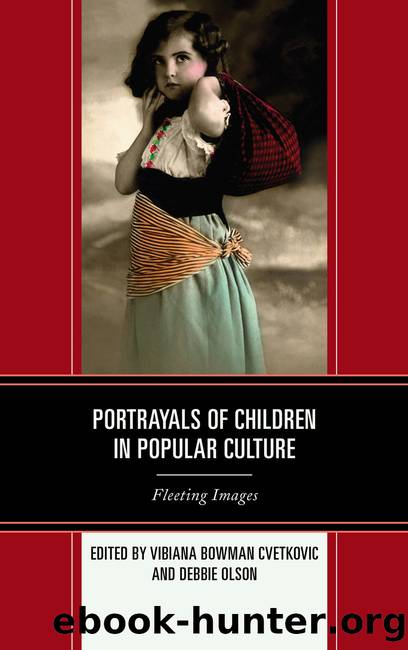
Author:Cvetkovic, Vibiana Bowman;Olson, Debbie C.;
Language: eng
Format: epub
ISBN: 1680214
Publisher: Lexington Books
Dora, Her World, and Borders
Dora revolves around a young Latina girl and her friends traveling through various landscapes in search of missing articles or characters, or collaborating on a group objective. Each show follows a similar format, based around the narrative style and strategies of a computer game. Dora and Boots, her monkey best friend, introduce themselves, and a complication emerges. To achieve their objective, they call upon Map, a talking, rolled-up map who identifies a series of locations to which they must travel. Often during their journey, they encounter Swiper the Fox, who attempts to steal an item that Dora needs. Sometimes Swiper succeeds, and sometimes Dora and Boots foil him by chanting âSwiper, no swiping!â three times. Also on the journey, Dora utilizes her backpack (herself a character) to retrieve some necessary item from the myriad of objects she contains. Eventually, Dora and her friends achieve their objective, and sing a victory song: âWe Did It.â They then ask the viewer to recall his/her âfavorite partâ of the journey, before sharing their own. Every show follows this formula; elements such as locations, objects needed, and characters encountered may change, but the journey structure never alters.
Dora takes place in a borderland; its main character speaks two languages and Dora seems caught between Mexican and U.S. culture. Author/theorist Gloria Anzaldúa defines borders as more than physical boundaries: âBorders are set up to define the places that are safe and unsafe, to distinguish us from them. A border is a dividing line, a narrow strip along a steep edge. A borderland is a vague and undetermined space created by the emotional residue of an unnatural boundaryâ (3). I find this definition a useful space to begin talking about the discourse around Doraâs explorations. Although Dora lives in a borderland, the only âbordersâ she encounters are spaces between locations, which are easily traversed. In her travels, she might be seen as a border crosserâsomeone who belongs to multiple cultures simultaneously and is able to move freely between and among them. Anzaldúa suggests that those who exist in this state are often feared, mocked, or seen as illegitimate, but Dora encounters no such prejudice. Although she holds several real-world markers of the historically subaltern or marginalizedâfemale, nonwhite, child, Spanish speakerâshe is centered in her own constructed society, and so represents the dominant identity (yet the audience has intertextual knowledge of her as a marginalized identityâat least in the U.S.).
By dominant identity, I mean that Dora represents a normative middle class U.S. childhood. She lives in a home, attends school, plays safely with her friends, and does not worry about money for meals (in fact, she sometimes gives Boots money when he doesnât have it available, as in âIce Creamâ). Her mother is an archaeologist, as we learn in âJob Day,â but her fatherâs employment (if any) is not addressed. He is mostly seen cooking and caring for Doraâs younger siblings. As she is represented as a normative U.S. child, Dora also demonstrates the
Download
This site does not store any files on its server. We only index and link to content provided by other sites. Please contact the content providers to delete copyright contents if any and email us, we'll remove relevant links or contents immediately.
| Anthropology | Archaeology |
| Philosophy | Politics & Government |
| Social Sciences | Sociology |
| Women's Studies |
Cecilia; Or, Memoirs of an Heiress — Volume 1 by Fanny Burney(32548)
Cecilia; Or, Memoirs of an Heiress — Volume 2 by Fanny Burney(31947)
Cecilia; Or, Memoirs of an Heiress — Volume 3 by Fanny Burney(31932)
The Great Music City by Andrea Baker(31917)
We're Going to Need More Wine by Gabrielle Union(19035)
All the Missing Girls by Megan Miranda(15961)
Pimp by Iceberg Slim(14489)
Bombshells: Glamour Girls of a Lifetime by Sullivan Steve(14058)
For the Love of Europe by Rick Steves(13933)
Talking to Strangers by Malcolm Gladwell(13350)
Norse Mythology by Gaiman Neil(13349)
Fifty Shades Freed by E L James(13233)
Mindhunter: Inside the FBI's Elite Serial Crime Unit by John E. Douglas & Mark Olshaker(9324)
Crazy Rich Asians by Kevin Kwan(9280)
The Lost Art of Listening by Michael P. Nichols(7494)
Enlightenment Now: The Case for Reason, Science, Humanism, and Progress by Steven Pinker(7306)
The Four Agreements by Don Miguel Ruiz(6745)
Bad Blood by John Carreyrou(6611)
Weapons of Math Destruction by Cathy O'Neil(6267)
