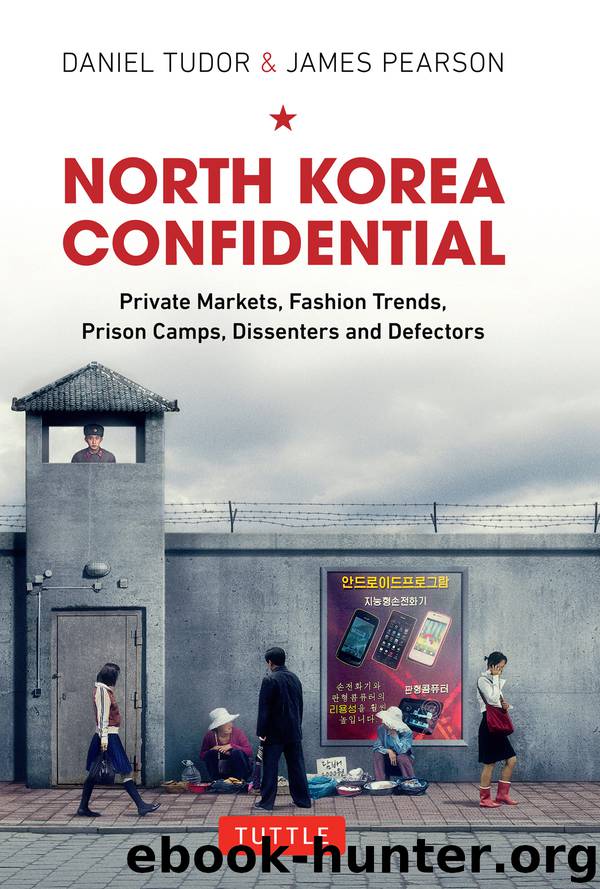
North Korea Confidential : Private Markets, Fashion Trends, Prison Camps, Dissenters and Defectors (9781462915125) by Tudor Daniel; Pearson James & James Pearson
Author:Tudor, Daniel; Pearson, James & James Pearson
Language: eng
Format: epub
ISBN: 978-0-8048-4458-1
Publisher: Perseus Book Group
How Does the Leadership Obtain Luxury Goods?
The Kim family possesses two luxury yachts docked at the east coast port of Wonsan; Kim Jong Un’s suits are cut from cloth from London’s Savile Row; his wristwatch is made by Swiss firm Movado. Amid strict international sanctions on the trade of luxury goods to the DPRK, how do all of the above—and so much more—manage to find its way into North Korea?
Trusted individuals based in Macau, Japan, Hong Kong, and mainland China have acted for years as the North Korean leadership’s middlemen in an international smuggling operation, coordinated by Office 39 in Pyongyang. One Macau-based businessman, who was fined by a Hong Kong court for facilitating a shipment of North Korean artillery parts from Pyongyang to Syria, simply closed down his shipping business and set up a new one under a different name (and in the same office). For years, his shipping companies kept numerous Pyongyang department stores and hotels well-stocked with a steady supply of whiskey, fine wine, and champagne.
Kim Jong Nam, the estranged half-brother of Kim Jong Un and the man who was once considered a potential successor to Kim Jong Il, has spent much of his life in reluctant exile, working as the North Korean leadership’s man on the outside, facilitating the procurement of these sought-after luxury goods and the export of North Korean arms. From luxury yachts to stretch Mercedes, if it can fit on a container ship, it can find its way to Pyongyang, escaping the watchful eye of UN sanctions.
The same is true of arms imports. The United Nations now says North Korea uses complex techniques pioneered by drug-trafficking organizations to conceal the movement of small arms, as well as nuclear weapons or missile components. It has also developed more complicated financial countermeasures to mask its financial transactions from international scrutiny, using a relatively complex corporate ecosystem of foreign-based firms and individuals. In one such example, North Korea embarked on a highly unusual transaction involving a contract by Air Koryo, the North’s national carrier, to purchase new aircraft in 2012. It paid for the new airplane using multiple payments that The Organization and Guidance Department Kim Jong Un has inherited a system in which he is utterly necessary, owing to the family personality cult. But he has also inherited a system in which genuine loyalty has been mostly replaced by fear, and where a “court economy” and payoffs encourage infighting and rent-seeking. And most importantly (for him, at least), he has inherited a system in which one rather shadowy organization may possess more power than he does, despite being leader of the country, and head of the ruling Workers’ Party. That organization is the OGD, and it represents the summation and natural extension of what Kim Jong Il learned during the early stages of his rise to power, particularly the Three Revolutions period. Through surveillance and the re-routing of information and reporting structures, the OGD has come to be the only part of the state that sees and knows everything.
Download
This site does not store any files on its server. We only index and link to content provided by other sites. Please contact the content providers to delete copyright contents if any and email us, we'll remove relevant links or contents immediately.
Cecilia; Or, Memoirs of an Heiress — Volume 1 by Fanny Burney(32549)
Cecilia; Or, Memoirs of an Heiress — Volume 2 by Fanny Burney(31948)
Cecilia; Or, Memoirs of an Heiress — Volume 3 by Fanny Burney(31932)
The Great Music City by Andrea Baker(31917)
We're Going to Need More Wine by Gabrielle Union(19036)
All the Missing Girls by Megan Miranda(15962)
Pimp by Iceberg Slim(14489)
Bombshells: Glamour Girls of a Lifetime by Sullivan Steve(14058)
For the Love of Europe by Rick Steves(13948)
Talking to Strangers by Malcolm Gladwell(13350)
Norse Mythology by Gaiman Neil(13349)
Fifty Shades Freed by E L James(13233)
Mindhunter: Inside the FBI's Elite Serial Crime Unit by John E. Douglas & Mark Olshaker(9324)
Crazy Rich Asians by Kevin Kwan(9280)
The Lost Art of Listening by Michael P. Nichols(7494)
Enlightenment Now: The Case for Reason, Science, Humanism, and Progress by Steven Pinker(7306)
The Four Agreements by Don Miguel Ruiz(6746)
Bad Blood by John Carreyrou(6612)
Weapons of Math Destruction by Cathy O'Neil(6267)
