Negro Comrades of the Crown by Horne Gerald;
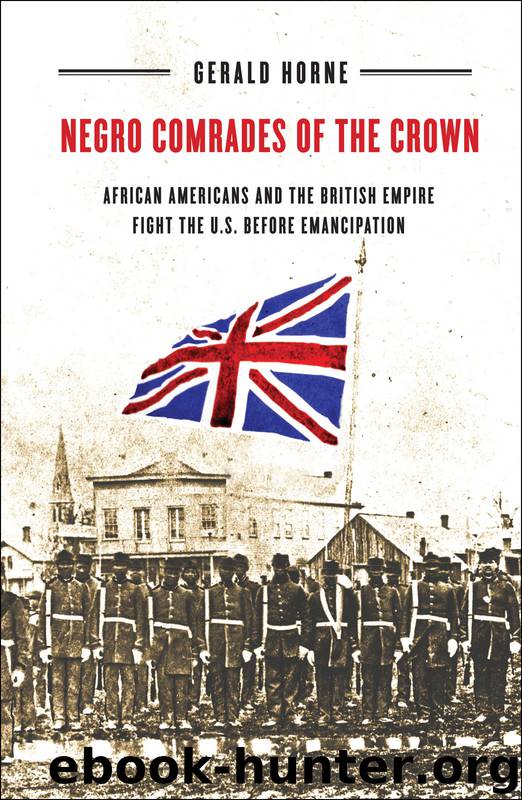
Author:Horne, Gerald;
Language: eng
Format: epub
Publisher: New York University Press
Published: 2012-12-08T16:00:00+00:00
Notes
INTRODUCTION
1. At this moment Florida was under Spanish rule though U.S. hegemony was soon to come; as a result, the now normative term “African American,” as it is now understood, would be inapposite. In this book, various terms will be used to denote the population of African descent in the U.S., including African, Negro, black, “of color,” colored, and, when appropriate, African American.
2. James Covington, “The Negro Fort,” Gulf Coast Historical Review, 5 (1990): 78–91, 81, 85. See also Canter Brown, Florida’s Peace River Frontier, Gainesville: University Press of Florida, 1991; Canter Brown and David Jackson, eds., Go Sound the Trumpet! Selections in Florida’s African American History, Tampa: University of Tampa Press, 2005; Jane Landers, “Slave Resistance on the Southern Frontier: Fugitives, Maroons, and Banditti in the Age of Revolution,” Escribano, (1995): 12–24.
3. Stephen R. Poe, “Archaeological Excavations at Fort Gadsden, Florida,” Notes in Anthropology, 8 (1963): 1–35, 2. See also Nathaniel Millett, “Defining Freedom in the Atlantic Borderlands of the Revolutionary Southeast,” Early American Studies, 5 (Number 2, 2007): 367–394.
4. In speaking of dominant British interests as reflected in government policies, a synecdoche—London—will be employed; the same holds true for Washington and the U.S.
5. Letter from Sir Alexander Cochrane, 27 April 1812, Viscount Melville Papers—Huntington Library, San Marino–California.
6. Simms to General Rob Young, Alexandria, 26 August 1814, HR13A-D15.3, House Select Committee Making Inquiry into the Success of the Enemy against Washington and Alexandria and into the Destruction of Public Buildings and Property and the Senate Committee on Military Affairs’ Investigation of the Defense of Maryland, Sen 13A-G3, National Archives and Records Administration–Washington, D.C.
7. “Report of His Excellency Governor Barbour to the Council of State,” 12 May 1812, in H. W. Flournoy, Calendar of Virginia State Papers and Other Manuscripts from January 1, 1808 to December 31, 1835, Richmond: Virginia State Library, 1892, 131–142.
8. John P. Hungerford, Westmoreland County, to Adjutant General, 5 August 1814, in Flournoy, Calendar, 367–369.
9. Alexander Cochrane to Secretary of State for War and the Colonies, Earl of Bathurst, 12 July 1814, in Michael Crawford, ed., The Naval War of 1812: A Documentary History, Volume III, Washington, D.C.: Naval Historical Center, Department of the Navy, 2002, 131
10. George Cockburn to Alexander Cochrane, 10 May 1814, in Crawford, Naval War, 63. Aware of the fear of armed Africans within the republic, as war approached London began recruiting soldiers in Africa: Lord Palmerston to George Harrison, Treasurer, War Office, 4 January 1812, “Further Papers Relating to Captured Negroes Enlisted, and to the Recruiting of Negro Soldiers in Africa for the West India Regiments, House of Commons, 30 July 1814,” Schomburg Center–New York Public Library. See also G. Bayley to Lavinia Bayley, 24 August circa 1814, Maryland Historical Society–Baltimore. Stoking the flames of fear was the republican allegation that armed Africans raped Euro-American women in Hampton, Virginia, during the war: Major Crutchfield to Governor Barbour, 20 June 1813, and undated letter to “Enquirer” in George Hay, “An Oration Delivered on the Thirty-Seventh Anniversary of American Independence at the Request
Download
This site does not store any files on its server. We only index and link to content provided by other sites. Please contact the content providers to delete copyright contents if any and email us, we'll remove relevant links or contents immediately.
| Anthropology | Archaeology |
| Philosophy | Politics & Government |
| Social Sciences | Sociology |
| Women's Studies |
Cecilia; Or, Memoirs of an Heiress — Volume 1 by Fanny Burney(32558)
The Great Music City by Andrea Baker(32019)
Cecilia; Or, Memoirs of an Heiress — Volume 2 by Fanny Burney(31956)
Cecilia; Or, Memoirs of an Heiress — Volume 3 by Fanny Burney(31942)
We're Going to Need More Wine by Gabrielle Union(19046)
All the Missing Girls by Megan Miranda(16031)
Pimp by Iceberg Slim(14508)
For the Love of Europe by Rick Steves(14121)
Bombshells: Glamour Girls of a Lifetime by Sullivan Steve(14077)
Talking to Strangers by Malcolm Gladwell(13370)
Norse Mythology by Gaiman Neil(13368)
Fifty Shades Freed by E L James(13243)
Mindhunter: Inside the FBI's Elite Serial Crime Unit by John E. Douglas & Mark Olshaker(9344)
Crazy Rich Asians by Kevin Kwan(9292)
The Lost Art of Listening by Michael P. Nichols(7506)
Enlightenment Now: The Case for Reason, Science, Humanism, and Progress by Steven Pinker(7314)
The Four Agreements by Don Miguel Ruiz(6765)
Bad Blood by John Carreyrou(6622)
Weapons of Math Destruction by Cathy O'Neil(6281)
