Metis and the Medicine Line by Hogue Michel;
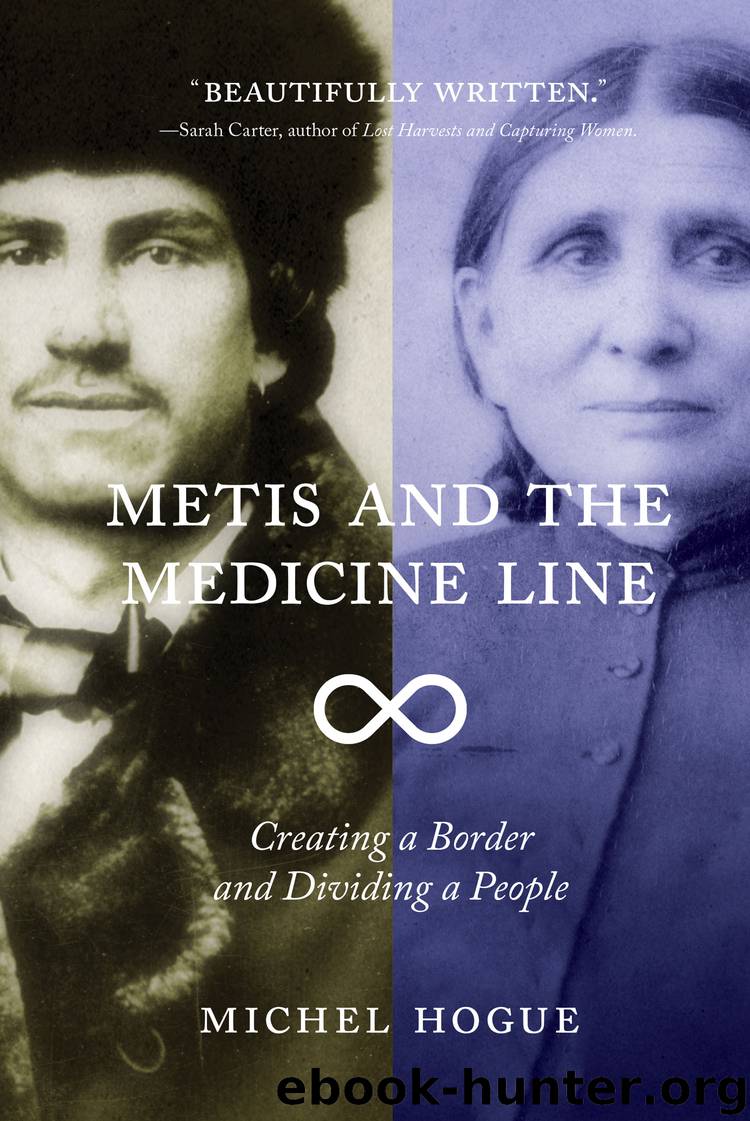
Author:Hogue, Michel;
Language: eng
Format: epub
Publisher: University of Regina
Published: 2015-05-04T22:25:11+00:00
Red River half-breed camp and carts [no date] (950-581). Montana Historical Society Research Center Photograph Archives, Helena.
In this case, the existence of the border helped mark the Metis as “foreign” and lent weight to arguments for their exclusion. In the hands of Indian agents and army officials, Assiniboine and Gros Ventre complaints that the Metis interfered with their hunting or supported their enemies became calls for the removal of “foreign half-breeds.”132 The Metis’s alien status also underpinned the U.S. Army’s rationale for removing them. General Terry contended that the Metis were British subjects and, as such, must face the penalties imposed on “foreigners” who entered Indian country without the required written permission from Interior Department or Indian Affairs officials.133
With personal genealogies and family histories that were entwined around the border, however, distinctions between “American” and “Canadian” Metis were rather arbitrary. Certainly, the Assiniboines and Gros Ventres drew their own distinctions. They argued that the forty “American half-breeds” living along the Milk River with their families should be allowed to remain on the reservation.134 Included among them were such families as the Azures, Bergers, Laverdures, Klines, Fayants, and others whose genealogies linked them to Metis communities in Pembina, North Dakota, and even the Great Lakes region. More important, many were bound to the neighbouring Assiniboine, Gros Ventre, and Piegan tribes through marriage.135 One of the leaders of this group, Gabriel Azure, was the son of a French Canadian fur trader and an Assiniboine woman. Azure, along with members of his extended family, were among the Metis who arrived in northern Montana to hunt and, in the late 1860s and early 1870s, to set up more permanent settlements.136 While some of the individuals no doubt left from time to time, the stable core of families had remained rooted in the region.
In this way, local understandings about belonging shaped decisions about who could remain. Because of their demonstrable ties to the local Assiniboine, Gros Ventre, or Yanktonai Indians, these Metis families were permitted to remain on the reservation. When Fort Belknap was reestablished as a separate Indian agency in 1878, Agent Wyman Lincoln, too, sanctioned their presence. Lincoln followed the policies established earlier in the decade by Andrew Simmons: he instructed the group that they could remain so long as they did not interfere with Gros Ventre or Assiniboine hunts, did not trade with or allow any smugglers into their camps, and did not communicate with “hostile Indians.” Lincoln also mandated that the Metis inform authorities when any hostile parties crossed the line. Some of these families, including those of Gabriel Azure and Cecile Laframboise, were eventually incorporated onto the rolls of the Assiniboine band at the Fort Belknap Agency. The commissioner of Indian affairs also instructed agents that “half-breeds” who resided within the bounds of the country occupied by a tribe and who were recognized as tribal members were able to trade without a license. Their inclusion as members reflected the U.S. government practice of recognizing the Metis only as members of “full-blood” Indian groups so long as those groups consented to their inclusion.
Download
This site does not store any files on its server. We only index and link to content provided by other sites. Please contact the content providers to delete copyright contents if any and email us, we'll remove relevant links or contents immediately.
| Africa | Americas |
| Arctic & Antarctica | Asia |
| Australia & Oceania | Europe |
| Middle East | Russia |
| United States | World |
| Ancient Civilizations | Military |
| Historical Study & Educational Resources |
Cat's cradle by Kurt Vonnegut(15364)
Pimp by Iceberg Slim(14520)
4 3 2 1: A Novel by Paul Auster(12402)
Underground: A Human History of the Worlds Beneath Our Feet by Will Hunt(12101)
The Radium Girls by Kate Moore(12035)
Wiseguy by Nicholas Pileggi(5795)
The Fire Next Time by James Baldwin(5454)
Perfect Rhythm by Jae(5410)
American History Stories, Volume III (Yesterday's Classics) by Pratt Mara L(5312)
Paper Towns by Green John(5195)
Pale Blue Dot by Carl Sagan(5013)
A Higher Loyalty: Truth, Lies, and Leadership by James Comey(4966)
The Mayflower and the Pilgrims' New World by Nathaniel Philbrick(4508)
The Doomsday Machine by Daniel Ellsberg(4493)
Killers of the Flower Moon: The Osage Murders and the Birth of the FBI by David Grann(4451)
The Sympathizer by Viet Thanh Nguyen(4398)
Too Much and Not the Mood by Durga Chew-Bose(4353)
The Borden Murders by Sarah Miller(4330)
Sticky Fingers by Joe Hagan(4207)
