Manteo's World by Helen Rountree
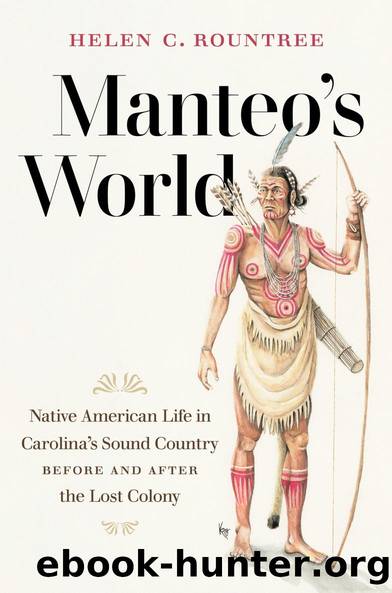
Author:Helen Rountree [Rountree, Helen]
Language: eng
Format: epub
Tags: Social Science, Ethnic Studies, American, Native American Studies, History, United States, State & Local, South (AL; AR; FL; GA; KY; LA; MS; NC; SC; TN; VA; WV), Indigenous Peoples of the Americas
ISBN: 9781469662947
Google: M8_9DwAAQBAJ
Publisher: UNC Press Books
Published: 2021-06-11T02:50:07+00:00
CHAPTER SEVEN
Foreigners Merging In
The English people left behind on Roanoke Island became known as the âLost Colony,â thanks to the uncertainty of their fate after August 22, 1587, when John White took leave of them and sailed back to England in quest of supplies. What concerns us now is the aftermath, as it affected the people native to the region. There is a strong likelihoodânot merely the possibilityâthat those English families were not completely wiped out by the hostile Algonquian speakers nearest them. Instead, at least some of them would have managed to take refuge with more distant, friendlier Native people. Those refugees would not have stayed for long in only one place, either: even in a good crop year, which 1587 was not, no one Indian townâs food supplies could possibly have supported a hundred or more extra people. So the âlost colonistâ refugees would have had to split up. Some would have been split off involuntarily, by being captured and taken home by hostile Native people. Given how Indian warfare handled women and children, any English women and children captured by the hostile neighbors would have been kept very much alive for as long as possible. On the other hand, English adult men, who were as touchy as the warriors they faced, may not have survived for long as captives or even as guests. But if they avoided sickening from the local âbugsâ to which they had no immunity, English females and pre-adult males had a good chance of living a long time and gradually assimilating into the Indian world. Early eighteenth-century traveler John Lawson was of this opinion too.1
Concrete evidence of their having done this merging is scanty and downright tantalizing, ranging from an alteration to John Whiteâs map hiding what may have been a planned new English fort at the west end of Albemarle Sound, to sightings of an Indian with yellow hair and pale skin in the Appomattox River area in the early 1600s.2 Many other scholars have written about this subject, and most agree nowadays that the colonists were not simply wiped out. They disagree about the details, however, and we shall leave it all to them, with only one parting shot: English-descended Indians in the early seventeenth century could very well have existed in many places in eastern North Carolina. Because of how war captives were treated, any of the Indian nations in the Sounds region, friendly or hostile as of 1587, could have added English people to their population. Not only that, but intertribal wars continued at least into John Lawsonâs time, the early 1700s, so that English captives and their descendants could have been recaptured and thus distributed all over the place. Scholars should therefore not just look toward the friendly Croatoans, for instance, as having English-descended people among them. Everybody probably did, after a decade or two.
This cultural anthropologist is more interested in reconstructing how the assimilation process would have played out. In the 1580s, it would have been the
Download
This site does not store any files on its server. We only index and link to content provided by other sites. Please contact the content providers to delete copyright contents if any and email us, we'll remove relevant links or contents immediately.
Cecilia; Or, Memoirs of an Heiress — Volume 1 by Fanny Burney(32559)
The Great Music City by Andrea Baker(32020)
Cecilia; Or, Memoirs of an Heiress — Volume 2 by Fanny Burney(31957)
Cecilia; Or, Memoirs of an Heiress — Volume 3 by Fanny Burney(31943)
We're Going to Need More Wine by Gabrielle Union(19049)
All the Missing Girls by Megan Miranda(16033)
Pimp by Iceberg Slim(14513)
For the Love of Europe by Rick Steves(14138)
Bombshells: Glamour Girls of a Lifetime by Sullivan Steve(14077)
Talking to Strangers by Malcolm Gladwell(13374)
Norse Mythology by Gaiman Neil(13371)
Fifty Shades Freed by E L James(13244)
Mindhunter: Inside the FBI's Elite Serial Crime Unit by John E. Douglas & Mark Olshaker(9345)
Crazy Rich Asians by Kevin Kwan(9293)
The Lost Art of Listening by Michael P. Nichols(7507)
Enlightenment Now: The Case for Reason, Science, Humanism, and Progress by Steven Pinker(7315)
The Four Agreements by Don Miguel Ruiz(6766)
Bad Blood by John Carreyrou(6623)
Weapons of Math Destruction by Cathy O'Neil(6282)
