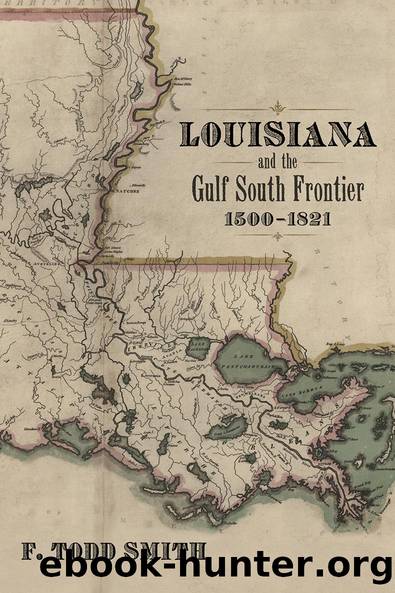
Louisiana and the Gulf South Frontier, 1500-1821 by F. Todd Smith
Author:F. Todd Smith [Smith, F. Todd]
Language: eng
Format: epub
Tags: Social Science, Regional Studies, History, United States, State & Local, South (AL; AR; FL; GA; KY; LA; MS; NC; SC; TN; VA; WV)
ISBN: 9780807157121
Google: hHqOAwAAQBAJ
Publisher: LSU Press
Published: 2014-11-17T05:43:56+00:00
Spanish Louisiana and the Influx of Newcomers
Unzaga, an army officer from Málaga who had been stationed in Cuba, served as governor of Louisiana until January 1777, during which time he successfully reconciled the French creoles to Spanish control. While Unzagaâs marriage to the daughter of New Orleans planter Gilbert Antoine de St. Maxent assisted him in this effort, Spanish policies that promoted Louisianaâs economic well-being ultimately convinced the colonyâs French elites to accept Spainâs control. Spainâs accession of Louisiana coincided with the reign of Carlos III, the reform-minded Bourbon ruler who desired to implement Enlightenment methods of government in order to transform Spanish holdings into efficiently governed and economically productive territories. The kingâs so-called Bourbon Reforms strongly affected Spanish Louisiana because the colony was administered through the captaincy-general of Havana, the crucible in which many of the changes put forth by Carlos III were tested. Minister of the Indies José de Gálvez, the man the king chose to implement the Bourbon Reforms in America, was the uncle of Bernardo de Gálvez, Unzagaâs gubernatorial successor and brother-in-law by his marriage to a St. Maxent daughter. As a result of the Spanish policy initiatives put forth under Unzaga and Gálvez, Louisianaâs exports increased dramatically during the period, the population grew, and the colony enjoyed more economic prosperity and stability than had ever occurred under the French dominion.
After establishing firm control over Louisiana in 1769, Spanish officials sought to develop the export economy through various means. Although OâReilly had forced Louisiana merchants to trade exclusively within the Spanish empire, most particularly with Cuba, Governor Unzaga recognized the necessity of illicit commerce with the British and thus permitted the renewal of the clandestine trade, while making a few symbolic seizures of English ships. With the outbreak of the American Revolution in 1775, however, the Spaniards took steps to weaken the British economic position prior to Spainâs 1779 entrance in the war. Spanish officials decreed the opening of trade between Louisiana and France and the French West Indies in 1776, thus restoring the commercial channels that had developed during the first two-thirds of the eighteenth century. Gálvez, upon becoming governor in early 1777, enhanced the diversion of the colonyâs trade from Great Britain to France by confiscating a number of British vessels and ordering their departure from Louisiana. In addition to increasing the number of ports colonial merchants could deal with, Spanish officials also took steps to promote the expansion of Louisiana exports. Tobacco production, which had languished during the French period, took off after the Spanish Crown made Louisiana the sole supplier for Mexico in 1776. At the same time the colony was given a monopoly on the production of the wooden boxes in which sugar was exported throughout the Spanish empire, resulting in the development of the colonyâs cypress industry. As a result of these initiatives, by the 1780s Louisiana was annually exporting an average of 1 million livresâ worth of tobacco, twice the amount produced during the French era, and another 1 million livresâ worth of timber products, a five-fold increase.
Download
This site does not store any files on its server. We only index and link to content provided by other sites. Please contact the content providers to delete copyright contents if any and email us, we'll remove relevant links or contents immediately.
The Great Music City by Andrea Baker(32796)
Cecilia; Or, Memoirs of an Heiress — Volume 1 by Fanny Burney(32672)
Cecilia; Or, Memoirs of an Heiress — Volume 2 by Fanny Burney(32035)
Cecilia; Or, Memoirs of an Heiress — Volume 3 by Fanny Burney(32015)
We're Going to Need More Wine by Gabrielle Union(19130)
All the Missing Girls by Megan Miranda(16450)
Pimp by Iceberg Slim(14724)
For the Love of Europe by Rick Steves(14708)
Bombshells: Glamour Girls of a Lifetime by Sullivan Steve(14169)
Norse Mythology by Gaiman Neil(13493)
Talking to Strangers by Malcolm Gladwell(13481)
Fifty Shades Freed by E L James(13315)
Mindhunter: Inside the FBI's Elite Serial Crime Unit by John E. Douglas & Mark Olshaker(9459)
Crazy Rich Asians by Kevin Kwan(9372)
The Lost Art of Listening by Michael P. Nichols(7578)
Enlightenment Now: The Case for Reason, Science, Humanism, and Progress by Steven Pinker(7380)
The Four Agreements by Don Miguel Ruiz(6865)
Bad Blood by John Carreyrou(6696)
Weapons of Math Destruction by Cathy O'Neil(6412)
