Louis S. Warren by Buffalo Bill's America: William Cody;the Wild West Show
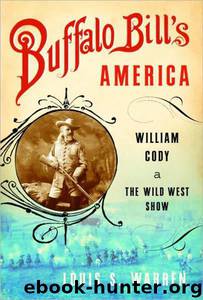
Author:Buffalo Bill's America: William Cody;the Wild West Show
Language: eng
Format: mobi
Tags: Frontier and Pioneer Life - West (U.S.), Fiction, HI, Civil War Period (1850-1877), Entertainers, Pioneers, NV, State & Local, CO, Frontier and Pioneer Life, Buffalo Bill, CA, Adventurers & Explorers, Entertainment & Performing Arts, United States, Historical, West (U.S.), ID, History, West (AK, Entertainers - United States, UT, Pioneers - West (U.S.), General, MT, Biography, Biography & Autobiography, Buffalo Bill's Wild West Show, WY)
ISBN: 9780375412165
Publisher: Random House Digital, Inc.
Published: 2005-01-15T06:00:00+00:00
Broncho Charlie Miller
IT WAS 1887 when the London reporter met the slight young cowboy in the camp of the Wild West show. His name, he said, was Charlie Miller, and his was a simple story of emigrants and settlers. His father was a Scotsman who emigrated to New York, where he married Charlie’s mother, herself an immigrant from England. They followed the gold rush west in 1849, and built a home at Hat Creek, in northern California. Their son Charlie was born eleven years later. Charlie was seven years old when local Indians, tired of being dispossessed and killed with impunity, rose up. The Miller home was among their targets. Charlie escaped, and his mother and his brother “only got away almost by a miracle.” His father was not so fortunate, and his killing left Charlie’s mother without support.
So the family moved to San Francisco, where Charlie attended school for a couple of years. By 1870, the problem of money must have troubled Mrs. Miller, for she sent him to work. He was only nine. But like thousands of other frontier children, including William Cody in Kansas, Charlie herded livestock. His employer, a rancher named Thompson, kept him on for four years, “doing anything and everything about the ranch that a boy could.” In 1874, he helped drive two thousand cattle to market in Sacramento, where he met a man named Summercamp. By this time, Miller was “a pretty smart boy on a horse.” Just as a Kansas teamster had hired ten-year-old Will Cody to drive horses from Leavenworth to Laramie, so Summercamp hired this thirteen-year-old boy to join him and two other men driving a herd of horses seven hundred miles to Idaho. There were sporadic Indian attacks on other parties along the route, and progress was slow. “At one place, Camp Watson, on Big Meadow Creek, we had to lay up three weeks before we could get along.” But in the end, “we never came to close quarters with them,” and the party arrived at the ranch in safety. Charlie was soon known as “Broncho Charlie,” and he broke horses for Summercamp for the next four years.
The horses Charlie handled, along with other settler livestock in southern Idaho, devastated the camas plants on which the Bannock Indians at Fort Hall depended. Facing starvation, the Bannock and their Paiute allies went to war in 1878. There was panic in Idaho and Oregon, and many settlers joined volunteer militias. But soon the combined Bannock and Pauite forces all but collapsed.
Even by his own account, Charlie Miller’s involvement in the fighting was small. He was a civilian dispatch carrier on a few occasions for the army, he said, but he admitted he saw no action until near the war’s end. Then, at Blue River, with a party of ranch hand volunteers and professional soldiers, Charlie found himself in an Indian battle. Historians, when they recalled the fight at all, described it as a skirmish. But like so many men who sweat through fights their people soon forget, Charlie Miller remembered it all too well.
Download
This site does not store any files on its server. We only index and link to content provided by other sites. Please contact the content providers to delete copyright contents if any and email us, we'll remove relevant links or contents immediately.
| Africa | Americas |
| Arctic & Antarctica | Asia |
| Australia & Oceania | Europe |
| Middle East | Russia |
| United States | World |
| Ancient Civilizations | Military |
| Historical Study & Educational Resources |
Cat's cradle by Kurt Vonnegut(15481)
Pimp by Iceberg Slim(14724)
4 3 2 1: A Novel by Paul Auster(12554)
Underground: A Human History of the Worlds Beneath Our Feet by Will Hunt(12184)
The Radium Girls by Kate Moore(12126)
Wiseguy by Nicholas Pileggi(5881)
The Fire Next Time by James Baldwin(5542)
Perfect Rhythm by Jae(5505)
American History Stories, Volume III (Yesterday's Classics) by Pratt Mara L(5354)
Paper Towns by Green John(5269)
Pale Blue Dot by Carl Sagan(5104)
A Higher Loyalty: Truth, Lies, and Leadership by James Comey(5044)
The Doomsday Machine by Daniel Ellsberg(4583)
The Mayflower and the Pilgrims' New World by Nathaniel Philbrick(4579)
Killers of the Flower Moon: The Osage Murders and the Birth of the FBI by David Grann(4499)
The Sympathizer by Viet Thanh Nguyen(4470)
Too Much and Not the Mood by Durga Chew-Bose(4415)
The Borden Murders by Sarah Miller(4413)
Sticky Fingers by Joe Hagan(4279)
