Lloyd George and Churchill by Richard Toye
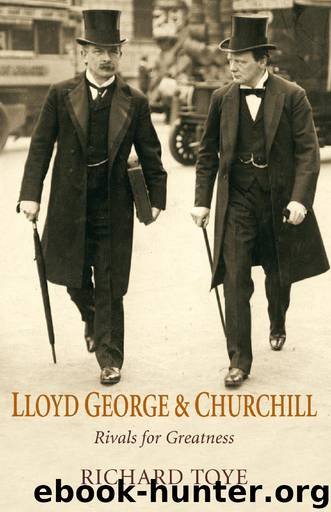
Author:Richard Toye [Toye, Richard]
Language: eng
Format: epub
Tags: General Fiction
Publisher: Pan Macmillan
Chapter Eight
POLITICS AND MEMORY
WITHIN MONTHS OF the Labour government taking office, the Wall Street Crash plunged the world further into economic crisis and political turmoil. In Britain unemployment rocketed, and in 1931 there was a major realignment of the parties, in which the Conservatives emerged as the dominant force in a cross-party National Government headed by Ramsay MacDonald. In the United States, the economic consequences were yet more serious, although in 1932 the election of Franklin D. Roosevelt heralded an ambitious ‘New Deal’ that aimed at the revival of prosperity through government action. In Germany, economic devastation combined with chronic political instability to give Hitler his chance at power, which he seized with alacrity in 1933. He immediately posed a threat to the peace of Europe. It must be remembered, though, that he was not the sole danger. Japan invaded Manchuria in 1931, Mussolini’s Italy attacked Abyssinia (modern Ethiopia) in 1935, and in 1936 the outbreak of the Spanish Civil War further exacerbated European tensions. It may well seem regrettable that Lloyd George and Churchill, with all their brilliant qualities, were out of power during this terrible time, for, if they could not have averted war, perhaps they could have ensured that Britain was better prepared for it when it came. Indeed, even before Churchill became Prime Minister in 1940, there had developed a powerful legend that ‘the elderly mediocrities in British politics’ had deliberately conspired ‘to exclude from the Government of this country – permanently it was hoped – the only two men of authentic genius in our public life’.1
This legend cannot be accepted without challenge. It is true that a number of senior politicians continued to fear a renewed Lloyd George–Churchill alliance, did their best to prevent it coming about, and were mightily relieved that it did not do so. Some other – rather fewer and less influential – people continued to hope that the two men would combine, in order to tackle the national crisis. But these fears and hopes, although they may have affected key political calculations, were unrealistic. Lloyd George and Churchill would themselves, at various times and for different reasons, have welcomed a restoration of the partnership. But although they achieved temporary, tactical agreement on certain important issues, and continued to build up the myth of their friendship, they no longer had enough in common politically to make sustained cooperation viable. In addition, throughout the 1930s they each made some fundamental mistakes. In Lloyd George’s case, these were to contribute to the eventual eclipse of his reputation by Churchill’s. In Churchill’s case, his errors cast serious doubt on his judgement, and made his warnings about Germany – a question on which, at the most basic level, he was right – appear to many as a typical example of his habit of exaggeration. It may have been a tragedy that their respective talents went unused, but if so it was a tragedy for which they themselves must shoulder a substantial amount of blame.
After the 1929
Download
This site does not store any files on its server. We only index and link to content provided by other sites. Please contact the content providers to delete copyright contents if any and email us, we'll remove relevant links or contents immediately.
| Africa | Americas |
| Arctic & Antarctica | Asia |
| Australia & Oceania | Europe |
| Middle East | Russia |
| United States | World |
| Ancient Civilizations | Military |
| Historical Study & Educational Resources |
Room 212 by Kate Stewart(5130)
The Crown by Robert Lacey(4821)
Endurance: Shackleton's Incredible Voyage by Alfred Lansing(4790)
The Iron Duke by The Iron Duke(4367)
The Rape of Nanking by Iris Chang(4224)
Joan of Arc by Mary Gordon(4119)
Killing England by Bill O'Reilly(4008)
Say Nothing by Patrick Radden Keefe(3992)
I'll Give You the Sun by Jandy Nelson(3452)
Shadow of Night by Deborah Harkness(3377)
Hitler's Monsters by Eric Kurlander(3352)
Mary, Queen of Scots, and the Murder of Lord Darnley by Alison Weir(3216)
Blood and Sand by Alex Von Tunzelmann(3207)
Eleanor & Park by Rainbow Rowell(3185)
Darkest Hour by Anthony McCarten(3137)
Margaret Thatcher: The Autobiography by Thatcher Margaret(3087)
Book of Life by Deborah Harkness(2943)
Red Famine: Stalin's War on Ukraine by Anne Applebaum(2940)
The One Memory of Flora Banks by Emily Barr(2871)
