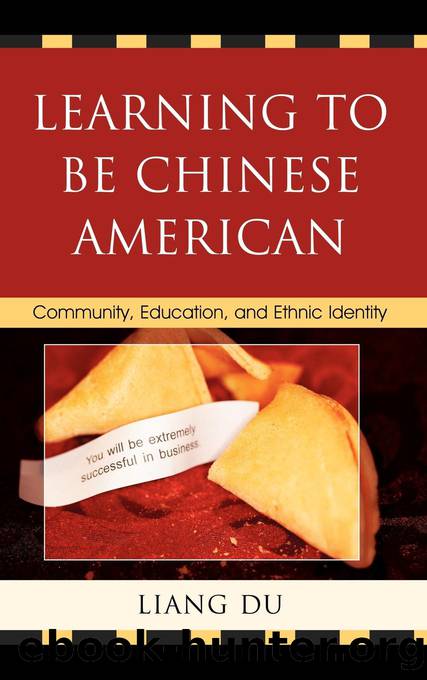
Learning to Be Chinese American by Du Liang;
Author:Du, Liang;
Language: eng
Format: epub
Publisher: Lexington Books/Fortress Academic
Published: 2010-08-15T00:00:00+00:00
Resistance, Negotiation, and Identity
While the community-based ethnic education represents a systematic practice that aims at the (re)production of the ethnic identity of the local youth, the responses of the youth to such efforts are two-fold. While they are aware of the importance of preserving an ethnic identity and the role of community force in the process, they also feel the alienation of the ethnic teaching from their everyday lives and the pressure of having to master another language, to which they are resistant. But rejection is not an option because of the parental pressure and, more important, because of their recognition of the importance of ethnic education for their building of the ethnic identity. The youth therefore have to negotiate with the reality and find a way to make the schooling process in the community more endurable and sometimes even interesting. Such negotiation process, I would argue, has become part of the shared experience of the local youth and contributes significantly to the formation of their ethnic identity.
Throughout my fieldwork, complaints and signs of resistance against the ethnic education, in particular against the Chinese School, were prevalent. One could frequently hear comments or shout-outs such as âI donât like to go to Chinese school?â âMy parents force me to go to Chinese school!â âWe donât care about thisâ or even âI hate Chinese school!â In the hallways or even in the classrooms at the Chinese School, the youth predominately talked to each other in English, despite the teachersâ frequent interventions. When I did my interviews or focus groups with the youth participants, most of them chose to talk in English. âI hate Chinese. [English] is easier.â A student once commented before the start of a focus group. Interestingly, during the subsequent discussions he claimed that he chose to learn Chinese himself, a gesture that won a warm clap from his classmates since most of them reported that they were forced to come to the Chinese School. However, it was not long before he confessed that he actually did not enjoy learning Chinese but realized âeventuallyâ he would learn it anyway. The same happened when I posed the question âdo you like learning Chinese?â to the supplementary student cohort. Almost all of them said âno!â âBut we will appreciate it in the future,â one added. âMy parents kind of force me to learn,â another said. I asked why they did not like learning Chinese. They gave me two main reasons: one was that they already got too much work from regular school and were too busy to spare time to learn Chinese; another reason was that it was too difficult to learn. It was not that they did not want to learn, but they did not want to âgo through the process.â âAfter all, it is another language!â one lamented. The resentment of the students about the extra burden of ethnic schooling was common, as was illustrated in the following classroom dialogues:
Linda [Being asked to make a sentence in Chinese]: Although she was very sleepy, her mother still asked her to get up to go to the Chinese School.
Download
This site does not store any files on its server. We only index and link to content provided by other sites. Please contact the content providers to delete copyright contents if any and email us, we'll remove relevant links or contents immediately.
| Anthropology | Archaeology |
| Philosophy | Politics & Government |
| Social Sciences | Sociology |
| Women's Studies |
Cecilia; Or, Memoirs of an Heiress — Volume 1 by Fanny Burney(32562)
The Great Music City by Andrea Baker(32022)
Cecilia; Or, Memoirs of an Heiress — Volume 2 by Fanny Burney(31959)
Cecilia; Or, Memoirs of an Heiress — Volume 3 by Fanny Burney(31945)
We're Going to Need More Wine by Gabrielle Union(19052)
All the Missing Girls by Megan Miranda(16046)
Pimp by Iceberg Slim(14520)
For the Love of Europe by Rick Steves(14161)
Bombshells: Glamour Girls of a Lifetime by Sullivan Steve(14081)
Talking to Strangers by Malcolm Gladwell(13376)
Norse Mythology by Gaiman Neil(13375)
Fifty Shades Freed by E L James(13246)
Mindhunter: Inside the FBI's Elite Serial Crime Unit by John E. Douglas & Mark Olshaker(9347)
Crazy Rich Asians by Kevin Kwan(9296)
The Lost Art of Listening by Michael P. Nichols(7508)
Enlightenment Now: The Case for Reason, Science, Humanism, and Progress by Steven Pinker(7316)
The Four Agreements by Don Miguel Ruiz(6768)
Bad Blood by John Carreyrou(6626)
Weapons of Math Destruction by Cathy O'Neil(6284)
