Justice and Grace by Dodd Gwilym;
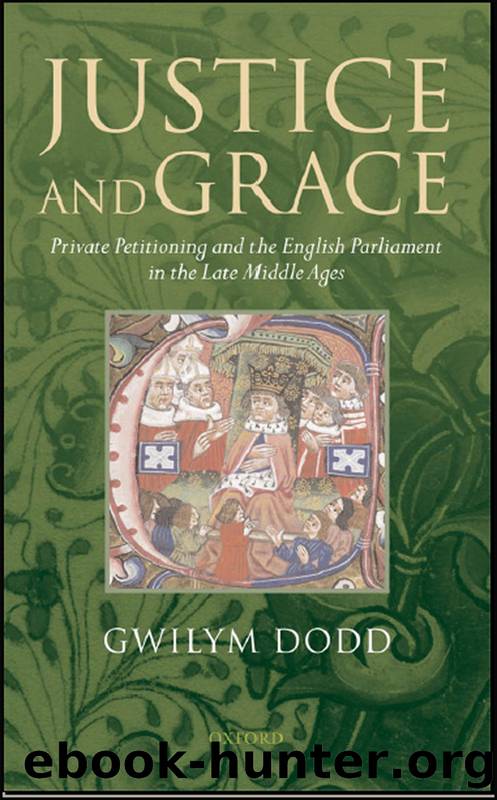
Author:Dodd, Gwilym;
Language: eng
Format: epub
Publisher: Oxford University Press, Incorporated
Published: 2007-07-14T16:00:00+00:00
8.1 PETITIONS FROM THE CLERGY
The communitas cleri live under our rule no less than the rest of the people and enjoy our defence and protection of their temporalities, and for the most part of their spiritualities.
Edward I to the bishop of Worcester, 12793
Clerical petitions are usually considered in terms of the parliamentary gravamina that were presented on an intermittent basis throughout the thirteenth and fourteenth centuries.4 These were the clerical equivalent of common petitions, formulated from widely-held and broad-based grievances, and presented to the Crown with the view to establishing remedial legislation. The attention given to the gravamina, though of crucial importance in demonstrating what concerned the clergy at a general level, tends to obscure the much more consistent—and remarkably extensive—use made of the private petition by members of the clergy in order to resolve difficulties or to have favours granted that were more specific to their circumstances. Remarkably, virtually nothing in print has been written about the recourse which clergymen made to parliament to obtain grace or justice from the king.5 This is an important omission, both for the history of the Church and for the history of parliament. In scholarship on the Church, it is a well-established truism that the affairs of the clergy were inextricably linked to—and in many areas determined by—the actions and policies of the Crown. This close relationship between ‘church and state’ has been addressed in many ways: in the context of the workings of royal patronage; the Crown’s financial demands; in its repressive as well as supportive legislative programmes; and in the service individual churchmen provided the Crown in government. Scholarship has also considered the complex and multifaceted relationship between secular and clerical jurisdictions.6 In this respect, special emphasis has been placed on conflict and discord, as the Crown increasingly sought to expand its control over the ‘borderland’7 of jurisdictional uncertainty that existed between canon law and the common law. The statement from Edward I quoted at the start of this section is demonstrative of the Crown’s assertiveness in this respect.
Petitions to parliament, from members of the clergy, cast interesting new light on the relationship between the Church and the Crown. Above all, they reveal a striking contrast between, on the one hand, the autonomy and independence claimed for the Church by the clergy as a unified body and, on the other hand, the readiness of ecclesiastics to seek royal interference in their individual affairs. Thus, whereas the clerical gravamina provide good grounds for crediting the Church with a vigorous, spirited, and united defence of its position against the encroachments of the Crown on the proper exercise of canonical justice, clerical private petitions reveal a very different set of dynamics, for they show the clergy acting as individuals or single corporate entities in cases that were not only highly specialized, but which also sometimes brought them into conflict with their fellow clergy. Moreover, if there was an unspoken assumption behind the gravamina that the Church’s defence of its rights and liberties stemmed from
Download
This site does not store any files on its server. We only index and link to content provided by other sites. Please contact the content providers to delete copyright contents if any and email us, we'll remove relevant links or contents immediately.
| Africa | Americas |
| Arctic & Antarctica | Asia |
| Australia & Oceania | Europe |
| Middle East | Russia |
| United States | World |
| Ancient Civilizations | Military |
| Historical Study & Educational Resources |
Room 212 by Kate Stewart(5189)
The Crown by Robert Lacey(4870)
Endurance: Shackleton's Incredible Voyage by Alfred Lansing(4849)
The Iron Duke by The Iron Duke(4411)
The Rape of Nanking by Iris Chang(4269)
Joan of Arc by Mary Gordon(4160)
Say Nothing by Patrick Radden Keefe(4050)
Killing England by Bill O'Reilly(4046)
I'll Give You the Sun by Jandy Nelson(3499)
Shadow of Night by Deborah Harkness(3412)
Hitler's Monsters by Eric Kurlander(3389)
Blood and Sand by Alex Von Tunzelmann(3246)
Mary, Queen of Scots, and the Murder of Lord Darnley by Alison Weir(3243)
Eleanor & Park by Rainbow Rowell(3241)
Darkest Hour by Anthony McCarten(3165)
Margaret Thatcher: The Autobiography by Thatcher Margaret(3115)
Book of Life by Deborah Harkness(2988)
Red Famine: Stalin's War on Ukraine by Anne Applebaum(2973)
The One Memory of Flora Banks by Emily Barr(2902)
