Judgment Calls: Twelve Stories of Big Decisions and the Teams That Got Them Right by Thomas H. Davenport & Brook Manville
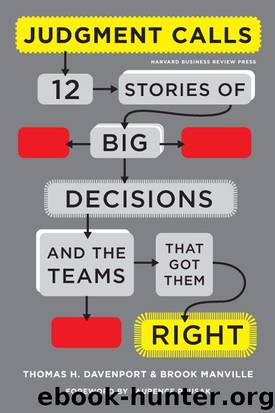
Author:Thomas H. Davenport & Brook Manville [Davenport, Thomas H.]
Language: eng
Format: mobi
ISBN: 9781422158111
Publisher: Harvard Business Review Press
Published: 2012-03-12T14:00:00+00:00
That Zeus the all-seeing grants to Athena's prayer
That the wooden wall only shall not fall, but help you and your children
But await not the host of horse and foot coming from Asia
Nor be still, but turn your backs and withdraw from the foe.
Truly a day will come when you will meet him face to face
Divine Salamis, you still bring death to the women's sons
When the corn is scattered or the harvest gathered in.
In the ensuing days, these words were debated for their meaning and significance among the Athenians in their citizen assembly. We can imagine a fully empowered group of citizens discussing the oracle and simultaneously formulating possible options for Athenian strategy. According to Herodotus, elders in the meetings advanced the point of view that “the wooden wall” that would not fall referred to a traditional hedgelike fence that surrounded the Acropolis, meaning that only the sacred citadel of Athens would survive. Others argued that the wooden wall referred to ships, the Athenian triremes that now made up the navy. But those advancing this contrary opinion took no comfort when a small group of “professional interpreters” pointed out that the lines about “divine Salamis, bringing death to the women's sons” suggested that reliance on ships as the wooden wall and fighting off the island offshore would be the demise of the nation.
Herodotus goes on to explain that the standoff was finally broken by the general Themistocles, who persuaded the Athenians—meeting as citizens in the assembly—that the riddle was in fact good news. Because Salamis was described as “divine” and not “hateful,” the women's sons to die would be those of the enemy, not Athens. Salamis would be divine because it would save the day for the Athenians in their wall of wooden ships.
Whatever the actual sequence of events, Herodotus portrays a group of citizens continuously gathering news from events afar, and then deliberating and weighing a course of action based on differing interpretations of seemingly authoritative information provided. The ancient commentator notes how in the end “the Athenians found Themistocles' explanation of the oracle preferable to that of the professional interpreters”—essentially evaluating differing options and then overturning a group of experts whose judgment seemed more questionable in the end. Themistocles was a persuasive speaker—but he was also the advocate of an earlier strategic decision (as we know from various sources) in fact to build up the same Athenian navy that was now being called upon to “create the wooden wall.” A few years before, when the city came into a large fortune from the discovery of silver in a nearby mine, Themistocles had persuaded the citizenry not just to distribute the wealth across the population, but instead to invest it on behalf of their collective defense—by building two hundred new ships. This earlier decision by the assembly had vaulted Athens into the status of a major Hellenic power, suddenly at the head of an unprecedentedly large navy. In the end, the assembly of citizens, having made a previous decision to
Download
This site does not store any files on its server. We only index and link to content provided by other sites. Please contact the content providers to delete copyright contents if any and email us, we'll remove relevant links or contents immediately.
Hit Refresh by Satya Nadella(9126)
The Compound Effect by Darren Hardy(8949)
Change Your Questions, Change Your Life by Marilee Adams(7761)
Nudge - Improving Decisions about Health, Wealth, and Happiness by Thaler Sunstein(7693)
The Black Swan by Nassim Nicholas Taleb(7110)
Deep Work by Cal Newport(7066)
Rich Dad Poor Dad by Robert T. Kiyosaki(6612)
Daring Greatly by Brene Brown(6504)
Principles: Life and Work by Ray Dalio(6422)
Playing to Win_ How Strategy Really Works by A.G. Lafley & Roger L. Martin(6250)
Man-made Catastrophes and Risk Information Concealment by Dmitry Chernov & Didier Sornette(6007)
Big Magic: Creative Living Beyond Fear by Elizabeth Gilbert(5756)
Digital Minimalism by Cal Newport;(5750)
The Myth of the Strong Leader by Archie Brown(5500)
The Slight Edge by Jeff Olson(5410)
Discipline Equals Freedom by Jocko Willink(5379)
The Motivation Myth by Jeff Haden(5205)
The Laws of Human Nature by Robert Greene(5177)
Stone's Rules by Roger Stone(5081)
