Journey to Britannia by Bronwen Riley
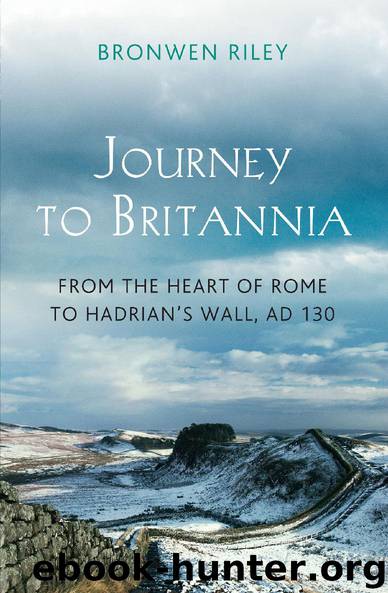
Author:Bronwen Riley [Riley, Bronwen]
Language: eng
Format: epub
ISBN: 9781781852675
Publisher: Head of Zeus Ltd.
X
To the Wall
Murum lo[ngi] operis… non [mul]to diutius exstrucxistis quam caespite exstruitur…Vos lapid[ibus] grandibus, gravibus, inaequalibus, quos neque vehere n[e]que attollere, neque locare quis possit nisi ut inaequa[lita]tes inter se compareant. Fossam glaria duram scabram recte percussistis et radendo levem reddidistis. Opere pr[o]bato introgressi castra raptim et cibum et arma cepistis equitem emissum secuti magno clamore revertentem…
You have built a long wall… in not much more time than if it were made of turf... You built with big, heavy, uneven stones which no one can carry, lift or lay without their unevenness becoming evident… You dug a hard, rough ditch correctly through the earth and by scraping it made it level. Your work approved, you quickly entered camp, took your food and weapons and followed the cavalry which had been sent out, with a great shout as they came back… 1
Extract from H ADRIAN ’S address to the troops at Lambaesis, Numidia,
North Africa, AD 128
*
ON LEAVING Viroconium and heading north for Deva (Chester), a little over 38 miles (61km) away, Julius Severus can make first for Mediolanum (Whitchurch), about 24 miles (39km) hence. There, at the junction of several roads, there is a mansio and small market. Although this is still in Cornovian territory, the countryside is beginning to change. More cereal crops are in evidence here, and while there are still settlements with their great ditched enclosures for livestock, the landscape now also reveals solitary roundhouses, surrounded by enclosed arable fields with pasture beyond. 2 Although some farms have been settled by veteran soldiers who employ Roman methods of agriculture, there are few recognizable villas.
After crossing a bridge over the River Dee, 3 the travellers enter Deva. Here is the legionary fortress and adjacent amphitheatre, which loom over the river, commanding the attention of everyone arriving either by road or up-river from the Irish Sea. But the garrison is even more depleted than at Isca. Most of the troops (and those from surrounding auxiliary forts) have gone up to the Wall, and many buildings, including some of the barrack blocks and the amphitheatre, have been abandoned. 4 The main military base in the north is now the legionary fortress at Eboracum, under the command of Minicius Natalis.
With little to detain them at Deva, the travellers soon move on, taking the road north-east towards Eboracum as far as the auxiliary fort at Mamucium (Manchester), some 34 miles (55km) away. The route passes through a flourishing industrialized landscape where vital supplies for the soldiers of the north-west garrisons are produced. The area is an important centre of brine extraction. Salt is a vital commodity, not only for preserving meat but also for tanning leather and making cheese, and the abundance of brine here has encouraged leather-working and shoe-making. 5 At Condate (Northwich), a stopping place almost 19 miles (30km) from Deva, at the confluence of the rivers Dane and Weaver, there is a connecting road south to Salinae (Middlewich), whose name means ‘Salt Works’: here there is a brine extraction plant in the vicus (village settlement) attached to the auxiliary fort.
Download
This site does not store any files on its server. We only index and link to content provided by other sites. Please contact the content providers to delete copyright contents if any and email us, we'll remove relevant links or contents immediately.
| Africa | Americas |
| Arctic & Antarctica | Asia |
| Australia & Oceania | Europe |
| Middle East | Russia |
| United States | World |
| Ancient Civilizations | Military |
| Historical Study & Educational Resources |
Room 212 by Kate Stewart(5194)
The Crown by Robert Lacey(4874)
Endurance: Shackleton's Incredible Voyage by Alfred Lansing(4858)
The Iron Duke by The Iron Duke(4416)
The Rape of Nanking by Iris Chang(4272)
Joan of Arc by Mary Gordon(4166)
Killing England by Bill O'Reilly(4060)
Say Nothing by Patrick Radden Keefe(4056)
I'll Give You the Sun by Jandy Nelson(3511)
Shadow of Night by Deborah Harkness(3428)
Hitler's Monsters by Eric Kurlander(3409)
Eleanor & Park by Rainbow Rowell(3263)
Blood and Sand by Alex Von Tunzelmann(3252)
Mary, Queen of Scots, and the Murder of Lord Darnley by Alison Weir(3251)
Darkest Hour by Anthony McCarten(3178)
Margaret Thatcher: The Autobiography by Thatcher Margaret(3128)
Book of Life by Deborah Harkness(2992)
Red Famine: Stalin's War on Ukraine by Anne Applebaum(2977)
The One Memory of Flora Banks by Emily Barr(2909)
