Jewish Life in Medieval Spain by Jonathan Ray;
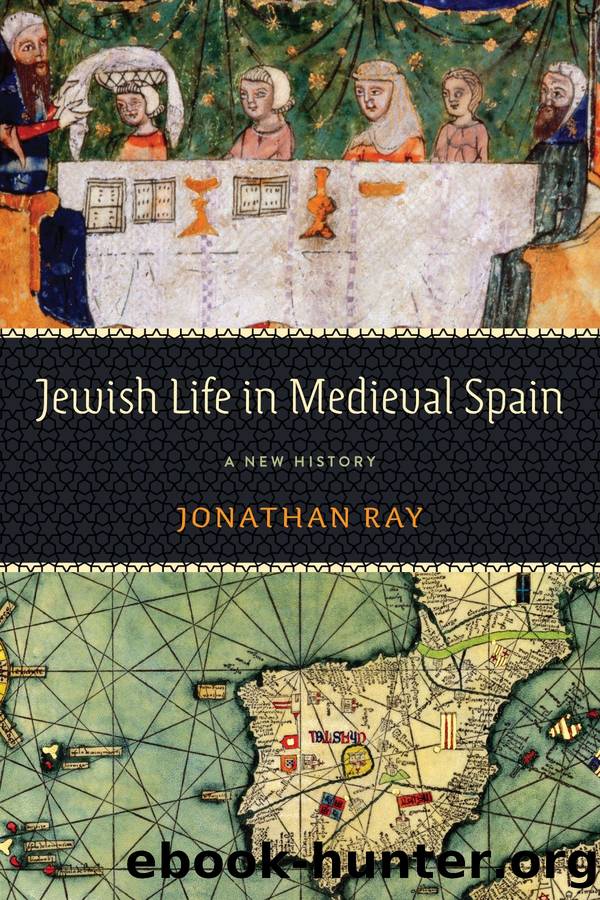
Author:Jonathan Ray;
Language: eng
Format: epub
ISBN: 978-1-512-82384-4
Publisher: Lightning Source Inc. (Tier 2)
Published: 2022-09-26T00:00:00+00:00
Jewish Responses to the Black Death
It is easy to forget that the greatest impact of the Black Death on Jewish society was the disease itself. Jews died along with their neighbors. In Barcelona and Girona new Jewish cemeteries needed to be established as the old ones reached their capacity, not all of which was due to violence.25 As noted earlier, the practice of medicine was popular among the Jews of late medieval Spain, and several Jewish physicians wrote or translated treatises on the Black Death. Some were written in Arabic, most in Hebrew, and others were translated from Arabic and Latin into Hebrew and Judeo-Spanishâa Romance vernacular rendered in Hebrew characters. Abraham Caslari, a leading Jewish physician in the Crown of Aragon, composed his Treatise on Pestilential Fevers and Other Kinds of Fevers immediately following the first major outbreak of the plague in 1348. Like many of his colleagues, he characterized the disease as a unique and severe form of fever: âMy heart awakened me to write this treatise because of what happened in the summer and the late spring. Fevers overcame the entire province and all of Catalonia and Aragon, and there was no city which was safe from the fevers. . . . And those fevers were lethal; they would not pass away for ten days and many would die of them; and the fevers were incessant, with much fainting and distress.â26 The Black Death was also responsible for financial losses and economic dislocation. Jews abandoned their home communities and sought security elsewhere, further disrupting an already chaotic situation. Jucef Samarell of Cervera immigrated to Lleida and was allowed to stay there. A royal letter in 1354 excused him from paying back taxes in his former city, as he had instead paid them in Lleida. While the king was understanding of such emigration from besieged aljamas, he endeavored to keep such instances to a minimum, and made a special effort to keep communal leaders with their original communities. An example is that of Perfet Adret, an authority of the aljama of TÃ rrega, who fled to Balaguer during the disturbances in his home city. Unable to find a suitable replacement for him and in desperate need of leadership, the beleaguered community in TÃ rrega petitioned the king to intervene on their behalf. In August 1350 a letter was duly sent from the Cortes to the countess of Urgell, in whose domain Adret had taken up residence, asking that he return to his community. The letter did not work, however, and neither did the royal proclamations of 1350 and 1356, which gave Jews who had emigrated from TÃ rrega and Girona thirty days to return to these cities or risk serious punishment. Both decrees were eventually revoked. These various episodes once again reflect how limited royal power was during this period.27
After a measure of calm was restored, those communities hit hard by the plague and by mob violence sought to reorganize. Jewish leaders did their best to hold things together during these
Download
This site does not store any files on its server. We only index and link to content provided by other sites. Please contact the content providers to delete copyright contents if any and email us, we'll remove relevant links or contents immediately.
| Anthropology | Archaeology |
| Philosophy | Politics & Government |
| Social Sciences | Sociology |
| Women's Studies |
Cecilia; Or, Memoirs of an Heiress — Volume 1 by Fanny Burney(32654)
The Great Music City by Andrea Baker(32621)
Cecilia; Or, Memoirs of an Heiress — Volume 2 by Fanny Burney(32025)
Cecilia; Or, Memoirs of an Heiress — Volume 3 by Fanny Burney(32005)
We're Going to Need More Wine by Gabrielle Union(19121)
All the Missing Girls by Megan Miranda(16411)
Pimp by Iceberg Slim(14713)
For the Love of Europe by Rick Steves(14659)
Bombshells: Glamour Girls of a Lifetime by Sullivan Steve(14152)
Talking to Strangers by Malcolm Gladwell(13474)
Norse Mythology by Gaiman Neil(13472)
Fifty Shades Freed by E L James(13306)
Mindhunter: Inside the FBI's Elite Serial Crime Unit by John E. Douglas & Mark Olshaker(9447)
Crazy Rich Asians by Kevin Kwan(9360)
The Lost Art of Listening by Michael P. Nichols(7568)
Enlightenment Now: The Case for Reason, Science, Humanism, and Progress by Steven Pinker(7369)
The Four Agreements by Don Miguel Ruiz(6852)
Bad Blood by John Carreyrou(6684)
Weapons of Math Destruction by Cathy O'Neil(6388)
