Interdisciplinary Essays on Environment and Culture by Manca Luigi Kauth Jean-Marie & Jean-Marie Kauth
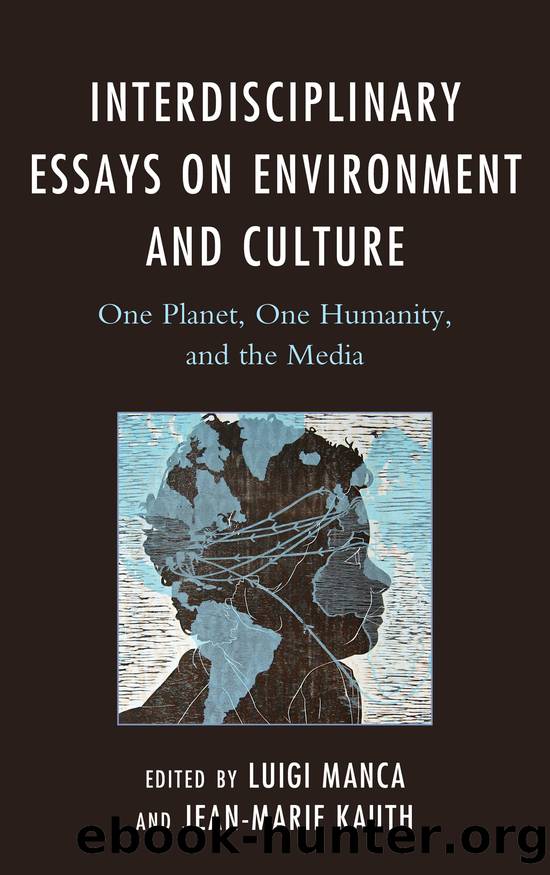
Author:Manca, Luigi,Kauth, Jean-Marie & Jean-Marie Kauth
Language: eng
Format: epub
Publisher: Lexington Books, a division of Rowman & Littlefield Publishers, Inc.
Section III
Environmental Science and the Media
Figure S.3 William Scarlato. 2015. Marsh at Mid-Day, Lisle, Illinois. Oil on Panel. Courtesy of the artist.
Chapter 11
Lost in Translation?
Public Perceptions and Mass Media Coverage of Climate Change Risks
Pierpaolo Duce
Over the last few decades, risk potentials from global warming and their interaction with socioeconomic and ecological processes appeared as a new challenge at a global level (WBGU 2000). Human pressure on nature has never assumed global dimensions before. This has largely depended on two main drivers: (i) an increasing world population, particularly in developing countries, and (ii) rising human expectations connected with specific patterns of production and consumption, particularly in developed countries (WBGU 2000).
A successful and efficient management of the risks related to climate- change impacts should be based on accurate knowledge and identification of risk potentials. As the German Advisory Council on Global Change (WBGU) has asserted for years, in a globally interconnected planet, where disasters can more easily reach global proportions, it is not ethically acceptable to let events take their course and just focus on adaptation to a different climate and reduction of the damage that will occur (2000).
In the past, environmental risks from occurrences like flood, storm, and fire were generally limited to the regional or local level. Nowadays, many of the environmental risks, and in particular the climate-change risk, are inherently global. In this new era, human emissions represent a large proportion of geochemical cycles. Measurements and observation systems can give an accurate depiction of environmental variables, but cannot provide projections on long-term consequences (WBGU 2000). Modeling these consequences at a smaller scale using computer simulation or other analytical tools often does not provide the expected results, due to the nonlinearity of processes in nature and their complex cause-effect patterns (WBGU 2000). Even in the best-case scenario, these uncertainties and inaccuracies can only be partially overcome. The risks inherent in the humanity-environment relationship cross over in complex ways. For example, it is clear that âthe risks of climate change, biodiversity loss, soil degradation, and food insecurityâ are strictly connected with âtypical manifestations of global change such as urbanization, population growth, migration, or impoverishmentâ (WBGU 2000). Political and governance systems also play a key role (WBGU 2000).
The protection of the environment and natural resources is a general concern spread throughout all regions of the globe. However, among environmental issues, climate change is not seen as a big priority, as illustrated by several surveys recently conducted in different countries during the last decades. On average and regardless of the country, approximately 50% of respondents said they worry about climate change âa great dealâ or âa fair amount,â and the remaining 50%, on the other hand, said they worry about it either âa little bit,â or ânot at all.â Most of the public also thinks global warming will not pose âa serious threat to them or their way of life in their lifetimesâ (Newport 2010). The main lessons about the public perception of climate change are that (i) global warming should affect plants
Download
This site does not store any files on its server. We only index and link to content provided by other sites. Please contact the content providers to delete copyright contents if any and email us, we'll remove relevant links or contents immediately.
| Anthropology | Archaeology |
| Philosophy | Politics & Government |
| Social Sciences | Sociology |
| Women's Studies |
Cecilia; Or, Memoirs of an Heiress — Volume 1 by Fanny Burney(32546)
Cecilia; Or, Memoirs of an Heiress — Volume 2 by Fanny Burney(31944)
Cecilia; Or, Memoirs of an Heiress — Volume 3 by Fanny Burney(31929)
The Great Music City by Andrea Baker(31916)
We're Going to Need More Wine by Gabrielle Union(19034)
All the Missing Girls by Megan Miranda(15956)
Pimp by Iceberg Slim(14488)
Bombshells: Glamour Girls of a Lifetime by Sullivan Steve(14057)
For the Love of Europe by Rick Steves(13908)
Norse Mythology by Gaiman Neil(13348)
Talking to Strangers by Malcolm Gladwell(13347)
Fifty Shades Freed by E L James(13232)
Mindhunter: Inside the FBI's Elite Serial Crime Unit by John E. Douglas & Mark Olshaker(9320)
Crazy Rich Asians by Kevin Kwan(9277)
The Lost Art of Listening by Michael P. Nichols(7494)
Enlightenment Now: The Case for Reason, Science, Humanism, and Progress by Steven Pinker(7306)
The Four Agreements by Don Miguel Ruiz(6744)
Bad Blood by John Carreyrou(6611)
Weapons of Math Destruction by Cathy O'Neil(6264)
