In the Lands of Fire and Sun by McArdle Stephens Michele;
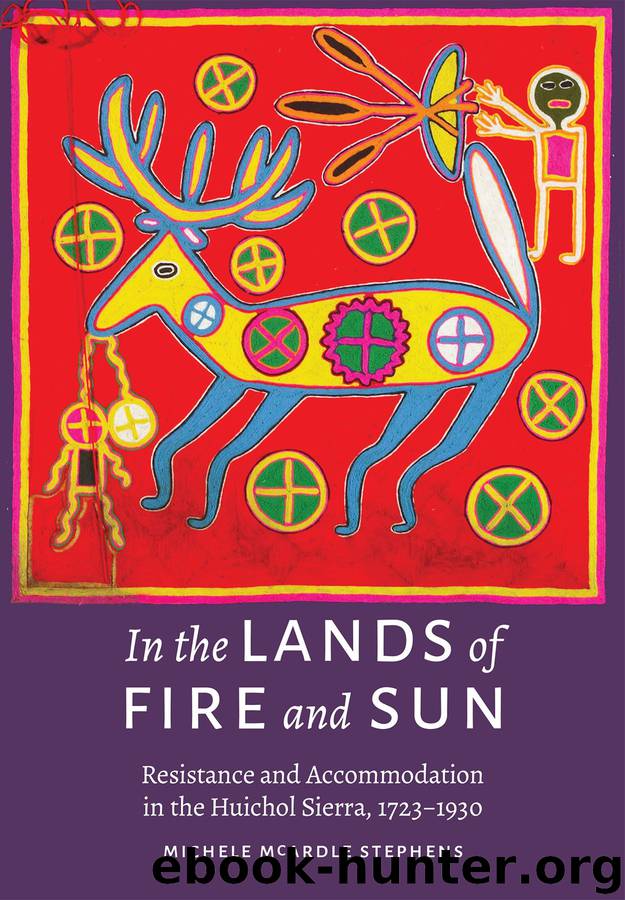
Author:McArdle Stephens, Michele; [McArdle Stephens, Michele]
Language: eng
Format: epub
Tags: HIS025000 History / Latin America / Mexico, SOC021000 Social Science / Ethnic Studies / Native American Studies
ISBN: 5323981
Publisher: UNP - Nebraska
Published: 2018-03-13T16:00:00+00:00
Conclusion
In May 2011 Wixárika leaders acted on a serious situation that had plagued them for several years. The Regional Wixárika Council for the Defense of Wirikuta wrote to President Felipe Calderón and other presidents and peoples of the world to explain the significance of Wirikuta and the devastation that mining would cause if First Majestic Mining Corporation were permitted to operate in the region. Citing their pilgrimages to the area, the importance of the biodiversity for the planet, and Wirikuta’s relevance as home to thousands of Wixárika ancestors, the letter demonstrates Wixárika unity, their continued defense of their homelands and culture, and a willingness to adapt to a changing world to protect their way of life.1
Over the two centuries since independence from Spain, the Huichols faced numerous external threats that they then internalized and responded to in various ways. Some of these experiences and exchanges with outsiders were peaceful; others created strife that exacerbated intertown rivalries or sparked tensions with Spaniards and nonindigenous Mexicans. Because the Huichols were culturally unified, but politically distinct, leadership in each Huichol town determined the best courses of action according to its unique circumstances. As a result, the history of the Huichols is a history of political and ethnic resistance and accommodation in patchwork form, as opposed to a story of unity against a common enemy.
The threats of Spanish colonialism, the burgeoning state, Catholic evangelization, Liberalism, foreign scholars, and revolution endangered Huichol cultural and physical survival in different ways. Liberalism, for instance, threatened the Huichols’ land base, which presented a problem in terms of physical survival and the maintenance of religious customs. As Franciscan missionaries remarked—although they did not realize what they were witnessing—Huichols left religious figurines throughout the landscape, marking their territory in a spiritual sense.2 The presence of Franciscans risked destroying ancient practices that had been passed down over the generations. To be sure, Huichol religious cultures changed as they absorbed some elements of Catholic traditions, but the core beliefs have remained remarkably stable in the face of such threats to their own indigenous traditions.3
Several larger conclusions emerge from the Huichols’ centuries-long struggle to confront the challenges of colonialism, evangelization, and modernization. The first of these concerns political unity among Huichol towns, or in this case, a lack thereof. Despite an extensive spectrum of shared cultural attributes, each Huichol town governs itself and acts of its own accord. For example, during the Porfiriato, Huichol villages chose different strategies to protect their territories; in the end, such a multifaceted approach often produced desired effects.4 Likewise, as revolution erupted throughout Mexico between 1910 and 1920, Huichol villages carefully weighed their options. It is safe to say, then, that in their political disunity they found strength, though this appeared most tenuous in the wake of the revolution. Such strength-through-discord may never have been Huichol leaders’ intention, but in the end it worked for them and protected their interests. Measured responses to difficult circumstances—particularly during the Porfirian era—meant that the Huichols rarely experienced extreme retaliation on the part of the Mexican state.
Download
This site does not store any files on its server. We only index and link to content provided by other sites. Please contact the content providers to delete copyright contents if any and email us, we'll remove relevant links or contents immediately.
| Africa | Americas |
| Arctic & Antarctica | Asia |
| Australia & Oceania | Europe |
| Middle East | Russia |
| United States | World |
| Ancient Civilizations | Military |
| Historical Study & Educational Resources |
Cat's cradle by Kurt Vonnegut(15480)
Pimp by Iceberg Slim(14720)
4 3 2 1: A Novel by Paul Auster(12554)
Underground: A Human History of the Worlds Beneath Our Feet by Will Hunt(12180)
The Radium Girls by Kate Moore(12125)
Wiseguy by Nicholas Pileggi(5879)
The Fire Next Time by James Baldwin(5541)
Perfect Rhythm by Jae(5505)
American History Stories, Volume III (Yesterday's Classics) by Pratt Mara L(5354)
Paper Towns by Green John(5269)
Pale Blue Dot by Carl Sagan(5104)
A Higher Loyalty: Truth, Lies, and Leadership by James Comey(5042)
The Doomsday Machine by Daniel Ellsberg(4583)
The Mayflower and the Pilgrims' New World by Nathaniel Philbrick(4576)
Killers of the Flower Moon: The Osage Murders and the Birth of the FBI by David Grann(4499)
The Sympathizer by Viet Thanh Nguyen(4468)
Too Much and Not the Mood by Durga Chew-Bose(4415)
The Borden Murders by Sarah Miller(4410)
Sticky Fingers by Joe Hagan(4277)
