Imagining the Creole City by Rien Fertel
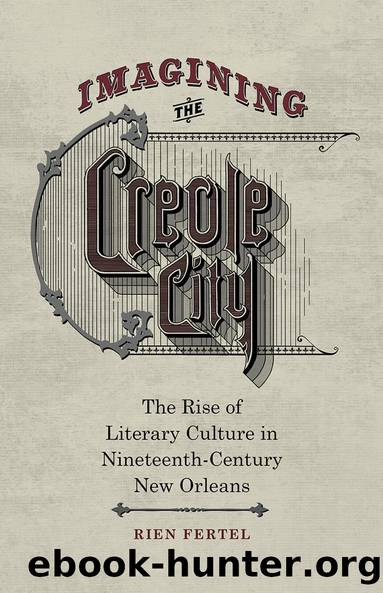
Author:Rien Fertel [Fertel, Rien]
Language: eng
Format: epub
Tags: Social Science, Anthropology, Cultural & Social, History, United States, State & Local, South (AL; AR; FL; GA; KY; LA; MS; NC; SC; TN; VA; WV), Foreign Language Study, Creole Languages
ISBN: 9780807158258
Google: MXeOAwAAQBAJ
Publisher: LSU Press
Published: 2014-11-17T04:06:08+00:00
âIf There Were Women, It Might be More Interestingâ
Knowing her background and the circles she traveled in, it is easy to understand Grace Kingâs Lost Cause stance. However, her vehement defense of the Creoles and the impassioned provincialism that defined her later writing are less conceivable. King, though a New Orleanian by birth, could not and never dared call herself a Creole. But she was brought up as a Creole. Mrs. King, born Sallie Ann Miller but called Mimi, raised her children, as she had been raised, to speak fluent French. (Throughout their adult lives King and her sisters would continue to pepper their English speech and writing with French words and phrases.)61 King remembered Mimi, despite being raised Presbyterian, drinking wine with breakfast and practicing her piano on Sundays, two behaviorisms that suggested that âshe too [was] a good little Creole.â62 Mimi and the King family, like most Creole New Orleanians, refused to honor the Fourth of July holiday. Instead, each year on July 14 the thoroughly creolized Kings sang the Marseillaise and read aloud the French Revolutionâs bill of rights, the Déclaration des droits de lâhomme et du citoyen.63 The Kings sent their four daughters to Catholic schools, thus ensuring that they would get the same Creole education that Mimi had had. Grace attended a typical Gallic-style academy, the Institut St. Louis on Dauphine Street, which she would recall as being âunique in a picturesque wayâ and full of âpeculiarly interestingâ Creole girls. Overseen by the Paris-educated Mme E. Deron, this private institution modeled itself on the Ursuline Convent and stressed a curriculum strong in history and foreign languages, two disciplines in which King excelled then and throughout adulthood. Birthplace, education, and friendships forged in young Grace an allegiance to Creole culture and society that she would accuse Cable of lacking.64 For a Gallic-cultured American, even one who had not yet visited the patrie-mère, âthe routine of life in New Orleansâ could, as King posited, seem perfectly âFrench.â65
In her first visit to Paris, in late autumn 1891, King found the French capitalââthe mother of New Orleans,â in her wordsânot as strange as she had previously imagined. The City of Lights appeared very much like home; King felt the city to be âso naturalâ because âNew Orleans is very much like it.â But as it so naturally does for many Americans, Paris could still hold sway over her. During several lengthy stays the city became for King a place to better understand New Orleans history and her own connection to the Creoles. Paris, Kingâs âgreatest pleasure ground in the world for memory,â allowed her to think like a historian.66 It was in Paris, her newfound home away from home, that Grace King would finalize her first work of history. Contracted by Dodd, Mead and Company to produce a book for their series âThe Makers of America,â King chose as her subject Jean-Baptiste Le Moyne de Bienville, founder of New Orleans. King would be filling in a major gap in
Download
This site does not store any files on its server. We only index and link to content provided by other sites. Please contact the content providers to delete copyright contents if any and email us, we'll remove relevant links or contents immediately.
Cecilia; Or, Memoirs of an Heiress — Volume 1 by Fanny Burney(32558)
The Great Music City by Andrea Baker(32019)
Cecilia; Or, Memoirs of an Heiress — Volume 2 by Fanny Burney(31956)
Cecilia; Or, Memoirs of an Heiress — Volume 3 by Fanny Burney(31942)
We're Going to Need More Wine by Gabrielle Union(19046)
All the Missing Girls by Megan Miranda(16031)
Pimp by Iceberg Slim(14508)
For the Love of Europe by Rick Steves(14121)
Bombshells: Glamour Girls of a Lifetime by Sullivan Steve(14077)
Talking to Strangers by Malcolm Gladwell(13371)
Norse Mythology by Gaiman Neil(13368)
Fifty Shades Freed by E L James(13243)
Mindhunter: Inside the FBI's Elite Serial Crime Unit by John E. Douglas & Mark Olshaker(9344)
Crazy Rich Asians by Kevin Kwan(9292)
The Lost Art of Listening by Michael P. Nichols(7506)
Enlightenment Now: The Case for Reason, Science, Humanism, and Progress by Steven Pinker(7314)
The Four Agreements by Don Miguel Ruiz(6765)
Bad Blood by John Carreyrou(6622)
Weapons of Math Destruction by Cathy O'Neil(6281)
