Ignorance by Peter Burke;
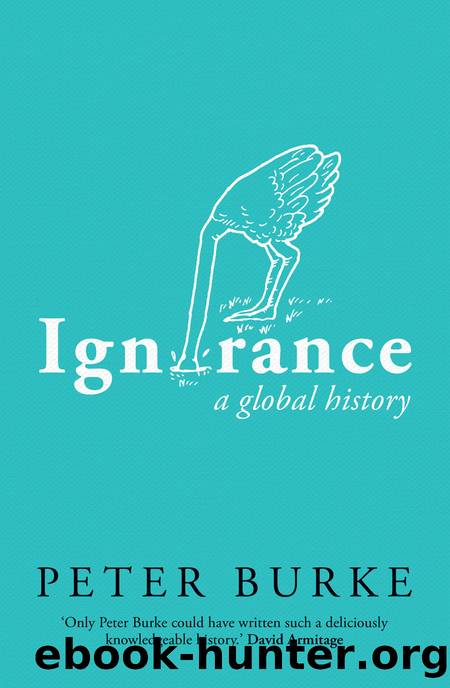
Author:Peter Burke;
Language: eng
Format: epub
ISBN: 9780300271263
Publisher: Yale University Press
LATE MODERN RULERS
The ignorance of modern presidents and prime ministers has become a more topical subject than I could have imagined or feared when I began research for this book. Donald Trump and Jaïr Bolsonaro offer conspicuous examples of ignorance, most obvious and most dangerous in their public response or lack of response to the spreading of the Coronavirus. However, they are not alone in their ignorance. Think, for instance, of the apparent ignorance of the conflicts between Sunni and Shia Muslims on the part of President George W. Bush when the decision was taken to invade Iraq in 2003. The president is also said not to have known where the country was on the map. Today, the consequences of that ignorance are difficult to miss.43
Presidents and prime ministers have usually been trained in a very different way from early modern monarchs. Before entering politics, they have often studied and practised law (like Tony Blair and Barack Obama) or administration (like Emmanuel Macron). They have also had time to acquire political experience in parliaments or town halls before reaching the top, an experience all the more necessary for leaders who are expected to share power with their ministers. Prime ministers have often had personal experience of foreign affairs as diplomats. Otto von Bismarck, for instance, who was chancellor of the new German Empire from 1871 to 1890, had already served as an ambassador abroad. Lord Salisbury, three times British prime minister in the late nineteenth century, had previously served as secretary of state for India and as foreign secretary.
Other leaders had experience in other departments of state. The famous liberal prime minister William Gladstone served four times as chancellor of the Exchequer. Ludwig Erhard was minister of economic affairs under Chancellor Konrad Adenauer before becoming chancellor himself. Amintore Fanfani, who was five times prime minister of Italy, had served as minister of agriculture and minister of economic planning. Some presidents and prime ministers studied economics or even âpolitical scienceâ. Fanfani was a professor of economic history before he entered politics. President Woodrow Wilson was a professor of political science who became president of Princeton University before he moved on to become president of the United States.
However, professional training involves specialization, while the job of president or prime minister requires wide-ranging knowledge. Gaps are inevitable. A study of the use of statistics by the German state notes the fact that in 1920, in the crisis of transition from the German Empire to the Weimar Republic, âthe vacuum of knowledgeâ about the state of the German economy âwas almost completeâ.44 More generally, the economist Frank Cowell has pointed to the problem of âthe lack of omniscienceâ of governments and its influence on the design of tax systems.45 The ignorance of officials allows direct taxes to be evaded. Indirect taxation avoids the problem of individual and corporate dishonesty but has the disadvantage of weighing more heavily on the poor than on the rich.
Ignorance of other countries is not uncommon among political leaders. Nikita Khrushchev, for instance, was described as âalarmingly ignorant of foreign affairsâ.
Download
This site does not store any files on its server. We only index and link to content provided by other sites. Please contact the content providers to delete copyright contents if any and email us, we'll remove relevant links or contents immediately.
| Anthropology | Archaeology |
| Philosophy | Politics & Government |
| Social Sciences | Sociology |
| Women's Studies |
Cecilia; Or, Memoirs of an Heiress — Volume 1 by Fanny Burney(32558)
The Great Music City by Andrea Baker(32018)
Cecilia; Or, Memoirs of an Heiress — Volume 2 by Fanny Burney(31956)
Cecilia; Or, Memoirs of an Heiress — Volume 3 by Fanny Burney(31941)
We're Going to Need More Wine by Gabrielle Union(19046)
All the Missing Girls by Megan Miranda(16023)
Pimp by Iceberg Slim(14506)
For the Love of Europe by Rick Steves(14121)
Bombshells: Glamour Girls of a Lifetime by Sullivan Steve(14073)
Talking to Strangers by Malcolm Gladwell(13370)
Norse Mythology by Gaiman Neil(13363)
Fifty Shades Freed by E L James(13239)
Mindhunter: Inside the FBI's Elite Serial Crime Unit by John E. Douglas & Mark Olshaker(9339)
Crazy Rich Asians by Kevin Kwan(9290)
The Lost Art of Listening by Michael P. Nichols(7506)
Enlightenment Now: The Case for Reason, Science, Humanism, and Progress by Steven Pinker(7311)
The Four Agreements by Don Miguel Ruiz(6765)
Bad Blood by John Carreyrou(6621)
Weapons of Math Destruction by Cathy O'Neil(6279)
