German Resistance against Hitler by von Klemperer Klemens;
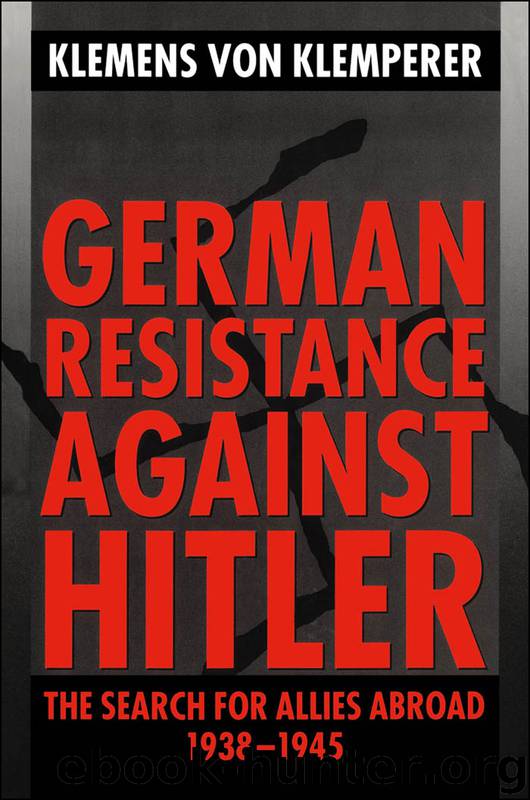
Author:von Klemperer, Klemens;
Language: eng
Format: epub
Publisher: Oxford University Press, Incorporated
Published: 1992-03-08T16:00:00+00:00
10. Despite Casablanca: Feelers from Russia. The Mission of Peter Kleist and the ‘Free Germany’ Movement
There was a certain paradox inherent in the fact that after the Russian victory at Stalingrad Soviet diplomacy should have extended feelers in the direction of the other side and opened up visions of a separate deal not only with the official German regime but also with the Resistance. Through the President’s Special Representative in Berne, Allen W. Dulles, the Americans themselves in the late winter and early spring of 1943 actually got involved in separate negotiations with Prince Max von Hohenlohe, one of the most slippery figures on the international scene who, while an emissary of the SS, also pretended to represent the interests of the Widerstand. It may well be that the Russians got wind of these talks and therefore felt all the more justified in exploring a course independent of the Western Allies.
Of course there were deeper reasons which impelled the Russians to court the Germans. While it would be too strong to talk in terms of a crisis of the Alliance, the latter showed distinct cracks at this time. Cracks do exist within the web of any alliance; but in this case they were sufficiently marked to propel the Russians into action. To begin with, Stalin, as we have seen, had not been a party to the Casablanca decisions, and not until after the landings in Normandy in June 1944 did he unequivocally commit the Soviet Union to the ‘unconditional surrender’ formula.181 Furthermore the Russian leadership had distinct aspirations concerning guarantees for future Russian control of the territories acquired as a result of the Nazi Soviet Pact of 1939, but had found itself consistently rebuffed on this score by the Western Allies. Then there was, of course, the issue, of paramount importance for the Russians, of the opening up of a second front. Stalin had become impatient at what he interpreted to be procrastination on the part of the Western Allies to launch it. Stalin, then, clearly had enough cause to go on a fishing expedition in German waters and thus to explore ways of exerting pressure on the Western Powers.
Our particular task here, however, is to determine, as far as possible, what Stalin’s venture meant in terms of Russia’s policy towards Germany. Had it really been initiated with the objective of reversing the course of Russian foreign policy and to conclude a separate peace, and especially what part did it assign to the forces of resistance in Germany and how, in fact, did it affect them?
The Russian readiness to enter into negotiations with the Third Reich goes back to the autumn of 1942. It was partly through the mediation of the Japanese, who were still maintaining diplomatic relations with the Russians, that the Germans learned that a change of course of the Soviet policy was not outside the realms of possibility.182 In any case, early in December, Dr Peter Kleist, one of Ribbentrop’s chief advisers in the Foreign Office on
Download
This site does not store any files on its server. We only index and link to content provided by other sites. Please contact the content providers to delete copyright contents if any and email us, we'll remove relevant links or contents immediately.
| Africa | Americas |
| Arctic & Antarctica | Asia |
| Australia & Oceania | Europe |
| Middle East | Russia |
| United States | World |
| Ancient Civilizations | Military |
| Historical Study & Educational Resources |
Room 212 by Kate Stewart(5194)
The Crown by Robert Lacey(4874)
Endurance: Shackleton's Incredible Voyage by Alfred Lansing(4858)
The Iron Duke by The Iron Duke(4416)
The Rape of Nanking by Iris Chang(4272)
Joan of Arc by Mary Gordon(4166)
Killing England by Bill O'Reilly(4060)
Say Nothing by Patrick Radden Keefe(4056)
I'll Give You the Sun by Jandy Nelson(3511)
Shadow of Night by Deborah Harkness(3427)
Hitler's Monsters by Eric Kurlander(3408)
Eleanor & Park by Rainbow Rowell(3263)
Blood and Sand by Alex Von Tunzelmann(3252)
Mary, Queen of Scots, and the Murder of Lord Darnley by Alison Weir(3251)
Darkest Hour by Anthony McCarten(3178)
Margaret Thatcher: The Autobiography by Thatcher Margaret(3128)
Book of Life by Deborah Harkness(2992)
Red Famine: Stalin's War on Ukraine by Anne Applebaum(2977)
The One Memory of Flora Banks by Emily Barr(2909)
