Generation Me - Revised and Updated by Jean M. Twenge Ph.D
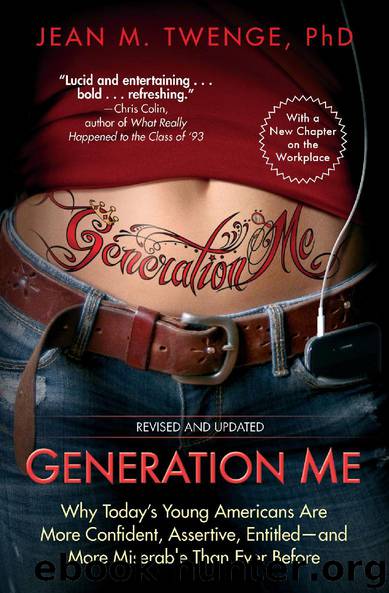
Author:Jean M. Twenge, Ph.D.
Language: eng
Format: epub
Publisher: Atria Books
Before the 1970s, lawyers considered product-liability cases no-wins; they were matters of personal responsibility, and no jury would convict a corporation for the choices of an individual. In 1940, about 20,000 civil lawsuits were heard; by 2012, this had increased more than tenfold—or 1,000%—to around 275,000. In contrast, the number of criminal cases merely doubled over this same period, suggesting that civil lawsuits increased five times faster than they should have. You don’t even have to make a faulty product to get sued. One young man sued the Wake Forest University Law School because his professors used the Socratic method to question him and his classmates, which, he says, caused him fatigue and weight loss.
Many other lawsuits have become the butt of numerous jokes: the woman who sued because her coffee was too hot, or the teens who sued McDonald’s for making them fat. It seems that when anything goes wrong, many people just want to sue whatever company is in reach. This is a foreign concept to the older generation. My uncle Charles, who owned an avocado farm, was using a trencher one weekend when he reached down too quickly and the machine cut off his thumb. Fortunately, doctors were able to reattach the digit. When he got back to work, one of his younger coworkers asked him if he was going to sue the company that made the trencher. “No!” exclaimed Charles. “It was my fault. Why would I sue them?” Although many people still share Charles’s attitude, others think that it’s natural to blame the product when things go wrong.
Of course, at times excuses are real. “Personal responsibility,” a favorite mantra of many conservatives, can’t extend to cases of true racism, sexism, or lack of opportunity. Some true hardships and true explanations exist that deserve to be heard. Chris Colin was heartened when his politically conservative classmate John Doyle readily acknowledged that the playing field isn’t always level. “Hard work is still the fundamental element of success, but some people, based on their situation, their circumstances, can work as hard as they want, but unless somebody steps in and gives them that boost . . . they’re not gonna get to that level. And to say that they can . . . is foolish.”
AN EDUCATION IN EXCUSES
The victim mentality arises full force in schools, where teachers often bear the brunt of these attitudes. Many public school teachers have told me that parents blame them when their children don’t do well in school. Arguing over grades has become commonplace, perhaps because of the self-esteem curriculum and the “you can do anything” mentality. “Kids today have extremely high expectations,” one student said. “And if they receive a D or an F, it always winds up being the teacher’s fault somehow.”
Community college professor Peter Sacks describes students who wouldn’t show up for class or do the required assignments and would then complain when their grades suffered. One student who turned in abysmally written papers complained to the administration about Sacks’s “tough grading.
Download
This site does not store any files on its server. We only index and link to content provided by other sites. Please contact the content providers to delete copyright contents if any and email us, we'll remove relevant links or contents immediately.
| Anthropology | Archaeology |
| Philosophy | Politics & Government |
| Social Sciences | Sociology |
| Women's Studies |
Cecilia; Or, Memoirs of an Heiress — Volume 1 by Fanny Burney(32558)
The Great Music City by Andrea Baker(32019)
Cecilia; Or, Memoirs of an Heiress — Volume 2 by Fanny Burney(31956)
Cecilia; Or, Memoirs of an Heiress — Volume 3 by Fanny Burney(31942)
We're Going to Need More Wine by Gabrielle Union(19046)
All the Missing Girls by Megan Miranda(16029)
Pimp by Iceberg Slim(14508)
For the Love of Europe by Rick Steves(14121)
Bombshells: Glamour Girls of a Lifetime by Sullivan Steve(14077)
Talking to Strangers by Malcolm Gladwell(13370)
Norse Mythology by Gaiman Neil(13367)
Fifty Shades Freed by E L James(13243)
Mindhunter: Inside the FBI's Elite Serial Crime Unit by John E. Douglas & Mark Olshaker(9344)
Crazy Rich Asians by Kevin Kwan(9292)
The Lost Art of Listening by Michael P. Nichols(7506)
Enlightenment Now: The Case for Reason, Science, Humanism, and Progress by Steven Pinker(7314)
The Four Agreements by Don Miguel Ruiz(6765)
Bad Blood by John Carreyrou(6622)
Weapons of Math Destruction by Cathy O'Neil(6281)
