Gender Justice and Legal Pluralities by Sieder Rachel;McNeish John-Andrew; & John-Andrew McNeish
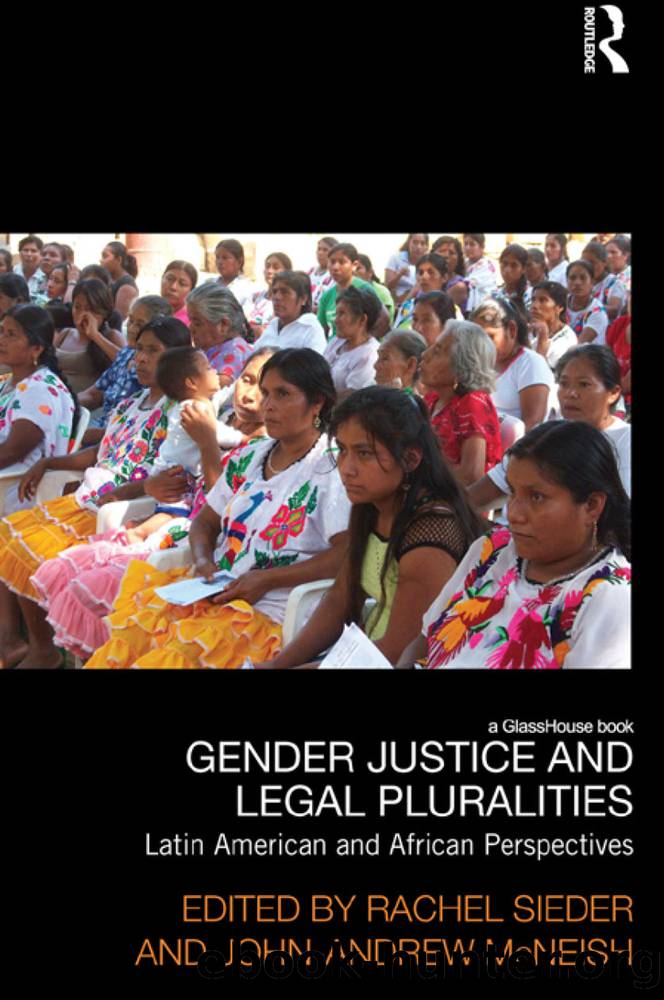
Author:Sieder, Rachel;McNeish, John-Andrew; & John-Andrew McNeish [Sieder, Rachel & McNeish, John-Andrew]
Language: eng
Format: epub
Publisher: Taylor & Francis Group
Published: 2013-08-15T00:00:00+00:00
These documents do not necessarily reflect practice on the ground. Nonetheless, such examples of the codification and reframing of custom within the broader context of efforts to strengthen indigenous autonomy and political participation at least holds out the promise that womenâs rights to participation, dignity, protection and physical integrity will be protected.
Addressing sexual violence within complex legal pluralities
Sexual violence against indigenous women is perpetrated by members of their families and communities and also by state officials and non-indigenous men, involving different scales of power and gendered and racialized inequalities. In theory rape is severely sanctioned within both state penal law and indigenous communal justice, yet in practice sexual violence against indigenous women is particularly ill-attended to within both the state justice system and indigenous community justice (ASIES/OACNUDH 2008). Precisely because it is such a social taboo, it is extremely hard for victims to denounce. Women who have been raped are socially stigmatized and feel enormous shame. A high value is put on virginity in indigenous communities and unmarried women known to have been raped are unlikely to be able to marry. Indeed, settlement of such cases within indigenous law may involve either the marriage of the victim and the man accused of her rape, or the payment of a significant financial sum in compensation. This can be explained in part because what constitutes consensual or non-consensual sex is a grey area: given the taboos against sex outside marriage, rape may be alleged by girls or their families, particularly if sex before marriage has resulted in pregnancy. In such cases indigenous authorities may bring pressure to bear on the boyâs family to ensure that a marriage takes place. In more clear-cut cases, indigenous authorities often suggest a financial payment by the aggressor as compensation to the woman and her family. The logic behind such payments is for women to have some economic means to support themselves as the shame and stigma associated with rape make it unlikely they will be able to marry in the future. Married women who denounce rape often face rejection and even violence from their husbands and families (ECAP-UNAMG 2009). Prevailing social attitudes are also shaped by broader historical legacies and the ways in which sexual violence has been embedded in particular economic and political regimes. Before the armed conflict sexual violence was used by non-indigenous plantation administrators and owners as a tool of ethnic and class domination within the system of agro-export production (Casaús Arzú 2007). During the years of the counterinsurgency the sustained and systematic rape and sexual torture of women and girl children by military and paramilitary forces was used as part of the campaign of terror against the civilian population accused of supporting the guerrilla (REMHI 1998; CEH 2000; ECAP-UNAMG 2009; Consorcio Actoras de Cambio 2006). Quiché, which is over 90 percent Maya Kâicheâ, was one of the areas most affected. The UN Historical Clarification Commission documented 626 massacres in the department, and confirmed that acts of genocide had been carried out by government forces against the indigenous population.
Download
This site does not store any files on its server. We only index and link to content provided by other sites. Please contact the content providers to delete copyright contents if any and email us, we'll remove relevant links or contents immediately.
| Anthropology | Archaeology |
| Philosophy | Politics & Government |
| Social Sciences | Sociology |
| Women's Studies |
Cecilia; Or, Memoirs of an Heiress — Volume 1 by Fanny Burney(32549)
Cecilia; Or, Memoirs of an Heiress — Volume 2 by Fanny Burney(31948)
Cecilia; Or, Memoirs of an Heiress — Volume 3 by Fanny Burney(31932)
The Great Music City by Andrea Baker(31917)
We're Going to Need More Wine by Gabrielle Union(19035)
All the Missing Girls by Megan Miranda(15962)
Pimp by Iceberg Slim(14489)
Bombshells: Glamour Girls of a Lifetime by Sullivan Steve(14058)
For the Love of Europe by Rick Steves(13948)
Talking to Strangers by Malcolm Gladwell(13350)
Norse Mythology by Gaiman Neil(13349)
Fifty Shades Freed by E L James(13233)
Mindhunter: Inside the FBI's Elite Serial Crime Unit by John E. Douglas & Mark Olshaker(9324)
Crazy Rich Asians by Kevin Kwan(9280)
The Lost Art of Listening by Michael P. Nichols(7494)
Enlightenment Now: The Case for Reason, Science, Humanism, and Progress by Steven Pinker(7306)
The Four Agreements by Don Miguel Ruiz(6745)
Bad Blood by John Carreyrou(6612)
Weapons of Math Destruction by Cathy O'Neil(6267)
