From Hitler's Germany to Saddam's Iraq by Scott A. Silverstone
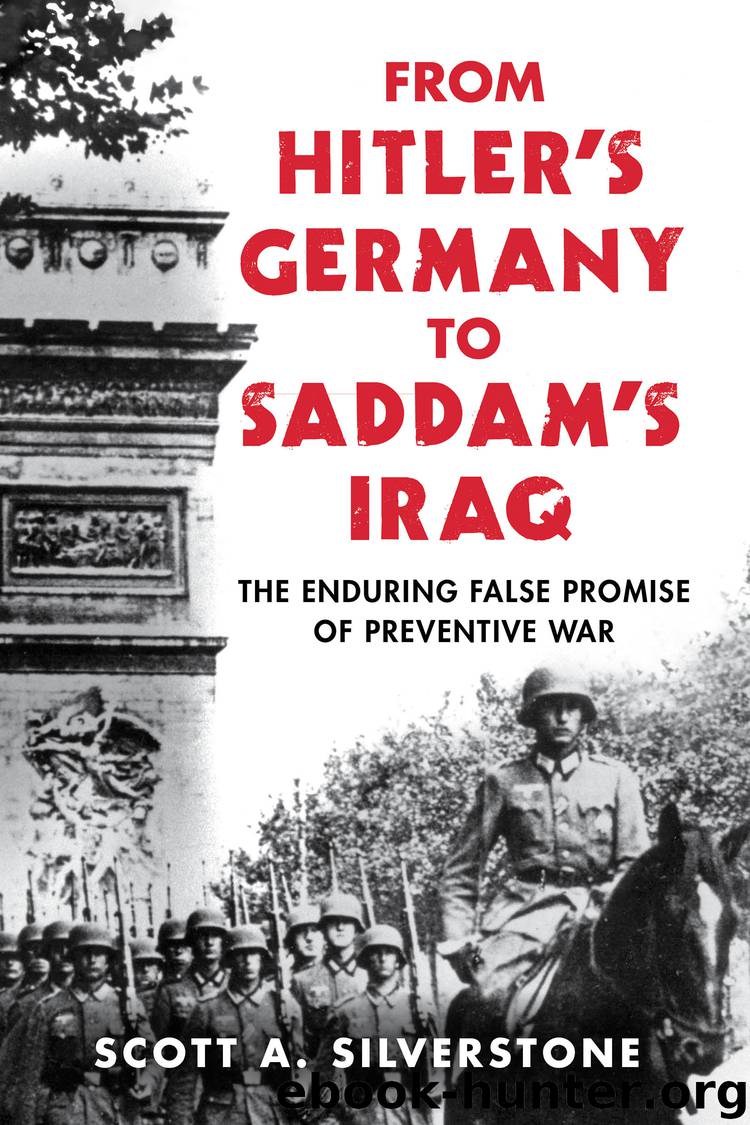
Author:Scott A. Silverstone [Silverstone, Scott A.]
Language: eng
Format: epub
Publisher: Rowman & Littlefield Publishing Group, Inc.
Published: 2018-10-02T16:00:00+00:00
Resist!
Two days after French and Belgian forces rolled into Essen, every political party in the Reichstag, from the Social Democrats to the hard-line nationalists, rallied around Cuno’s response: Germany would defy the invaders with a campaign of passive resistance. Since the German military was powerless to defend the nation, civilian leadership would be issuing the orders for the struggle. The opening move was brilliant: The entire Ruhr coal syndicate—its directors and its advisory personnel, with their detailed files and archives on the coal industry—fled the region as the crisis percolated, taking refuge in the city of Hamburg before the Allies made their move on Essen. For everyone who remained—the industrial barons, the local government authorities, the public works personnel, the miners, the railroad engineers, and the factory workers—Berlin’s orders were explicit. Cooperation with the occupying force was forbidden. They would not mine, process, load, or transport a single chunk of coal for France; and with the German government still paying their wages, the workers now idled by this resistance order rallied behind the cause just as fervently as the wealthy industrialists did.
Within days the occupiers realized that a terrible wrench had been jammed into the gears of their plan. There was no alternative to the supervisory model for the operation, no alternative to putting the Germans themselves to work to pry the reparations loose. The only way to make this “economic occupation” viable was to break the passive resistance campaign. If German authorities refused to cooperate with goodwill, they would be forced to cooperate through coercion. So the Allies turned up the pressure. Thousands of new French and Belgian troops poured into the Ruhr valley; five days after seizing Essen, the force had nearly tripled, from eighteen thousand to almost sixty thousand soldiers that fanned out to occupy new cities and towns.
Download
This site does not store any files on its server. We only index and link to content provided by other sites. Please contact the content providers to delete copyright contents if any and email us, we'll remove relevant links or contents immediately.
| Africa | Americas |
| Arctic & Antarctica | Asia |
| Australia & Oceania | Europe |
| Middle East | Russia |
| United States | World |
| Ancient Civilizations | Military |
| Historical Study & Educational Resources |
Room 212 by Kate Stewart(5209)
The Crown by Robert Lacey(4884)
Endurance: Shackleton's Incredible Voyage by Alfred Lansing(4871)
The Iron Duke by The Iron Duke(4427)
The Rape of Nanking by Iris Chang(4283)
Joan of Arc by Mary Gordon(4179)
Killing England by Bill O'Reilly(4067)
Say Nothing by Patrick Radden Keefe(4064)
I'll Give You the Sun by Jandy Nelson(3523)
Shadow of Night by Deborah Harkness(3440)
Hitler's Monsters by Eric Kurlander(3413)
Eleanor & Park by Rainbow Rowell(3282)
Blood and Sand by Alex Von Tunzelmann(3261)
Mary, Queen of Scots, and the Murder of Lord Darnley by Alison Weir(3260)
Darkest Hour by Anthony McCarten(3190)
Margaret Thatcher: The Autobiography by Thatcher Margaret(3136)
Book of Life by Deborah Harkness(3003)
Red Famine: Stalin's War on Ukraine by Anne Applebaum(2983)
The One Memory of Flora Banks by Emily Barr(2920)
