Exploring Southeastern Archaeology by Galloway Patricia; Peacock Evan; Brain Jeffrey P. & Evan Peacock
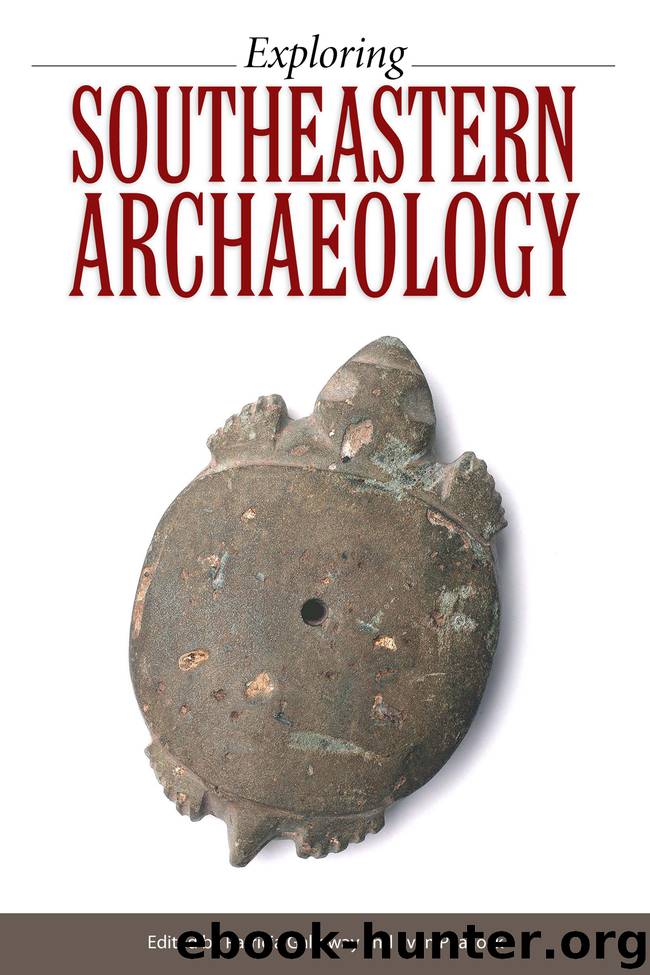
Author:Galloway, Patricia; Peacock, Evan; Brain, Jeffrey P. & Evan Peacock
Language: eng
Format: epub
Publisher: University Press of Mississippi
Published: 2015-04-13T04:00:00+00:00
Acknowledgments
Thanks are due to Sam Brookes, who first drew my attention to the Owl Creek Mounds site and its importance; to Keith Baca and Jim Atkinson, who helped locate artifacts and information about Thelma Mounds; to students in the 1991 and 1992 MSU field schools at Owl Creek and to the field assistants for those projects, Robert Bryan, Chris Davies, Terry Lolley, and John Underwood.
Notes
1. Use of cultural periods (Mississippian, Late Woodland, Middle Woodland) causes considerable awkwardness to cogent writing when one is examining changes that cut across the usually accepted period boundaries, as is the case here. There is no theoretically grounded reason why cultural traits (even those, like shell or grog tempering, that are used to define such periods) should begin or end their temporal distributions at the period boundaries (e.g., Feathers 2006, 2009). Period names are used here for convenience of reference but are not held to represent congeries of traits that share the same time or space distributions.
2. One of the mounds (Chambers’s Mound 5) was said by Johnson and Atkinson (1987:63) to have been removed by terracing between 1935 and 1937, but this terracing occurred south of the east-west road and could not have destroyed Mound 5, which was located well north of the road.
3. Errors were made in transcribing the dimensions of Thelma’s mounds from Chambers’s site form to the table given by Johnson and Atkinson (1987:64). Mound 1, the one tested by Johnson and Atkinson, is recorded by Chambers as 126 ft long, no width given, 10 ft high; Mound 2 was 72 × 63 × 6 ft; Mound 3 was 135 × 66 × 5.5 ft, with this height measured at the west end; Mound 4 was 95 × 55 × 5.5 ft, with a length of 75 ft given for the top; Mound 5 was 25 ft in diameter and 4 ft high (Chambers’s 1935 site card, MDAH site file).
Download
This site does not store any files on its server. We only index and link to content provided by other sites. Please contact the content providers to delete copyright contents if any and email us, we'll remove relevant links or contents immediately.
| Anthropology | Archaeology |
| Philosophy | Politics & Government |
| Social Sciences | Sociology |
| Women's Studies |
The Great Music City by Andrea Baker(32794)
Cecilia; Or, Memoirs of an Heiress — Volume 1 by Fanny Burney(32666)
Cecilia; Or, Memoirs of an Heiress — Volume 2 by Fanny Burney(32030)
Cecilia; Or, Memoirs of an Heiress — Volume 3 by Fanny Burney(32013)
We're Going to Need More Wine by Gabrielle Union(19129)
All the Missing Girls by Megan Miranda(16448)
Pimp by Iceberg Slim(14723)
For the Love of Europe by Rick Steves(14701)
Bombshells: Glamour Girls of a Lifetime by Sullivan Steve(14165)
Norse Mythology by Gaiman Neil(13492)
Talking to Strangers by Malcolm Gladwell(13481)
Fifty Shades Freed by E L James(13315)
Mindhunter: Inside the FBI's Elite Serial Crime Unit by John E. Douglas & Mark Olshaker(9456)
Crazy Rich Asians by Kevin Kwan(9372)
The Lost Art of Listening by Michael P. Nichols(7575)
Enlightenment Now: The Case for Reason, Science, Humanism, and Progress by Steven Pinker(7379)
The Four Agreements by Don Miguel Ruiz(6865)
Bad Blood by John Carreyrou(6695)
Weapons of Math Destruction by Cathy O'Neil(6409)
