Ecologies of Empire in South Asia, 1400-1900 by Sumit Guha;
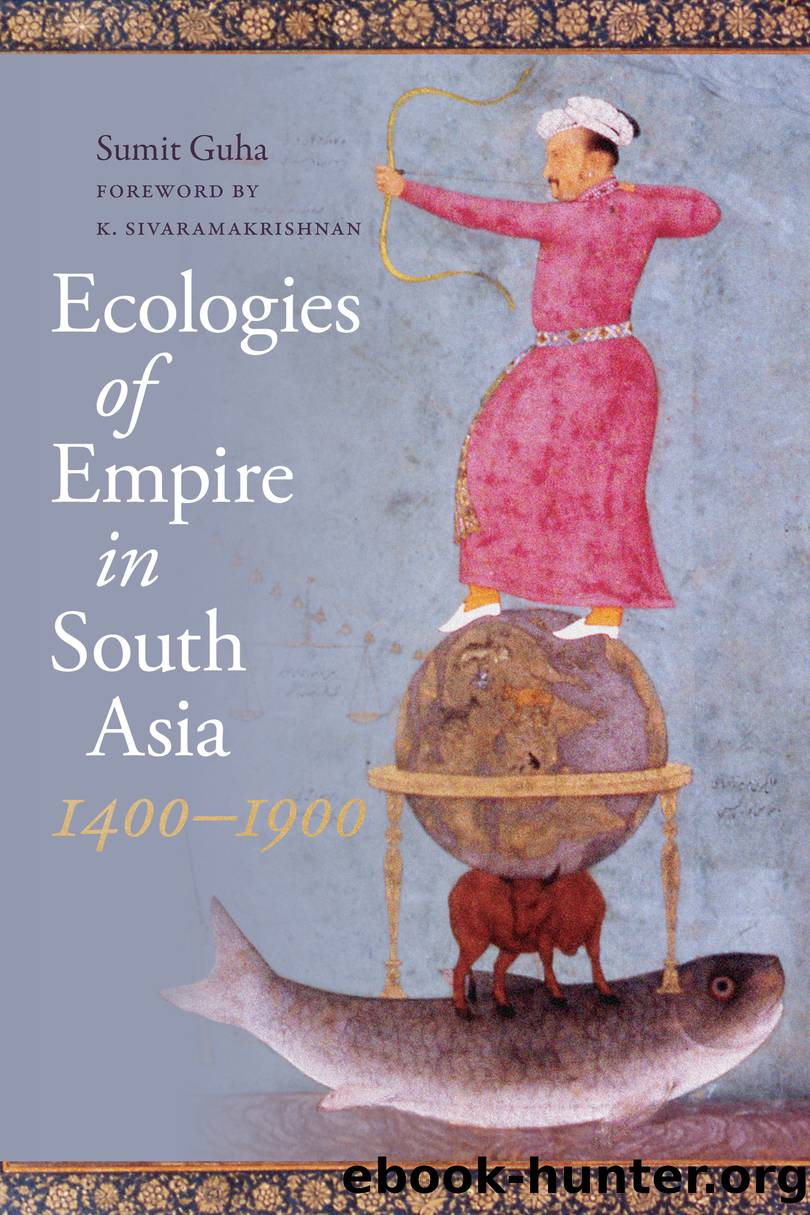
Author:Sumit Guha;
Language: eng
Format: epub
Publisher: Lightning Source Inc. (Tier 3)
* * *
South Asia was long thought to be a land of territorially fixed, autonomous villages. This chapter has demonstrated that the village was the result of a complex historical interaction of states, communities, and ecosystems. But people and land can be recalcitrant, so governments often failed to achieve the transparency they desired. The chapter has additionally explored alternative lifeways pursued through and around the same lands as well as the importance of untilled lands, spontaneous tree growth, and wild foods in everyday life. Finally, it has included those transients and nomads who did not fit in the village frame. Their circuits, however, intersected in time and space with many villages in ways that were both symbiotic with and predatory upon peasant farming. Empires and kingdoms, domains and fiefs all ultimately depended on the extraction of many different resources from the many anthropogenic environments of Asia. It took the skill and toil of millions of peasants, herdsmen and foragers, and artisans and traders to produce those resources. Their production required all of them to each develop unconscious resource maps that told them where unused dung might be collected, where wild tubers could be found, which barks yielded dyes and which were medicinal, which trees were in fruit, and when or where to cut the long axle of a peasant cart. But production possibilities varied by time and season across the many ecological zones of the subcontinent. They also varied depending on the range of and fluctuation in political authority. Governments in South Asia have been called âsoft states.â But they were far from universally emollient with all; rather, they were soft with the hard and hard with the soft. These encounters were repeated through centuries. The next chapter considers the effects of conflict upon the environment at a regional and village scale.
Download
This site does not store any files on its server. We only index and link to content provided by other sites. Please contact the content providers to delete copyright contents if any and email us, we'll remove relevant links or contents immediately.
| Anthropology | Archaeology |
| Philosophy | Politics & Government |
| Social Sciences | Sociology |
| Women's Studies |
Cecilia; Or, Memoirs of an Heiress — Volume 1 by Fanny Burney(32563)
The Great Music City by Andrea Baker(32024)
Cecilia; Or, Memoirs of an Heiress — Volume 2 by Fanny Burney(31962)
Cecilia; Or, Memoirs of an Heiress — Volume 3 by Fanny Burney(31945)
We're Going to Need More Wine by Gabrielle Union(19055)
All the Missing Girls by Megan Miranda(16053)
Pimp by Iceberg Slim(14523)
For the Love of Europe by Rick Steves(14177)
Bombshells: Glamour Girls of a Lifetime by Sullivan Steve(14081)
Norse Mythology by Gaiman Neil(13379)
Talking to Strangers by Malcolm Gladwell(13376)
Fifty Shades Freed by E L James(13247)
Mindhunter: Inside the FBI's Elite Serial Crime Unit by John E. Douglas & Mark Olshaker(9350)
Crazy Rich Asians by Kevin Kwan(9297)
The Lost Art of Listening by Michael P. Nichols(7510)
Enlightenment Now: The Case for Reason, Science, Humanism, and Progress by Steven Pinker(7316)
The Four Agreements by Don Miguel Ruiz(6770)
Bad Blood by John Carreyrou(6626)
Weapons of Math Destruction by Cathy O'Neil(6285)
