Early English Queens, 650850 by Stefany Wragg;
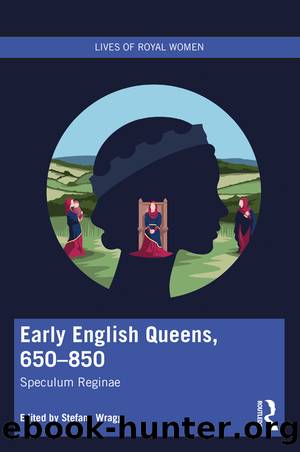
Author:Stefany Wragg; [Wragg;, Stefany]
Language: eng
Format: epub
ISBN: 9780367335762
Publisher: TaylorFrancis
Published: 2022-09-15T00:00:00+00:00
Cynethryth and Wigmund, Ãlfflæd and Wigstan
The branch of the Mercian royal family under Coenwulf did not continue long in the male line. After Coenwulfâs death, his brother Ceolwulf reigned, but was deposed by Beornwulf after two short years. In 827, Wiglaf came to the throne of Mercia. Once again, the connections of his wife appear to have been crucial to securing support for his claim.
Wiglafâs own background is difficult to place. Richard Northâs work dating Beowulf to the ninth century suggests that Wiglafâs family may have originated in the area around Breedon and Repton.67 No pedigree survives for Wiglaf, but texts relating to his son Wigmund and grandson Wigstan do suggest royal connections in their genealogies â but probably via the maternal line. Cynethrythâs name, the same of that as the queen of Offa, likely indicates a connection with that family. If so, she descended from a powerful family who may have acted as kingmakers both in the past and in her lifetime.
As such, Cynethrythâs ancestry was, if anything, more valuable as a legitimising factor in the succession than that of her husband. Like the queens of Coenwulf and Offa before her, she too features in the documentary record of charters. She attests two surviving charters of Wiglaf, both of which survive in ninth-century copies.68 In these two charters, the first dated to 831 and the second dated to 836, although she is not the first signatory, she is among the highest: in the earlier, in favour of Wulfred of Canterbury, she witnesses following Wiglaf, the king, and Wulfred, the archbishop and recipient of the land; in the latter, she is second only to her husband. Whilst this position is not unusual for a queen, it reconfirms her high status as wife of the king, and mother of the presumptive heir.
The heir occupies a much lower position in the charter witnesses than his mother the queen. In the same charter of 831, Wigmund witnesses: Ego Wigmund filius regis consensi et subscripsi (âI, Wigmund, son of the king, consent and subscribeâ). He witnesses behind the king, the archbishop of Canterbury, the queen, and several men identified as dux in the witness list, perhaps pegging his status as heir to the throne as being of less importance than the men currently in power in the region. Cynethrythâs signature before the leading men of the kingdom reinforces the importance of her position as a wife, advisor and mother to any possible heirs.
Cynethryth must be regarded as at least partially successful as a mother in notably difficult circumstances. In 829, early in his reign, Wiglaf was expelled from the Mercian throne by Ecgberht of Wessex; historical records differ on whether or not Wiglafâs restoration later in 830 was one of the Mercian king accepting his overlordship as a tributary king, or, as in the Anglo-Saxon Chronicle, merely a restoration in his own right, with a period of increased cooperation between the former enemies of Mercia and Wessex.69 Wigmundâs survival added to the stability of
Download
This site does not store any files on its server. We only index and link to content provided by other sites. Please contact the content providers to delete copyright contents if any and email us, we'll remove relevant links or contents immediately.
Room 212 by Kate Stewart(5205)
The Crown by Robert Lacey(4879)
Endurance: Shackleton's Incredible Voyage by Alfred Lansing(4863)
The Iron Duke by The Iron Duke(4420)
The Rape of Nanking by Iris Chang(4276)
Joan of Arc by Mary Gordon(4172)
Killing England by Bill O'Reilly(4065)
Say Nothing by Patrick Radden Keefe(4062)
I'll Give You the Sun by Jandy Nelson(3517)
Shadow of Night by Deborah Harkness(3432)
Hitler's Monsters by Eric Kurlander(3412)
Eleanor & Park by Rainbow Rowell(3272)
Mary, Queen of Scots, and the Murder of Lord Darnley by Alison Weir(3257)
Blood and Sand by Alex Von Tunzelmann(3257)
Darkest Hour by Anthony McCarten(3186)
Margaret Thatcher: The Autobiography by Thatcher Margaret(3133)
Book of Life by Deborah Harkness(2997)
Red Famine: Stalin's War on Ukraine by Anne Applebaum(2979)
The One Memory of Flora Banks by Emily Barr(2912)
