Dominion: History of England by Peter Ackroyd
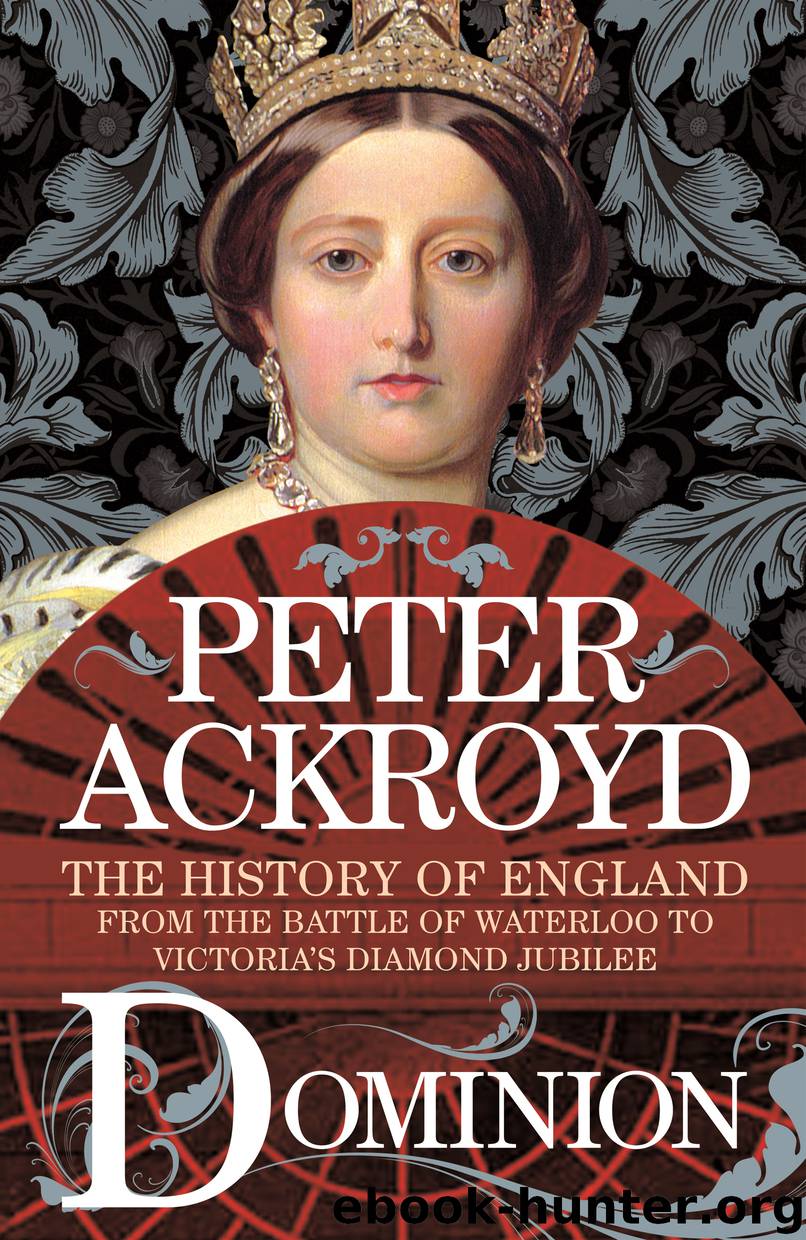
Author:Peter Ackroyd
Language: eng
Format: epub
Publisher: St. Martin's Press
16
A dark world
The life of 1855 was the high water mark of mid-Victorian society. This was the period when Anglo-Saxon studies were revived, when Tennyson derived inspiration from the Arthurian epics and Pugin from the Middle Ages. All were looking backwards at earlier societies that were characterized by an organic unity, a collective will and a shared piety. Many of the most notable writers of the period – Ruskin, Morris, Carlyle – looked back with nostalgia to feudal or semi-feudal ages of England when hierarchy and authority were regarded with reverence. It was all a matter of myth, of course, but the myth mattered. Life mattered. Life was earnest. The High Church revival with John Keble and Edward Pusey shared a rapport with medieval England. At the opening of Macaulay’s History of England, published in 1848, he states: ‘I will relate … how from the auspicious union of order and freedom sprang a prosperity of which the annals of human affairs had furnished no example…’ But the triumph of competitive enterprise and individual attainment was dismissed by Carlyle as ‘Pig Prosperity’. No epoch was so beset by energy and by doubt.
Walter Bagehot, who never did cease to comment on such matters, said that ‘in a period of rapid change such as is confronting men today, the preservation of such continuity with the past, with the standards they are used to, and the social world where they can find their way about, is essential…’ The Victorians were not always talking about Malory or medieval monasteries, but they were still looking for the same permanence, the same security and the same stability. At the Royal Academy Exhibition in 1855 the paintings praised were resplendent with ‘energy’, ‘passion’ and ‘feeling’. George Eliot was talking with a contemporary on God, Immortality and Duty, which may be considered the Holy Trinity of the period. She ‘pronounced with terrible earnestness how inconceivable was the first, how unbelievable the second, and yet how peremptory and absolute the third’. We may think once more of the Crimean soldier fiercely slashing in the fog.
The picture of the family, at a dining table generally of mahogany, lingered well into the Edwardian age. There was no picture without a frame, no chair without upholstery, no screen or curtain without a tassel, no table without a cover, no box without its little objects, no maid without her pinny. Domestic servants became a necessity, and when Seebohm Rowntree completed a survey in York, he reckoned the keeping of at least one servant as a distinctive mark of the middle class as opposed to the lower class. There were visitings and dinings out, and when the moon was high they were known as ‘moons’; hospitality was a social duty, and those who did not mingle with their neighbours were considered to be very odd indeed. You greeted acquaintances with two fingers of the outstretched hand; good friends and family were offered three. Choral societies and learned institutes, social clubs and sporting associations might be
Download
This site does not store any files on its server. We only index and link to content provided by other sites. Please contact the content providers to delete copyright contents if any and email us, we'll remove relevant links or contents immediately.
| Africa | Americas |
| Arctic & Antarctica | Asia |
| Australia & Oceania | Europe |
| Middle East | Russia |
| United States | World |
| Ancient Civilizations | Military |
| Historical Study & Educational Resources |
Room 212 by Kate Stewart(5124)
The Crown by Robert Lacey(4817)
Endurance: Shackleton's Incredible Voyage by Alfred Lansing(4783)
The Iron Duke by The Iron Duke(4357)
The Rape of Nanking by Iris Chang(4214)
Joan of Arc by Mary Gordon(4115)
Killing England by Bill O'Reilly(4005)
Say Nothing by Patrick Radden Keefe(3988)
I'll Give You the Sun by Jandy Nelson(3448)
Shadow of Night by Deborah Harkness(3369)
Hitler's Monsters by Eric Kurlander(3343)
Mary, Queen of Scots, and the Murder of Lord Darnley by Alison Weir(3210)
Blood and Sand by Alex Von Tunzelmann(3205)
Eleanor & Park by Rainbow Rowell(3178)
Darkest Hour by Anthony McCarten(3133)
Margaret Thatcher: The Autobiography by Thatcher Margaret(3083)
Book of Life by Deborah Harkness(2939)
Red Famine: Stalin's War on Ukraine by Anne Applebaum(2934)
The One Memory of Flora Banks by Emily Barr(2864)
