Disability and Isaiah's Suffering Servant by Schipper Jeremy;
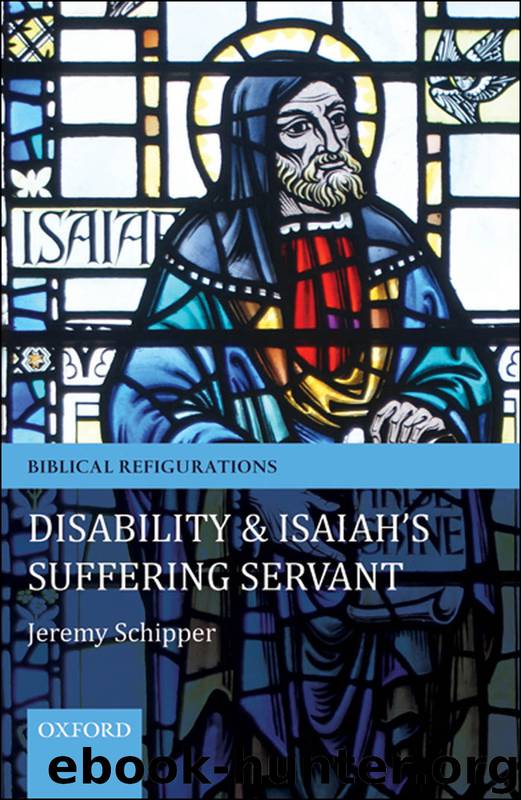
Author:Schipper, Jeremy;
Language: eng
Format: epub
Publisher: Oxford University Press
Published: 2011-04-08T04:00:00+00:00
Conclusion: the invention of the able-bodied suffering servant
The servant in Isaiah 53 has a number of traits and experiences other than disability. Thus, while disability imagery saturates this passage, later biblical texts tend to draw on these other traits. Other Hebrew Bible texts may connect the servant to the experience of righteous martyrs (Isa 57:1; Dan 12:1–3). Likewise, some recent scholarship also interprets Isaiah 53 in relation to violence experienced by contemporary oppressed communities. Jorge Pixley interprets the servant’s suffering as violence inflicted upon exiles that resist the Babylonian empire. He connects the political violence in Isaiah 53 to the political violence in Nicaragua.41 Similarly, François Kabasele Lumbala and Cyris Heesuk Moon connect the servant’s suffering to violence experienced by communities in Africa and Asia respectively.42 Nevertheless, the specific examples of violence focus on violence inflicted on the able-bodied in these comparisons of Isaiah 53 to contemporary communities.
In fact, only one reference to people with disabilities appears in these essays. Lumbala recounts the story of a mother who goes to prison to serve her oldest daughter’s sentence. During her incarceration, she worries that she cannot care for two of her other children described as ‘epileptic’ and ‘mentally retarded’ respectively.43 Lumbala does not compare the servant to the children with disabilities, but rather their elderly, but otherwise able-bodied, mother. As with their ancient typological counterparts, the servant’s disability disappears in these contemporary comparisons.
Yet, within ancient typological interpretations, the servant was not only positioned as an example of an able-bodied sufferer. Certain New Testament texts quote isolated verses from Isaiah 53 as examples of various other typological figures such as a healer, an innocent one, or a martyr. Along with early translations of Isaiah 53, these typologies show how quickly interpretations can move away from our passage’s focus on the servant’s experience of disability. At the same time, the ancient translations and quotations of our passage do not suggest that there was a unified interpretation of the servant as an able-bodied sufferer that began with Isaiah 53 itself. Instead, Isaiah 53 describes the servant as a figure with disabilities while other biblical texts incorporate the servant into a variety of typologies that have little to do with disability.
Nor does this mean that interpretations involving the servant began with a unified understanding of the servant as the typical able-bodied sufferer. That would not account for the diversity among early typological uses of the servant. In other words, the idea of the able-bodied suffering servant does not naturally arise from Isaiah 53’s depiction of the servant. Rather, this idea emerges slowly from a long process of interpretation in which the servant becomes increasingly used as an example in typologies of able-bodied suffering.
Eventually, the servant becomes more than an example of a suffering type. Instead, he becomes identified as a suffering character independent of not only his disability but also his typological framework. Once the servant is not understood as representing a typological figure nor as having a disability, interpreters are free to identify him as biblical characters traditionally understood as suffering but able-bodied.
Download
This site does not store any files on its server. We only index and link to content provided by other sites. Please contact the content providers to delete copyright contents if any and email us, we'll remove relevant links or contents immediately.
| Anthropology | Archaeology |
| Philosophy | Politics & Government |
| Social Sciences | Sociology |
| Women's Studies |
Cecilia; Or, Memoirs of an Heiress — Volume 1 by Fanny Burney(32542)
Cecilia; Or, Memoirs of an Heiress — Volume 2 by Fanny Burney(31939)
Cecilia; Or, Memoirs of an Heiress — Volume 3 by Fanny Burney(31928)
The Great Music City by Andrea Baker(31915)
We're Going to Need More Wine by Gabrielle Union(19032)
All the Missing Girls by Megan Miranda(15931)
Pimp by Iceberg Slim(14479)
Bombshells: Glamour Girls of a Lifetime by Sullivan Steve(14046)
For the Love of Europe by Rick Steves(13883)
Talking to Strangers by Malcolm Gladwell(13342)
Norse Mythology by Gaiman Neil(13340)
Fifty Shades Freed by E L James(13229)
Mindhunter: Inside the FBI's Elite Serial Crime Unit by John E. Douglas & Mark Olshaker(9313)
Crazy Rich Asians by Kevin Kwan(9273)
The Lost Art of Listening by Michael P. Nichols(7487)
Enlightenment Now: The Case for Reason, Science, Humanism, and Progress by Steven Pinker(7305)
The Four Agreements by Don Miguel Ruiz(6744)
Bad Blood by John Carreyrou(6610)
Weapons of Math Destruction by Cathy O'Neil(6261)
