Denny's Trek by Cecil E. Denny
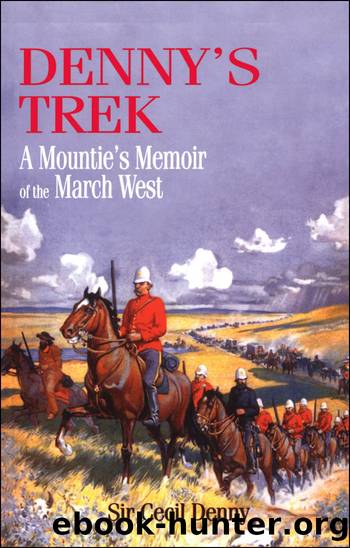
Author:Cecil E. Denny
Language: eng
Format: epub
ISBN: 978-1-926613-04-8
Publisher: Heritage House
Published: 2010-12-31T16:00:00+00:00
Built in 1795 as a Hudson’s Bay Company trading post, Fort Edmonton became an important fur-trading centre. This photo shows the interior of the fort as it looked in the 1870s.
Charles Horetzky
The Chief Factor expressed himself as much gratified over the change in the country since our arrival. The truce between the different Indian tribes enabled them to carry on their vocation of hunting without fear of attack. He gave us due credit for this, as well as for ending the lawlessness that had prevailed prior to our advent.
He pointed out to me logs of the fort both inside and out pitted by bullet marks made when bands of Indians engaged in drunken warfare. A small brass field gun of ancient pattern in each bastion commanded the outside walls. In the front gate was a small log-shuttered window through which goods had been passed in exchange for furs when some southern tribe, such as the Blackfeet, came to trade. On these occasions, should any Crees be camped near, they were likely to take shelter in the fort until the departure of their hereditary enemies, who were eager for their scalps. Peace and contentment had now supplanted all this.
Piles of dried and frozen fish for dog feed were also stored in the fort, and quantities of dried buffalo meat taken in trade during the summer. Numerous large flat-bottomed boats, called “bateaux” by the half-breeds, were under construction. They would be used to transport furs, pemmican, etc., to Hudson Bay in the spring. These scows were of several tons’ capacity. By way of the Saskatchewan they journeyed from Edmonton to Lake Winnipeg, then via the Nelson River to the Bay. They returned to Edmonton from York Factory with fresh stocks of supplies and trade goods just before winter set in, the round trip occupying from the breakup of the river in the spring to its closing again in the fall.
Hardy crews of Indians or half-breeds manned what was called a brigade, numbering 20 or more boats. Portages were frequent, and on the return journey against the stream, the boats were towed for hundreds of miles by gangs of men with “tracking” lines, working in relays of a few hours each.
These voyageurs were a stalwart type, peculiar to the service of the Hudson’s Bay Company, certain families having followed the calling for generations. They were inured to water, in which most of their summer working hours were spent. They were satisfied with gaudy scarves and blankets, tobacco, and a little flour and sugar, or other goods occasionally, as pay for their work. Game and fish were plentiful everywhere en route, so that they had always an abundance of good sustaining food. The winters they spent about the different Hudson’s Bay Company posts in dancing, feasting, and drinking, when they could procure liquor. Occasionally they went south to hunt buffalo.
Download
This site does not store any files on its server. We only index and link to content provided by other sites. Please contact the content providers to delete copyright contents if any and email us, we'll remove relevant links or contents immediately.
| Africa | Americas |
| Arctic & Antarctica | Asia |
| Australia & Oceania | Europe |
| Middle East | Russia |
| United States | World |
| Ancient Civilizations | Military |
| Historical Study & Educational Resources |
Cat's cradle by Kurt Vonnegut(15441)
Pimp by Iceberg Slim(14666)
4 3 2 1: A Novel by Paul Auster(12513)
Underground: A Human History of the Worlds Beneath Our Feet by Will Hunt(12145)
The Radium Girls by Kate Moore(12093)
Wiseguy by Nicholas Pileggi(5841)
The Fire Next Time by James Baldwin(5503)
Perfect Rhythm by Jae(5461)
American History Stories, Volume III (Yesterday's Classics) by Pratt Mara L(5337)
Paper Towns by Green John(5247)
Pale Blue Dot by Carl Sagan(5081)
A Higher Loyalty: Truth, Lies, and Leadership by James Comey(5017)
The Doomsday Machine by Daniel Ellsberg(4545)
The Mayflower and the Pilgrims' New World by Nathaniel Philbrick(4540)
Killers of the Flower Moon: The Osage Murders and the Birth of the FBI by David Grann(4488)
The Sympathizer by Viet Thanh Nguyen(4445)
Too Much and Not the Mood by Durga Chew-Bose(4386)
The Borden Murders by Sarah Miller(4381)
Sticky Fingers by Joe Hagan(4255)
