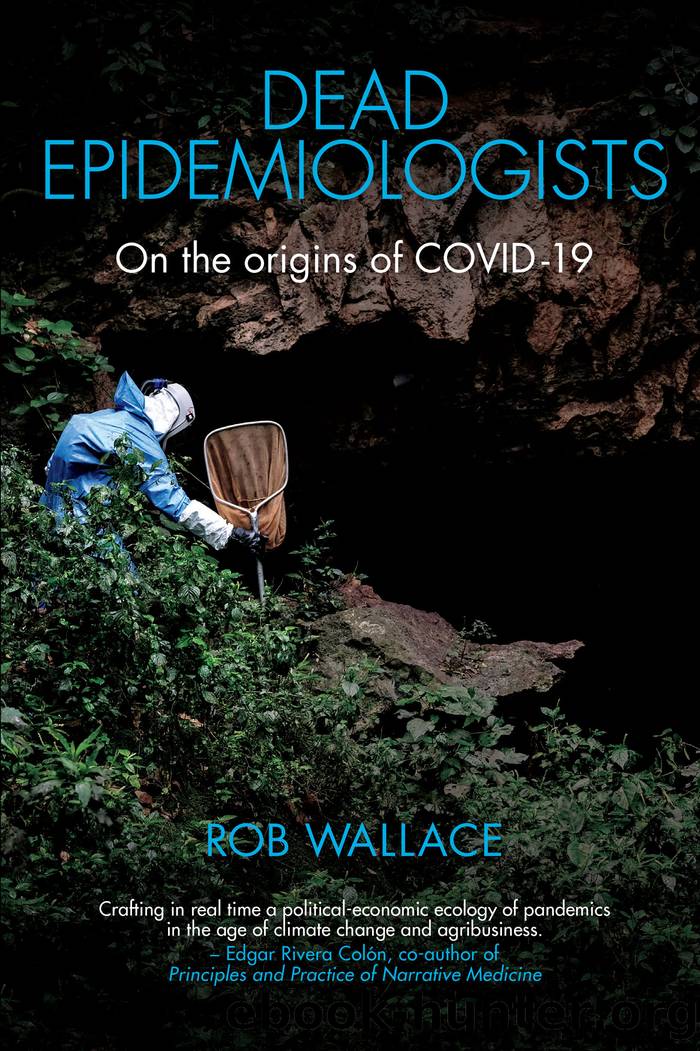
Dead Epidemiologists: On the Origins of COVID-19 by Rob wallace
Author:Rob wallace
Language: eng
Format: epub
Publisher: NYU Press
Published: 2020-11-15T00:00:00+00:00
To the Bat Cave
The tantric egg is the magma of all possibilities, the chaotic content looking for shape. The general intellect is the content, semio-capitalism is the gestalt, the generator of coded forms: paradigmatic captureâ¦. Who will decide the actualization of one possibility or another?
â FRANCO BERARDI (2017)
I co-authored our finale for the first half of 2020âeach week feeling a month longâwith public health ecologist Deborah Wallace.
PEOPLE IN THE CITY OF Foshan in Guangdong province began falling ill with a disease that led to serious lung damage.584 The illness was labeled, appropriately, Severe Acute Respiratory Syndrome, or SARS for short. In 2002â2003, SARS spread down the Kowloon Peninsula to Hong Kong and throughout Chinaâs southern provinces. It hopscotched internationally, with significant caseloads popping up in, among other places, Hanoi and Toronto, ultimately infecting over eight thousand people and killing 10 percent of those infected. The pathogen causing SARS was identified as part of a clade of coronavirus, the betacoronaviruses, different from the alphacoronaviruses, which cause some of the more severe common colds.
Epidemiologists in China went to work to find the source of this novel coronavirus.
Samples taken from wild animals on sale at the live market in Foshan yielded the virus in palm civets and a few other individual animals, including a single raccoon dog.585 When these species were sampled in the wild, however, the SARS virus wasnât detected. Previous sampling of insectivorous bats had shown that they harbor a variety of viruses and research teams visited caves in the countryside.586 Several bat species there had their guano sampled and, surely a fun time for all, their throats and anuses swabbed. The bats harbored not only a virus with very high consonance with the SARS genome, particularly the early human cases, but a slew of related coronaviruses that were dubbed âSARS-likeâ or SL.587 Rhinolophid bats would also serve as a source for the Middle East Respiratory Syndrome (MERS)-CoV that emerged in Saudi Arabia a decade later.588 Several milder human strains have also been identified: 229E, HKU1, NL63, and OC43.589
One of the species that most consistently harbored SARS and SL viruses was the Chinese horseshoe bat, or Rhinolophus sinicus.590 This bat has a very wide range from Nepal through southern China and metapopulations large enough that it isnât considered endangered.591 It lives mainly in caves and stays away from cities.592 R. sinicus lives in groups of about a dozen to several hundred. Little has been published in English about its natural history.593 The genus encompasses one species that is monogamous and one that is polyandrous, wherein only a few males in a colony mate with multiple females. The monogamous species is considered an oddity and most related species, many of whom also host SL, are assumed to be polyandrous.594
All bats in the genus Rhinolophus hibernate. Their reproductive cycles appear linked to both the hibernation and immunological status.595 Reproductionâs seasonality imprints upon âneuroimmunological reactivitiesâ or how responsive the batâs neurons are to immunological intervention. So these reactivities arenât just a matter of some inherent properties of the different kinds of neurons.
Download
This site does not store any files on its server. We only index and link to content provided by other sites. Please contact the content providers to delete copyright contents if any and email us, we'll remove relevant links or contents immediately.
| Administration & Medicine Economics | Allied Health Professions |
| Basic Sciences | Dentistry |
| History | Medical Informatics |
| Medicine | Nursing |
| Pharmacology | Psychology |
| Research | Veterinary Medicine |
Periodization Training for Sports by Tudor Bompa(8366)
Why We Sleep: Unlocking the Power of Sleep and Dreams by Matthew Walker(6811)
Paper Towns by Green John(5269)
The Immortal Life of Henrietta Lacks by Rebecca Skloot(4662)
The Sports Rules Book by Human Kinetics(4478)
Dynamic Alignment Through Imagery by Eric Franklin(4305)
ACSM's Complete Guide to Fitness & Health by ACSM(4109)
Kaplan MCAT Organic Chemistry Review: Created for MCAT 2015 (Kaplan Test Prep) by Kaplan(4074)
Livewired by David Eagleman(3845)
Introduction to Kinesiology by Shirl J. Hoffman(3829)
The Death of the Heart by Elizabeth Bowen(3697)
The River of Consciousness by Oliver Sacks(3662)
Alchemy and Alchemists by C. J. S. Thompson(3574)
Bad Pharma by Ben Goldacre(3490)
Descartes' Error by Antonio Damasio(3356)
The Emperor of All Maladies: A Biography of Cancer by Siddhartha Mukherjee(3227)
The Gene: An Intimate History by Siddhartha Mukherjee(3155)
The Fate of Rome: Climate, Disease, and the End of an Empire (The Princeton History of the Ancient World) by Kyle Harper(3109)
Kaplan MCAT Behavioral Sciences Review: Created for MCAT 2015 (Kaplan Test Prep) by Kaplan(3044)
