Critique on the Couch by Amy Allen;
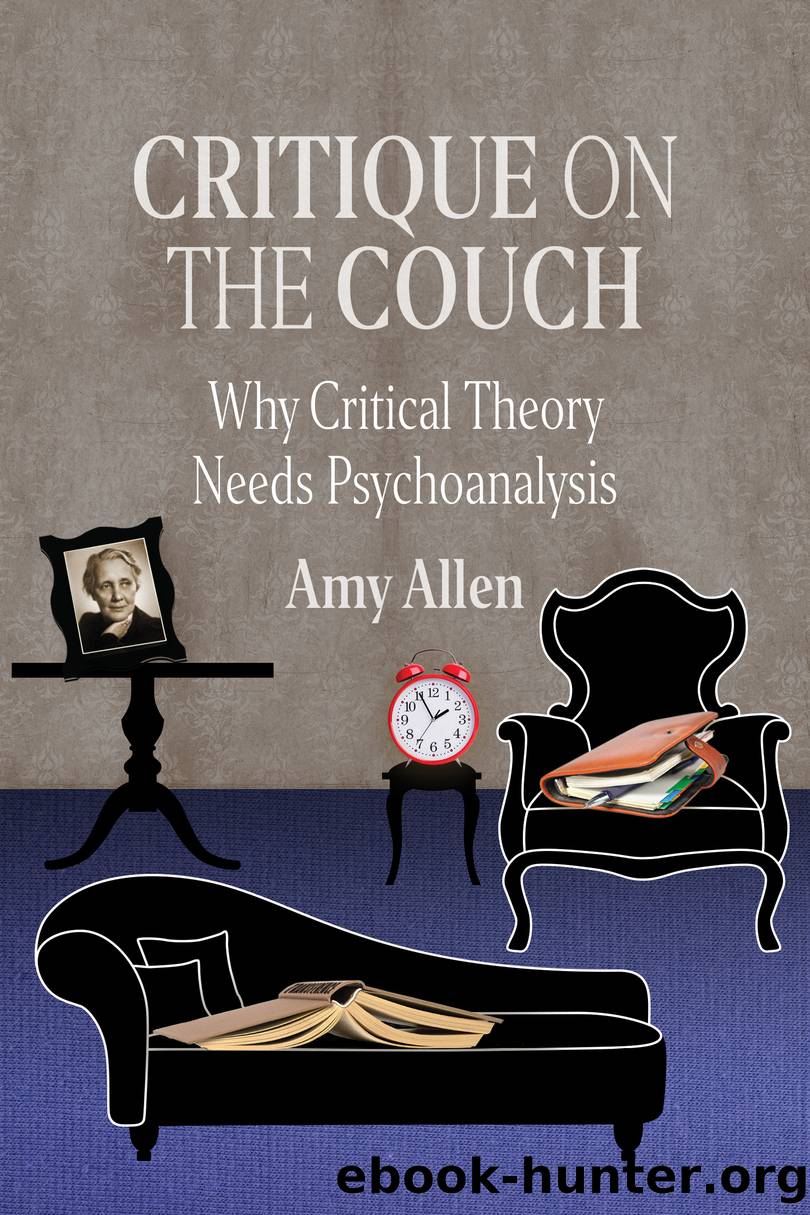
Author:Amy Allen;
Language: eng
Format: epub
Publisher: Lightning Source Inc. (Tier 3)
Love thus stands in a complex relationship to reparation. Reparation is made possible by love: first, in the sense that depressive guilt emerges as a response to the infantâs fear that they have attacked and destroyed the object that they love, and, second, as I discussed more fully in chapter 1, in the sense that the move to the depressive position is made possible by the primary caregiverâs love for the infant. More fundamentally still, however, reparation is made possible by love inasmuch as love is the unifying force that enables the psychic integration characteristic of the depressive position.
However, Kleinâs account of love is deeply ambivalent. To relate to the object as a whole object is to accept that the good breast that one loves and idealizes is one and the same as the bad breast that one hates and feels persecuted byâand to continue to love that object all the same. This dynamic sets up a challenge for the subject, who must, as Klein puts it, âfind the way to bear inevitable and necessary frustrations and the conflicts of love and hate which are in part caused by them: that is, to find his way between his hate which is increased by frustrations, and his love and wish for reparation which bring in their train sufferings of remorse.â63 Even if love is the only force that can mitigate and repair the damage unleashed by aggression and destructiveness, depressive love is also in large part about living with, managing, and withstanding ambivalence. For Klein, ambivalence cannot be overcome precisely because the death drive is ineliminable. This is another way of saying that, for Klein, unlike for Marcuse, there is no possibility of complete and final reconciliation, no possibility of wholeness.64
Kleinâs distinction between manic and genuine or mature forms of reparation, discussed briefly in chapter 2, sheds further light on how her account differs from the strong notion of reconciliation envisioned by Marcuse. In manic reparation, the subject attempts to put the shattered object back together perfectly, as if it had never been destroyed, and in so doing denies its own responsibility for having attacked or destroyed the object in the first place. In this mode, reparation manifests as an obsessional need to control the object. As Klein puts it: âThe reparative tendency, too, first employed in an omnipotent way, becomes an important defence. The infantâs feelings (in phantasy) might be described as follows: âMy mother is disappearing, she may never return, she is suffering, she is dead. No, this canât be, for I can revive her.ââ65 Genuine reparation, by contrast, requires, as Hanna Segal explains, âlearning to give up omnipotent control of this object and accept it as it really is.â66 If manic reparation is the attempt to restore the object in an omnipotent way, without admitting guilt or the reality of loss, genuine or mature reparation is, according to Segal, âthe very reverse of a defense, it is a mechanism important both for the growth of the ego and its adaptation to reality.
Download
This site does not store any files on its server. We only index and link to content provided by other sites. Please contact the content providers to delete copyright contents if any and email us, we'll remove relevant links or contents immediately.
| Anthropology | Archaeology |
| Philosophy | Politics & Government |
| Social Sciences | Sociology |
| Women's Studies |
Cecilia; Or, Memoirs of an Heiress — Volume 1 by Fanny Burney(32558)
The Great Music City by Andrea Baker(32019)
Cecilia; Or, Memoirs of an Heiress — Volume 2 by Fanny Burney(31956)
Cecilia; Or, Memoirs of an Heiress — Volume 3 by Fanny Burney(31942)
We're Going to Need More Wine by Gabrielle Union(19046)
All the Missing Girls by Megan Miranda(16030)
Pimp by Iceberg Slim(14508)
For the Love of Europe by Rick Steves(14121)
Bombshells: Glamour Girls of a Lifetime by Sullivan Steve(14077)
Talking to Strangers by Malcolm Gladwell(13370)
Norse Mythology by Gaiman Neil(13367)
Fifty Shades Freed by E L James(13243)
Mindhunter: Inside the FBI's Elite Serial Crime Unit by John E. Douglas & Mark Olshaker(9344)
Crazy Rich Asians by Kevin Kwan(9292)
The Lost Art of Listening by Michael P. Nichols(7506)
Enlightenment Now: The Case for Reason, Science, Humanism, and Progress by Steven Pinker(7314)
The Four Agreements by Don Miguel Ruiz(6765)
Bad Blood by John Carreyrou(6622)
Weapons of Math Destruction by Cathy O'Neil(6281)
