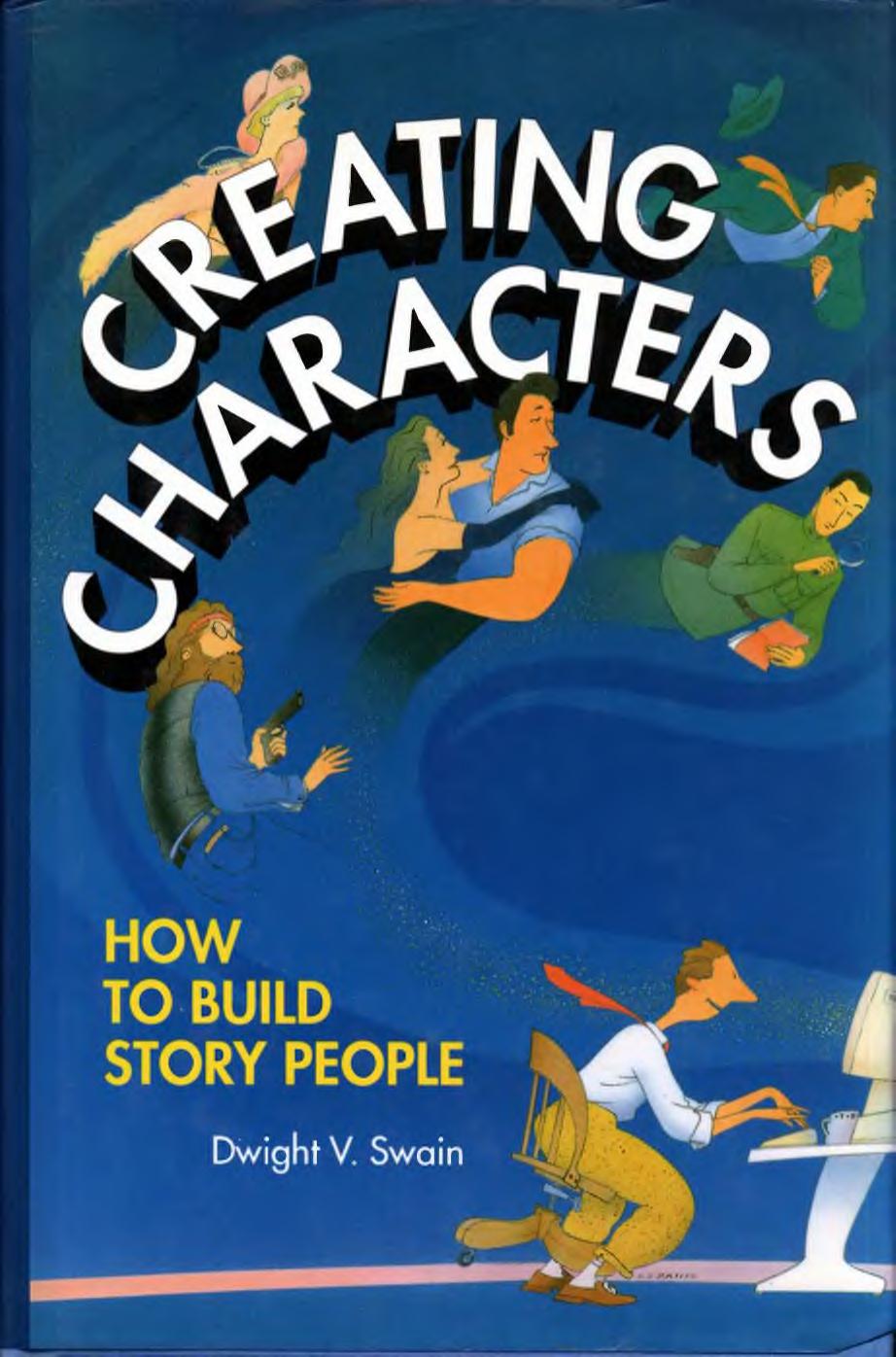
Creating Characters: How to Build Story People by Dwight V. Swain
Author:Dwight V. Swain [Swain, Dwight V.]
Language: eng
Format: mobi, epub, pdf
ISBN: 9780806183855
Publisher: Univ of Oklahoma Pr (Trd)
Published: 2012-11-27T14:00:00+00:00
11
THE LIGHT TOUCH
How do you make a character amusing?
You replace reader assumptions with offbeat alternatives.
How do you give a character or story a light touch? What’s the secret of “amusing”? Those are questions on which most of us have pondered at one time or another.
People do like to laugh, though. Ask Bob Hope, Phyllis Diller, Bill Cosby, Art Buchwald, Daniel Pinkwater, Garrison Keillor, Anne Tyler, Roseanne Barr, or your friendly neighborhood TV gagman if you don’t believe me.
Where you as a writer are concerned, humor and its low-key cousin, the amusing, often are next to vital, and not just on account of their reader appeal. In addition, they’re useful tools for changing pace, reducing tension, adding proportion, neutralizing purple prose, and maybe even unscrewing the inscrutable.
Further, there’s a simple approach, once you understand the issues. But said understanding is important. Without it, you can grope and fumble endlessly.
The thing to remember is that the amusing character actually is a character whose roots lie in humor.
So, what is humor? How do you handle it?
Answer: Humor is first and foremost a state of mind, and said state varies drastically from individual to individual. Attitude is the issue—an attitude or character trait we call a sense of humor.
Before a character can have a sense of humor, you must. Do you view the world through slightly skewed, laugh-tinted glasses? Do you see people and events with which you come in contact as funny? Is it your habit to chuckle—perhaps involuntarily—at things others take at face value?
Fine! The fact that you react thus constitutes a good start when it comes to creating lighthearted story moods and ludicrous or pleasantly entertaining people and situations. Beyond that, once you learn humor’s underlying principles, applying them to your story people will soon be second nature.
So, forward, and forgive me if I seem to take the long way around, through cartoons and jokes and gag definitions and mirth-provoking verse en route to where we discuss the actual creation of humorous and amusing characters and situations. It’s necessary, believe me, if you’re to understand the issues.
WHAT HAPPENS IN HUMOR?
Laughter is the noise a person makes when he or she attains release from the tyranny of the “should.”
Humor is a device designed to do this releasing. It’s a trigger, a detonating cap, a mental tickle.
To make people laugh, you devise a plausible (and quite possibly ridiculous), yet unanticipated alternative for something that is or is supposed to be a certain way. Then, you call attention to this alternative in such a manner that the reader or auditor abruptly becomes aware of both its contrast with and its similarity to the norm.
In other words, implicitly or explicitly your reader anticipates one thing, then unexpectedly gets another. Yet what he gets makes sense, in its own warped way, and no damage is done, and so he laughs.
Exhibit A: A cartoon shows three ghosts in a spooky-looking attic. Two, garbed in white sheets, are talking. The third, silent and the obvious object of the discussion, wears a black sheet.
Download
Creating Characters: How to Build Story People by Dwight V. Swain.epub
Creating Characters: How to Build Story People by Dwight V. Swain.pdf
This site does not store any files on its server. We only index and link to content provided by other sites. Please contact the content providers to delete copyright contents if any and email us, we'll remove relevant links or contents immediately.
Asking the Right Questions: A Guide to Critical Thinking by M. Neil Browne & Stuart M. Keeley(5855)
Autoboyography by Christina Lauren(5269)
Eat That Frog! by Brian Tracy(4628)
Dialogue by Robert McKee(4470)
Sticky Fingers by Joe Hagan(4273)
Journeys Out of the Body by Robert Monroe(3665)
Annapurna by Maurice Herzog(3515)
Full Circle by Michael Palin(3499)
Schaum's Quick Guide to Writing Great Short Stories by Margaret Lucke(3438)
Elements of Style 2017 by Richard De A'Morelli(3390)
The Art of Dramatic Writing: Its Basis in the Creative Interpretation of Human Motives by Egri Lajos(3107)
The Fight by Norman Mailer(3025)
Why I Write by George Orwell(3014)
Atlas Obscura by Joshua Foer(3002)
In Patagonia by Bruce Chatwin(3000)
The Diviners by Libba Bray(2983)
The Mental Game of Writing: How to Overcome Obstacles, Stay Creative and Productive, and Free Your Mind for Success by James Scott Bell(2945)
Venice by Jan Morris(2634)
The Elements of Style by William Strunk and E. B. White(2511)
