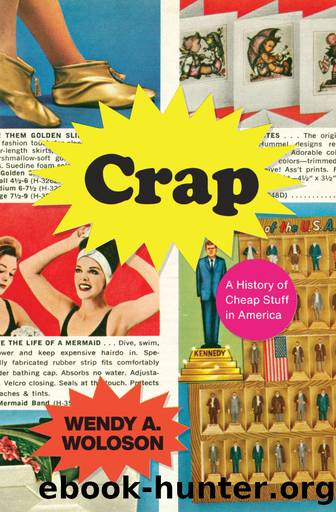
Crap by Wendy A. Woloson
Author:Wendy A. Woloson [Woloson, Wendy A.]
Language: eng
Format: epub
Tags: HIS000000 History / General
Publisher: University of Chicago Press
Published: 2020-10-09T00:00:00+00:00
Making the Modern Collector
Simply calling something a âcollectibleâ or âcollectorâs itemâ or âsomething collectedâ is enough to set it apart from other material artifacts (useful things like tools and appliances, and things to be literally consumed, like food). By dint of occupying its own category and special space, the âcollectibleâ is distinguished from and elevated above other pedestrian objects. Collectibles also draw from histories of collecting practices that are linked to the surplus time, money, and knowledge possessed by the elite. During the Enlightenment, for instance, royalty kept Wunderkammern, or âwonder roomsââcabinets of curiosity containing weird and fascinating objects from remote places and people. Wunderkammern were status symbols that showed their ownersâ mastery and possession of the physical realm.2
Most humans collect things, though it isnât clear why. Some scholars believe the impulse comes from our need to order the world as a way to understand itâthe âmaterial embodimentâ of classification. Collecting shows âhow human beings have striven to accommodate, to appropriate, and to extend the taxonomies and systems of knowledge they have inherited.â3 Others see collecting as a kind of psychological malady born of neurosis and maladaptation. From this perspective, collectors are not just âdedicatedâ and âseriousâ but âinfatuatedâ and âbesetâ by an âall-consuming drive.â They are compelled by an insatiable âhungerâ toward the next acquisition, their âhabitâ pursued with a âchronic restiveness.â4 And still others see collecting as an intimate practice of self-fashioning and memory-making. For them, collections create highly personal material worlds within which people can feel comforted and comfortable. The individual items in those collections serve as memory objects that invite recollections about their acquisition and perhaps offer a connection to the past.5
Motivated by these factors or a combination of them, Americans in the mid-nineteenth century began building collections. âStamp maniaâ was one of the first collecting crazes, initially pursued by middle- and upper-class women who had leisure time, were attracted to the aesthetic qualities of stamps, and considered activities such as indexing and arranging to be productive and educational pursuits. Increasingly, though, the pastime became segregated by gender. After the Civil War, men took up the hobby in greater numbers, likely driven by a number of factors: stampsâ increasing ubiquity, their association with the adventure and discovery of foreign places, and their direct connection to monetary systems (since in many cases stamps could be used in lieu of currency). Women continued to collect âjunk stamps by the millions,â according to one historian, âbut a woman philatelist was rare, indeed.â6 The masculinization of stamp collecting cast it as a serious and cerebral activity. In a sense, stamp collecting was another way, like Wunderkammern, for collectors to colonize and then impose order on foreign lands and people. Stamp brokers, practicing a new occupation, offered bounties on used stamps and helped collectors think of their hobby as an outgrowth of intellectual pursuits rather than collecting passions.7
Collecting coins and commemorative medals, too, was a male province. Aficionados of the allied hobbies of philately and numismatics often branched out into other masculine collecting fields such as antiquities and natural history specimens.
Download
This site does not store any files on its server. We only index and link to content provided by other sites. Please contact the content providers to delete copyright contents if any and email us, we'll remove relevant links or contents immediately.
| Anthropology | Archaeology |
| Philosophy | Politics & Government |
| Social Sciences | Sociology |
| Women's Studies |
Cecilia; Or, Memoirs of an Heiress — Volume 1 by Fanny Burney(32558)
The Great Music City by Andrea Baker(32019)
Cecilia; Or, Memoirs of an Heiress — Volume 2 by Fanny Burney(31956)
Cecilia; Or, Memoirs of an Heiress — Volume 3 by Fanny Burney(31942)
We're Going to Need More Wine by Gabrielle Union(19046)
All the Missing Girls by Megan Miranda(16029)
Pimp by Iceberg Slim(14508)
For the Love of Europe by Rick Steves(14121)
Bombshells: Glamour Girls of a Lifetime by Sullivan Steve(14076)
Talking to Strangers by Malcolm Gladwell(13370)
Norse Mythology by Gaiman Neil(13365)
Fifty Shades Freed by E L James(13241)
Mindhunter: Inside the FBI's Elite Serial Crime Unit by John E. Douglas & Mark Olshaker(9343)
Crazy Rich Asians by Kevin Kwan(9292)
The Lost Art of Listening by Michael P. Nichols(7506)
Enlightenment Now: The Case for Reason, Science, Humanism, and Progress by Steven Pinker(7313)
The Four Agreements by Don Miguel Ruiz(6765)
Bad Blood by John Carreyrou(6622)
Weapons of Math Destruction by Cathy O'Neil(6281)
