Course of Andean History by Henderson Peter V. N.;
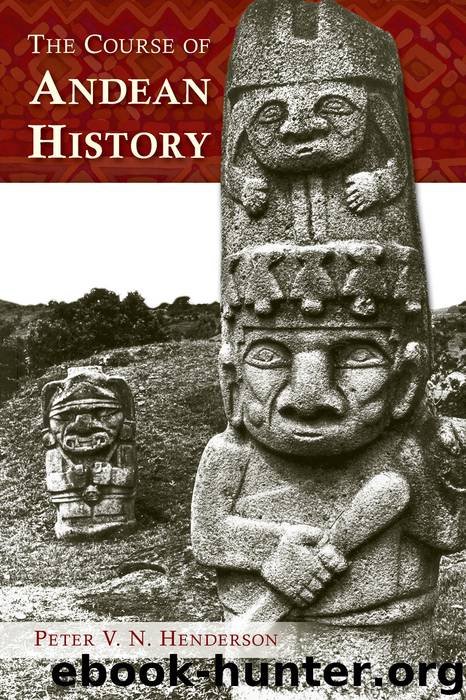
Author:Henderson, Peter V. N.;
Language: eng
Format: epub
Publisher: University of New Mexico Press
Published: 2013-09-27T16:00:00+00:00
The Andean Nations and the European Powers
Relationships with European countries and the United States, whether good or bad, tended to revive pan-Andean sentiments in the nineteenth century. In general, the four countries felt positively about Great Britain, France, and the United States but remained wary of Spain’s intentions. Because of the tales of untapped and untold wealth in the newly independent Andean nations, the European powers Great Britain and France, as well as the fledgling United States, expressed an interest in having commercial relations with Peru, Bolivia, Colombia, and Ecuador. Direct investment proved more hazardous. As previously mentioned, a British banking house, the Baring Brothers, lent Gran Colombia a huge sum of money in the 1820s that none of the successor nations could repay for generations. When the debt was proportionally divided by population in 1830 as Gran Colombia dissolved, the Ecuadorians complained that their share should be smaller since they had received no benefit from the loan. British investors also poured money into futile attempts to revive Potosí’s wealth and uncover new sources of silver and gold elsewhere in Peru and Bolivia. These financial disasters taught British capitalists a lesson, and after the 1830s they resisted further direct involvement in the Andean economy except for marketing a surefire moneymaker—guano. At the same time, British merchants enjoyed a dominant position in Andean shops, meeting much of these countries’ domestic demand for textiles, shoes, and other manufactured goods. Given Great Britain’s enormous commercial stake in the region, its diplomats tried to keep the peace and prevent other powers from muscling in on its preeminent economic role. Essentially, then, Great Britain remained the most influential foreign power in the Andean nations until the British surrendered commercial superiority to the United States after World War I.
French goods also satisfied niche demands of Andean consumers. Certain products such as fashionable clothing and fine wines found eager customers among the elites, who continued to express an affinity for French culture. Upper-class families often sent their sons to study in Paris or at the very least paid for the “grand tour” of European capitals. Although for the most part the French wanted only the benefits of trade with Latin America, Emperor Napoleon III (1851–1871) demonstrated a greater aggressiveness as he deployed physical force in the region, perhaps because of a secret desire to emulate his uncle. Always eager to expand France’s share of the Andean market at the expense of its British rival, Napoleon III briefly considered the possibility of establishing a protectorate over Ecuador in 1861, but eventually turned down Gabriel García Moreno’s offer in favor of more promising possibilities of wealth in Mexico. (García Moreno wanted to use the French to protect Ecuador from another Peruvian invasion.) When rumors of the French protectorate over Ecuador leaked, Peru’s Ramón Castilla and other Andean presidents denounced García Moreno. By the 1870s, France’s role in the Andean world, as in the rest of Latin America and Europe, diminished.
At the same time, Spain dreamed of resurrecting its New World empire.
Download
This site does not store any files on its server. We only index and link to content provided by other sites. Please contact the content providers to delete copyright contents if any and email us, we'll remove relevant links or contents immediately.
| Africa | Americas |
| Arctic & Antarctica | Asia |
| Australia & Oceania | Europe |
| Middle East | Russia |
| United States | World |
| Ancient Civilizations | Military |
| Historical Study & Educational Resources |
Cat's cradle by Kurt Vonnegut(15365)
Pimp by Iceberg Slim(14522)
4 3 2 1: A Novel by Paul Auster(12403)
Underground: A Human History of the Worlds Beneath Our Feet by Will Hunt(12101)
The Radium Girls by Kate Moore(12035)
Wiseguy by Nicholas Pileggi(5795)
The Fire Next Time by James Baldwin(5454)
Perfect Rhythm by Jae(5411)
American History Stories, Volume III (Yesterday's Classics) by Pratt Mara L(5312)
Paper Towns by Green John(5195)
Pale Blue Dot by Carl Sagan(5013)
A Higher Loyalty: Truth, Lies, and Leadership by James Comey(4966)
The Mayflower and the Pilgrims' New World by Nathaniel Philbrick(4508)
The Doomsday Machine by Daniel Ellsberg(4493)
Killers of the Flower Moon: The Osage Murders and the Birth of the FBI by David Grann(4451)
The Sympathizer by Viet Thanh Nguyen(4398)
Too Much and Not the Mood by Durga Chew-Bose(4353)
The Borden Murders by Sarah Miller(4330)
Sticky Fingers by Joe Hagan(4207)
