Conservation Biology by Scott P. Carroll;Charles W. Fox; & Charles W. Fox
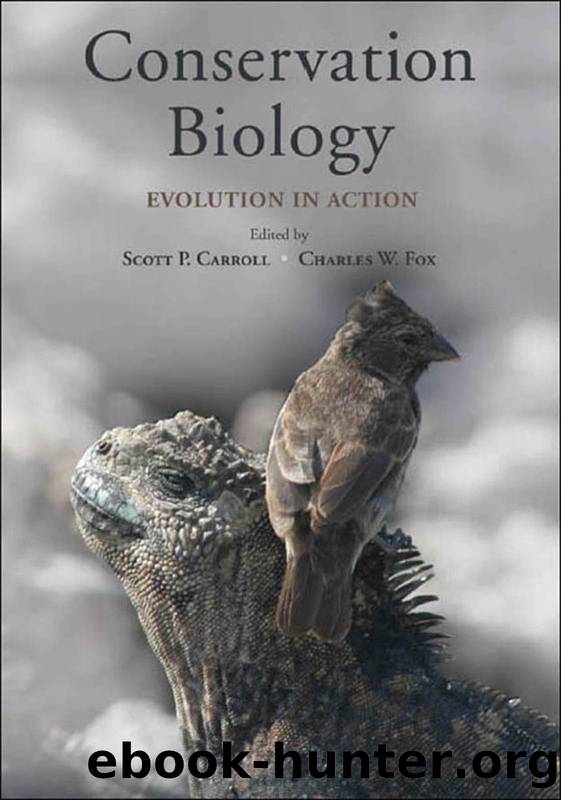
Author:Scott P. Carroll;Charles W. Fox; & Charles W. Fox
Language: eng
Format: epub
Publisher: Oxford University Press USA
Published: 2008-06-15T00:00:00+00:00
FUTURE DIRECTIONS
There is ample evidence that populations and species evolve in response to human influences on nature, and such adaptive change is probably more common and widespread than is currently recognized. In the face of pervasive environmental change, efforts to prevent adaptive phenotypic or genetic change with the goal of preserving more ancestral or âpristineâ states are at best difficult and at worst misguided. For populations that do not disappear, evolution is likely an inevitable consequence, if not a prerequisite, for persistence (Carroll, 2007a). Only when there is a plan to return or transfer individuals to former conditions should efforts to retard or reverse evolution be considered. Allowing evolution to proceed should in general facilitate conservation goals while potentially preserving genetic variation in taxa of interest. If wild-lands are, in the long run, restored and expanded, we can likely count on future evolution and evolutionarily enlightened management to assist in the process of adapting old populations to new environments.
This is not to argue that management schemes that reduce stress and risk cannot also buffer the intensity of selection and thus permit plastic responses to be the main path of adaptation. For example, after initiating a risk-averse tactic of sheltering the endangered tammar wallaby, Macropus eugenii, on predator-free islands off Australia, restoration of mainland populations began only after managers taught wallabies to avoid introduced predatory foxes. Once entrained in a pilot population, there is evidence that predator avoidance may be copied by conspecifics (Griffin & Evans, 2003), potentially generating a self-replicating, adaptive antipredator meme of conservation value. If effective, such learned, culturally transmitted adaptive responses could strongly limit both predation and evolution on the mainland.
Nonetheless, populations are changing in important ways beyond simply the number of surviving individuals, suggesting that monitoring adaptive responses to environmental change should be a first principle of conservation biology. Clearly, any long-term, sustainable approaches would have to assay evolution in managed populations, and the current rates of change are pushing the problem to the forefront. The challenge now is to design ways to use awareness of inevitable adaptive responses to avoid problems stemming from mistaken assumptions of stasis, as well as to devise ways to enhance how adaptive processes may serve conservation goals. Evolutionary conservation biology is a new discipline in its intellectual infancy. The notion of species as fixed entities pervades endeavors ranging from global change models to PVAs. Moreover, standard conservation genetics approaches use molecular markers that are presumed to be neutral. Rapid adaptation is often associated with the same factors that are causing extinctions (Stockwell et al., 2003), and thus conservationists are well positioned to work with species change, provided they remain alert to such processes.
If we accept the likelihood of ongoing adaptation to anthropogenic change, the next challenge from a management perspective is to predict and deal with its outcome, and, if possible, to manipulate its expression. Like other problems in biology, solutions must generally come from detailed knowledge of natural history. Yet the degree and form of environmental change may make some adaptive responses more likely than others (Fig.
Download
This site does not store any files on its server. We only index and link to content provided by other sites. Please contact the content providers to delete copyright contents if any and email us, we'll remove relevant links or contents immediately.
Whiskies Galore by Ian Buxton(42106)
Introduction to Aircraft Design (Cambridge Aerospace Series) by John P. Fielding(33199)
Rewire Your Anxious Brain by Catherine M. Pittman(18742)
Craft Beer for the Homebrewer by Michael Agnew(18306)
Cat's cradle by Kurt Vonnegut(15477)
Sapiens: A Brief History of Humankind by Yuval Noah Harari(14485)
Leonardo da Vinci by Walter Isaacson(13433)
The Tidewater Tales by John Barth(12722)
Thinking, Fast and Slow by Kahneman Daniel(12463)
Underground: A Human History of the Worlds Beneath Our Feet by Will Hunt(12178)
The Radium Girls by Kate Moore(12124)
The Art of Thinking Clearly by Rolf Dobelli(10648)
Mindhunter: Inside the FBI's Elite Serial Crime Unit by John E. Douglas & Mark Olshaker(9455)
A Journey Through Charms and Defence Against the Dark Arts (Harry Potter: A Journey Throughâ¦) by Pottermore Publishing(9308)
Tools of Titans by Timothy Ferriss(8528)
Wonder by R. J. Palacio(8193)
Turbulence by E. J. Noyes(8152)
Change Your Questions, Change Your Life by Marilee Adams(7881)
Nudge - Improving Decisions about Health, Wealth, and Happiness by Thaler Sunstein(7783)
