Budapest 1900 by John Lukacs
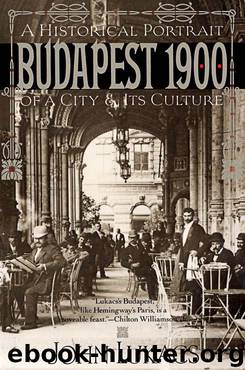
Author:John Lukacs
Language: eng
Format: epub
Publisher: Grove Atlantic
The general crisis of nineteenth-century Liberalism has not yet found its general historian. Almost all historians and political thinkers have dealt with the devolution of Liberalism on the economic or social plane. But there was a deeper, emotional substance to that devolution. The Liberal ideas were losing their appeal not only to thinkers, but also to masses of the lower classes who were supposed to have been its beneficiaries. Economically speaking, the Liberal principles and policies of free trade and free enterprise had lost their novel ring of generosity and freedom. While industrialists and financiers were still profiting from them, many of their workers were left to fend for themselves in cold and dark places, unlit by the elsewhere brilliant arc lights of capitalist enterprise. Hence the emotional anticapitalism of the masses preceded their eventual, and partial, rational acceptance of socialism. After 1880 some of the Liberals in England and the Progressives in the United States began to comprehend this. Hence they moved away from classic Liberalism toward social reforms, toward the beginning of the welfare, or provider, state—toward the Lib-Lab ethos (or the lack of it). There was some of this among the Liberals in Hungary, too, but not much. My argument is that it did not matter much either. Had the Hungarian Liberal Party moved toward social democracy as had the British, its eventual demise may have come somewhat later, but, as in England, it would have come nonetheless.
One of the elements of its eventual demise was the emergence of a politically conscious working class. By 1900 in Hungary, and especially in Budapest, an industrial working class had come into being that was both larger and better educated than the working classes in other European nations east of Vienna. The first great May Day demonstration in Budapest took place in 1890, when perhaps as many as 40,000 workers marched in the City Park. The Hungarian Social Democratic Party was founded in that year (one year after the Austrian one). During the next ten years its influence grew. There were a few significant strikes in the factories of Budapest. Yet on May 1, 1900, a rainy day, the planned Socialist demonstration fizzled. In 1900 the Hungarian Social Democrats were not yet a strong national party. (Népszava, their first daily newspaper, appeared only in 1904.) There were at least two reasons for this. One was the pronounced urban character of the party, with many Jews among its leaders. Yet the poorest workers in Hungary were peasants, not factory workers. Among some of the peasants in certain parts of the country, a tradition of agrarian socialism had already taken root. Since this is a history of Budapest and not of Hungary, this is not the place to describe the moving, at times pathetic, and sometimes deeply religious sentiments and manifestations of this Christ-like socialism of the poor peasants. In the 1890s they were often suppressed by the government and by its local police instruments with even greater force than that directed against the occasional strikes and working-class demonstrations in Budapest.
Download
This site does not store any files on its server. We only index and link to content provided by other sites. Please contact the content providers to delete copyright contents if any and email us, we'll remove relevant links or contents immediately.
| Africa | Americas |
| Arctic & Antarctica | Asia |
| Australia & Oceania | Europe |
| Middle East | Russia |
| United States | World |
| Ancient Civilizations | Military |
| Historical Study & Educational Resources |
Room 212 by Kate Stewart(5122)
The Crown by Robert Lacey(4817)
Endurance: Shackleton's Incredible Voyage by Alfred Lansing(4783)
The Iron Duke by The Iron Duke(4356)
The Rape of Nanking by Iris Chang(4213)
Joan of Arc by Mary Gordon(4112)
Killing England by Bill O'Reilly(4004)
Say Nothing by Patrick Radden Keefe(3986)
I'll Give You the Sun by Jandy Nelson(3447)
Shadow of Night by Deborah Harkness(3368)
Hitler's Monsters by Eric Kurlander(3343)
Mary, Queen of Scots, and the Murder of Lord Darnley by Alison Weir(3210)
Blood and Sand by Alex Von Tunzelmann(3205)
Eleanor & Park by Rainbow Rowell(3175)
Darkest Hour by Anthony McCarten(3133)
Margaret Thatcher: The Autobiography by Thatcher Margaret(3082)
Book of Life by Deborah Harkness(2939)
Red Famine: Stalin's War on Ukraine by Anne Applebaum(2934)
The One Memory of Flora Banks by Emily Barr(2863)
