British Marxist Historians, The by Harvey J. Kaye;
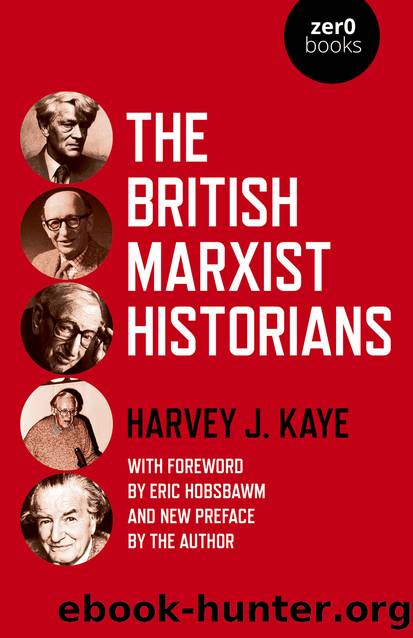
Author:Harvey J. Kaye;
Language: eng
Format: epub
Publisher: National Book Network
Published: 2022-07-22T00:00:00+00:00
Hobsbawmâs historical studies of class experience have not been limited to the British working class in the Industrial Revolution. He has also done much work of importance on pre-industrial urban and (especially) rural labouring classesâ experiences. It is in this area that we really encounter Hobsbawmâs international scholarship, for his writings on peasant and agrarian studies include British, European (especially Mediterranean) and Latin American studies. In fact, it might be said that a new subject in social history was actually opened up and given its name by Hobsbawm: the study of âprimitive rebellionsâ. It should also be noted that Hobsbawm was a founding member not only of the Society for the Study of Labour History but also, along with Rodney Hilton, of the editorial board of the Journal of Peasant Studies, providing the lead article, âPeasants and Politicsâ, for its opening issue.42
Hobsbawmâs first work in this area, published in 1959, was the now-classic Primitive Rebels (1963).43 Interestingly enough, his original scholarly interest was the agrarian problem in North Africa, but in the immediate post-war period he found it necessary to pursue labour history instead. During the 1950s, however, several things happened to renew his interest in peasant studies. He was making frequent trips to Mediterranean countries in this period and meeting and talking to a number of intellectuals in the Italian Communist Party, who knew a great deal about southern Italy. He was also reading the work of Antonio Gramsci, who has a lot to say about ânon-political protest movementsâ (what Hobsbawm was to call âprimitive rebellionsâ). At about the same time, he became involved in discussions with the social anthropologists Myer Fortes and Max Gluckman. They were studying the Mau Mau movement and were anxious to know if similar movements had occurred in Europe in earlier periods. It was these anthropologists who asked him to give a lecture âout of which Primitive Rebels grewâ.44 (Thus, as in labour history studies, where Hobsbawm made links with sociology, in peasant studies he established links between history and anthropology, two decades before the âinterdisciplinary historyâ vogue.)
Yet another influence in the years during which Hobsbawm was writing Primitive Rebels was the Twentieth Congress of the Communist Party of the Soviet Union in 1956, and the process of de-Stalinization. He even refers to the work as a âpolitical as well as a historical one.â45 He recalls that it had become necessary to reconsider the models of revolutionary activity which âmilitant communists had accepted in the pastâ. In effect, he says, PrimitiveRebels can be viewed as an âattempt to see whether we were right in believing in a strongly organized partyâ. Concerning this question he contends that the âanswer is yesâ. He adds, however, that the book shows that such a path was not the only way forward.46
In Primitive Rebels Hobsbawm examines what he terms âarchaicâ forms of social movements. Specifically, his studies are of: âbanditry of the Robin Hood type, rural secret societies, various peasant revolutionary movements of the millenarian sort, pre-industrial urban âmobsâ
Download
This site does not store any files on its server. We only index and link to content provided by other sites. Please contact the content providers to delete copyright contents if any and email us, we'll remove relevant links or contents immediately.
| Africa | Americas |
| Arctic & Antarctica | Asia |
| Australia & Oceania | Europe |
| Middle East | Russia |
| United States | World |
| Ancient Civilizations | Military |
| Historical Study & Educational Resources |
Room 212 by Kate Stewart(5208)
The Crown by Robert Lacey(4882)
Endurance: Shackleton's Incredible Voyage by Alfred Lansing(4870)
The Iron Duke by The Iron Duke(4423)
The Rape of Nanking by Iris Chang(4281)
Joan of Arc by Mary Gordon(4176)
Killing England by Bill O'Reilly(4067)
Say Nothing by Patrick Radden Keefe(4064)
I'll Give You the Sun by Jandy Nelson(3520)
Shadow of Night by Deborah Harkness(3435)
Hitler's Monsters by Eric Kurlander(3412)
Eleanor & Park by Rainbow Rowell(3278)
Blood and Sand by Alex Von Tunzelmann(3260)
Mary, Queen of Scots, and the Murder of Lord Darnley by Alison Weir(3258)
Darkest Hour by Anthony McCarten(3188)
Margaret Thatcher: The Autobiography by Thatcher Margaret(3134)
Book of Life by Deborah Harkness(3001)
Red Famine: Stalin's War on Ukraine by Anne Applebaum(2982)
The One Memory of Flora Banks by Emily Barr(2918)
