Bond Men Made Free by Rodney Hilton; & Christopher Dyer
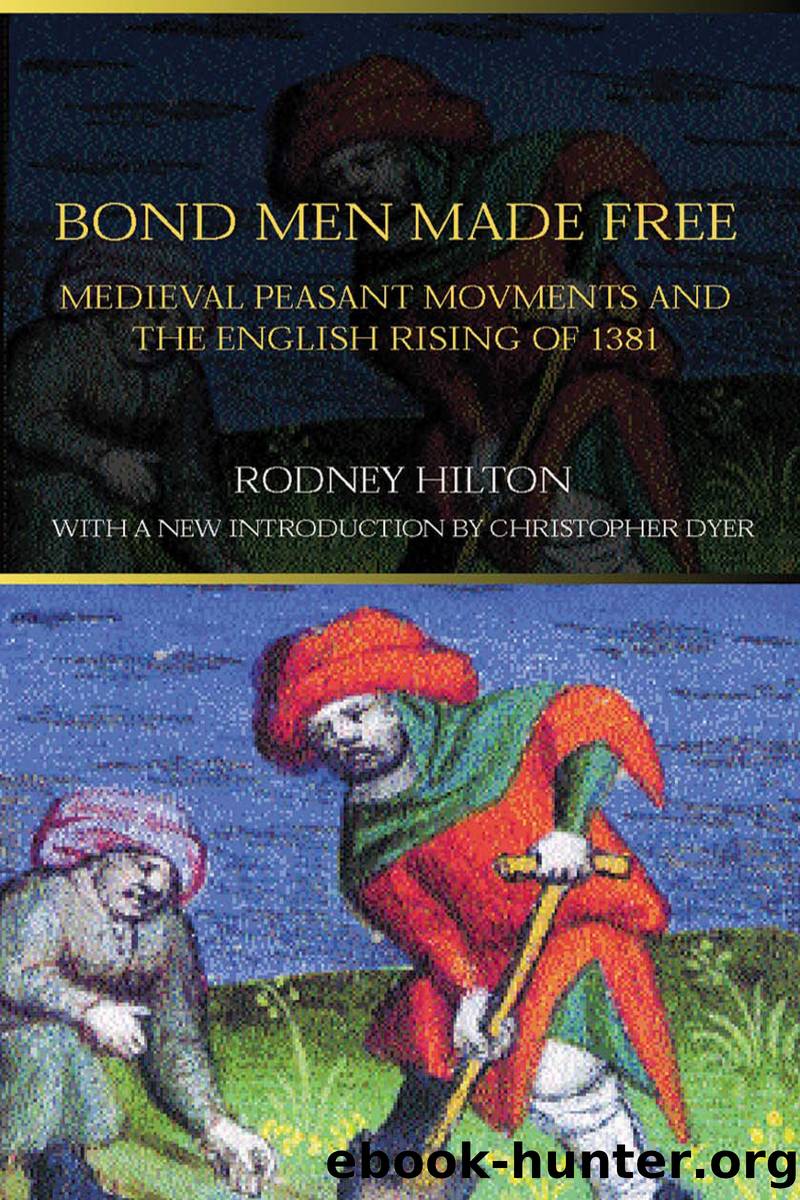
Author:Rodney Hilton; & Christopher Dyer [Hilton, Rodney & Dyer, Christopher]
Language: eng
Format: epub
ISBN: 9781134374670
Publisher: Taylor & Francis (Unlimited)
Published: 2022-06-21T00:00:00+00:00
And again Froissart says (somewhat illogically) that when the peasants were asked the reason for their violent actions, âthey replied that they did not know; it was because they saw others doing them that they copied them. They thought that by such means they could destroy all the nobles and gentry in the world, so that there would be no more of them.'36
36 J. Froissart, Chronicles, ed. Brereton, pp 151, 153. Jean de Venette emphasizes the same element of class hatred:
⦠the peasants ⦠seeing that the nobles gave them no protection, but rather oppressed them as heavily as the enemy, rose and took arms against the nobles of France ⦠the number of peasants eager to extirpate the nobles and their wives and to destroy their manor houses grew until it was estimated at five thousand.37
37 Chronicle, ed. J. Birdsall and R. A. Newhall, p 76.
The social bandit, as compared with the peasants engaged in mass risings, operated mostly with a less precise consciousness of his position of social antagonism to his opponents. Any bird was worth the plucking, and if he did not pluck his own kind it was because there was little or nothing to be had. All the same, awareness of social conflict was not altogether missing. The evidence for the greatest degree of class consciousness comes from the last major phase of Tuchin activity, that of the 1380s, when, according to the life of Charles VI in the St Denis chronicle, the terrible mutual oaths of the Tuchin bands included the promise never more to submit to taxation, but only to keep the ancient liberty of their country (patrie antiquam servantes libertatem).38 The social bandit's chosen prey were men of the church, the nobles, and the merchants. One of their captains, the renegade noble, Pierre de Brugère, gave orders to his lieutenants that no-one with smooth uncalloused hands or who by gesture, clothing or speech showed courtliness or elegance should even be admitted to their company, but rather slain. Such remarks about the Tuchins come from a hostile writer, writing no doubt like Froissart from hearsay evidence. But even taking exaggeration into account, the element of conscious class antagonism which is suggested may well have been present.
38 M. Boudet, op. cit., appendix III. The ferocity which, rightly or wrongly, was attributed to the French rebels by the aristocratic chroniclers does not appear in the Catalan wars unless we can glimpse it in the physical demonstrations by some of the remensas peasants at the turn of the fourteenth century, when in order to intimidate the landowners, and perhaps unwelcome lessees of the lapsed holdings, they dug ditches and put up crosses and other signs, the senyals mort, threatening death. There may have been some diversion from possible class antagonism on the peasants' part by the attitude evinced by the monarchy from time to time, and expressed in its strongest terms perhaps by Queen Maria de Luna in letters to Pope Benedict XIII. In these letters she
Download
This site does not store any files on its server. We only index and link to content provided by other sites. Please contact the content providers to delete copyright contents if any and email us, we'll remove relevant links or contents immediately.
| Belgium | France |
| Germany | Great Britain |
| Greenland | Italy |
| Netherlands | Romania |
| Scandinavia |
Room 212 by Kate Stewart(5203)
The Crown by Robert Lacey(4879)
Endurance: Shackleton's Incredible Voyage by Alfred Lansing(4863)
The Iron Duke by The Iron Duke(4420)
The Rape of Nanking by Iris Chang(4276)
Joan of Arc by Mary Gordon(4172)
Killing England by Bill O'Reilly(4065)
Say Nothing by Patrick Radden Keefe(4062)
I'll Give You the Sun by Jandy Nelson(3516)
Shadow of Night by Deborah Harkness(3432)
Hitler's Monsters by Eric Kurlander(3412)
Eleanor & Park by Rainbow Rowell(3272)
Blood and Sand by Alex Von Tunzelmann(3257)
Mary, Queen of Scots, and the Murder of Lord Darnley by Alison Weir(3256)
Darkest Hour by Anthony McCarten(3186)
Margaret Thatcher: The Autobiography by Thatcher Margaret(3133)
Book of Life by Deborah Harkness(2996)
Red Famine: Stalin's War on Ukraine by Anne Applebaum(2979)
The One Memory of Flora Banks by Emily Barr(2912)
