Bonaparte in Egypt by J. Christopher Herold
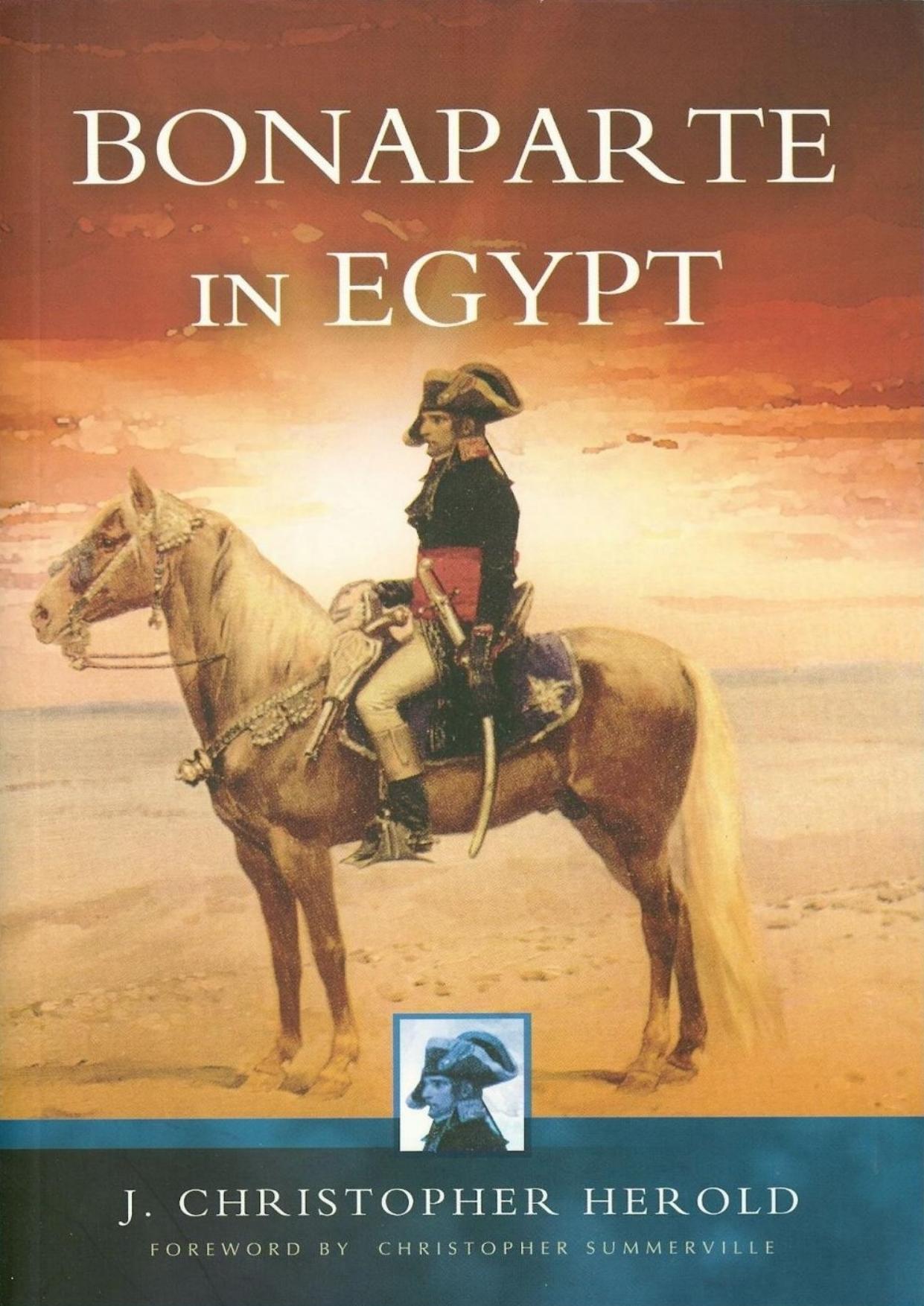
Author:J. Christopher Herold [Herold, J. Christopher]
Language: eng
Format: epub, pdf
Tags: Campaigns & Battles, Egypt, Modern Warfare, Napoleonic Wars
ISBN: 9781844152858
Goodreads: 885160
Publisher: Pen & Sword
Published: 1962-01-02T10:00:00+00:00
III
While Bonaparte faced the plague just as he faced the Porte’s declaration of war—with fortitude and blinkers—he still had to seek some means to counteract the continuing diminution of his army. The incorporation of the naval crews into the land forces was a partial solution. There were other measures. As early as September 7, Bonaparte ordered all Mameluke slaves between the ages of eight and fourteen to be drafted, with a view toward the eventual formation of a Mameluke corps in French service. On October 3, all male European civilians in Egypt of military age were constituted as a National Guard. An order dated December 28 contains this paragraph: ‘Wherever a village rises in rebellion, the general in command of the province, by way of punishment, will seize all boys between twelve and sixteen years old. A report will be sent to the commander-in-chief, who will issue orders concerning their subsequent disposition.’32 The object, quite obviously, was to create a reservoir of recruits. After Bonaparte’s return from Syria, where casualties had been heavy, his thoughts turned toward a colonial army of black Mamelukes. ‘I should like, Citizen General, to purchase two or three thousand Negroes above sixteen years of age’, he wrote to Desaix in June 1799.33 And, a few days later, to the Sultan of Darfur, in the Sudan: ‘I beg you to send me, with the next caravan, 2,000 black slaves over sixteen years old, strong and vigorous. I shall buy them all on my own account.’34 It is interesting to note that Bonaparte did not contemplate the formation of coloured units; rather, as he wrote to Desaix, he wished to incorporate about a hundred Negroes in each French battalion.
Desaix himself strongly advocated a similar project: to amalgamate the approximately two thousand young Mameluke slaves in Egypt with the French apprentice seamen, with imported Negroes, and with Arab lads, all of whom would be given military training and French schooling. The project was eminently practical and, if realized, would have obviated any need for reinforcements from the homeland. Also, it might well have changed the course of history: the racially mixed army contemplated by Desaix and Bonaparte would have borne no resemblance whatever to the colonial armies of the nineteenth and twentieth centuries. Frenchmen, Negroes, Arabs, and Mamelukes would have served and been promoted on a basis of equality. In a detailed memorandum he left behind when he returned to France, Bonaparte developed this idea on a large scale: envoys should be sent to Sennar, Abyssinia, and Darfur to purchase 10,000 young slaves per year; 20,000 of these could be incorporated into the army at the ratio of twenty slaves per company; the rest would form an auxiliary corps with French cadres.
But these were long-term projects, requiring about five years to come to fruition. Meanwhile, the growing shortage of manpower was remedied to some degree by recruitment into such auxiliary forces as Barthelmy’s Greek and Moroccan cut-throats. The essential thing was to remain in Egypt long enough to develop its latent resources.
Download
This site does not store any files on its server. We only index and link to content provided by other sites. Please contact the content providers to delete copyright contents if any and email us, we'll remove relevant links or contents immediately.
| Africa | Americas |
| Arctic & Antarctica | Asia |
| Australia & Oceania | Europe |
| Middle East | Russia |
| United States | World |
| Ancient Civilizations | Military |
| Historical Study & Educational Resources |
Room 212 by Kate Stewart(5125)
The Crown by Robert Lacey(4817)
Endurance: Shackleton's Incredible Voyage by Alfred Lansing(4784)
The Iron Duke by The Iron Duke(4360)
The Rape of Nanking by Iris Chang(4214)
Joan of Arc by Mary Gordon(4115)
Killing England by Bill O'Reilly(4005)
Say Nothing by Patrick Radden Keefe(3988)
I'll Give You the Sun by Jandy Nelson(3448)
Shadow of Night by Deborah Harkness(3370)
Hitler's Monsters by Eric Kurlander(3343)
Mary, Queen of Scots, and the Murder of Lord Darnley by Alison Weir(3210)
Blood and Sand by Alex Von Tunzelmann(3205)
Eleanor & Park by Rainbow Rowell(3178)
Darkest Hour by Anthony McCarten(3133)
Margaret Thatcher: The Autobiography by Thatcher Margaret(3083)
Book of Life by Deborah Harkness(2939)
Red Famine: Stalin's War on Ukraine by Anne Applebaum(2935)
The One Memory of Flora Banks by Emily Barr(2864)
