Blood at the Root: A Racial Cleansing in America by Phillips Patrick
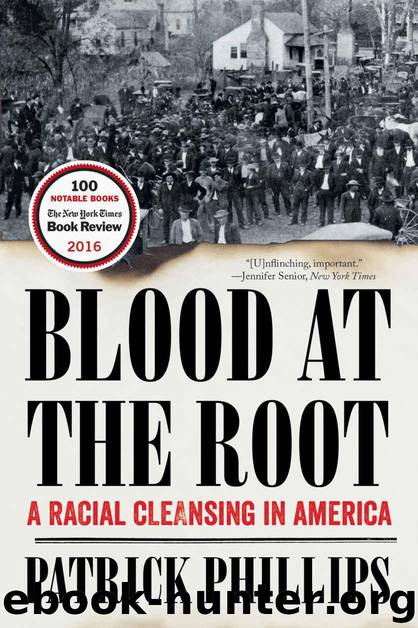
Author:Phillips, Patrick [Phillips, Patrick]
Language: eng
Format: azw3, epub
Publisher: W. W. Norton & Company
Published: 2016-09-19T16:00:00+00:00
WHETHER THEY JOINED, opposed, or were indifferent to the raids of Forsyth’s night riders, for many whites the misfortune of black property owners became a once-in-a-lifetime opportunity. The early years of the new century had seen a sharp rise in the value of real estate in the foothills, as the introduction of chemical fertilizers and mechanized agriculture turned what had always been a marginal region into more productive and more valuable farmland. Spikes in land values and crop yields meant that as the new century entered its second decade, Joseph Kellogg’s large spread near Sawnee Mountain came to seem both highly attractive to landless whites and terribly far out of reach.
In a market that was making landowners richer and richer, poor whites in Forsyth must have realized that if they were ever going to climb up from the bottom of the economic ladder, something would have to give. And in the last quarter of 1912, something finally did, when one black family after another was forced at gunpoint to pack up their belongings and leave. As even the proudest, most prosperous black men, like Joseph Kellogg, gave in to the threats, Forsyth County suddenly became—for the first time in living memory—a buyer’s market.
Even peaceful whites understood that as the violence escalated, and as more and more of the black community scattered, black owners might be tempted by lowball offers. One owner in Forsyth placed an ad in the Atlanta Constitution, offering for sale “200 Acres [in] Forsyth County . . . and [a] business corner lot in Cumming, 100 x 175, on public square.” This description matches the two hundred acres and town lot on which Joseph Kellogg paid taxes in 1912, and it seems likely that this anonymous listing was part of Kellogg’s last-ditch effort to cut his losses and get something approaching fair value for land he had acquired through forty years of sweat, determination, and keen business sense. By advertising the property in an Atlanta paper, Kellogg may have hoped to find a buyer who wouldn’t fully understand, and therefore fully exploit, his desperate situation.
In the last sentence of the listing, the seller added that in the absence of a cash transaction, he would let go of his Forsyth County farm in “exchange for negro property.” Implicit in such an offer was the seller’s hope of relocating to some new place far from the night riders and arsonists of Forsyth, and free from the inherent risks that came with white neighbors. With this offer to trade his land for “negro property,” whoever placed that ad seemed to acknowledge what was fast becoming clear to everyone: regardless of how prosperous and productive he might be, Forsyth County was no place for a black man.
Download
Blood at the Root: A Racial Cleansing in America by Phillips Patrick.epub
This site does not store any files on its server. We only index and link to content provided by other sites. Please contact the content providers to delete copyright contents if any and email us, we'll remove relevant links or contents immediately.
| Africa | Americas |
| Arctic & Antarctica | Asia |
| Australia & Oceania | Europe |
| Middle East | Russia |
| United States | World |
| Ancient Civilizations | Military |
| Historical Study & Educational Resources |
Cat's cradle by Kurt Vonnegut(15465)
Pimp by Iceberg Slim(14706)
4 3 2 1: A Novel by Paul Auster(12536)
Underground: A Human History of the Worlds Beneath Our Feet by Will Hunt(12168)
The Radium Girls by Kate Moore(12106)
Wiseguy by Nicholas Pileggi(5867)
The Fire Next Time by James Baldwin(5534)
Perfect Rhythm by Jae(5492)
American History Stories, Volume III (Yesterday's Classics) by Pratt Mara L(5348)
Paper Towns by Green John(5261)
Pale Blue Dot by Carl Sagan(5095)
A Higher Loyalty: Truth, Lies, and Leadership by James Comey(5029)
The Doomsday Machine by Daniel Ellsberg(4572)
The Mayflower and the Pilgrims' New World by Nathaniel Philbrick(4564)
Killers of the Flower Moon: The Osage Murders and the Birth of the FBI by David Grann(4495)
The Sympathizer by Viet Thanh Nguyen(4457)
Too Much and Not the Mood by Durga Chew-Bose(4402)
The Borden Murders by Sarah Miller(4401)
Sticky Fingers by Joe Hagan(4268)
