Appalachia on the Table by Erica Abrams Locklear;
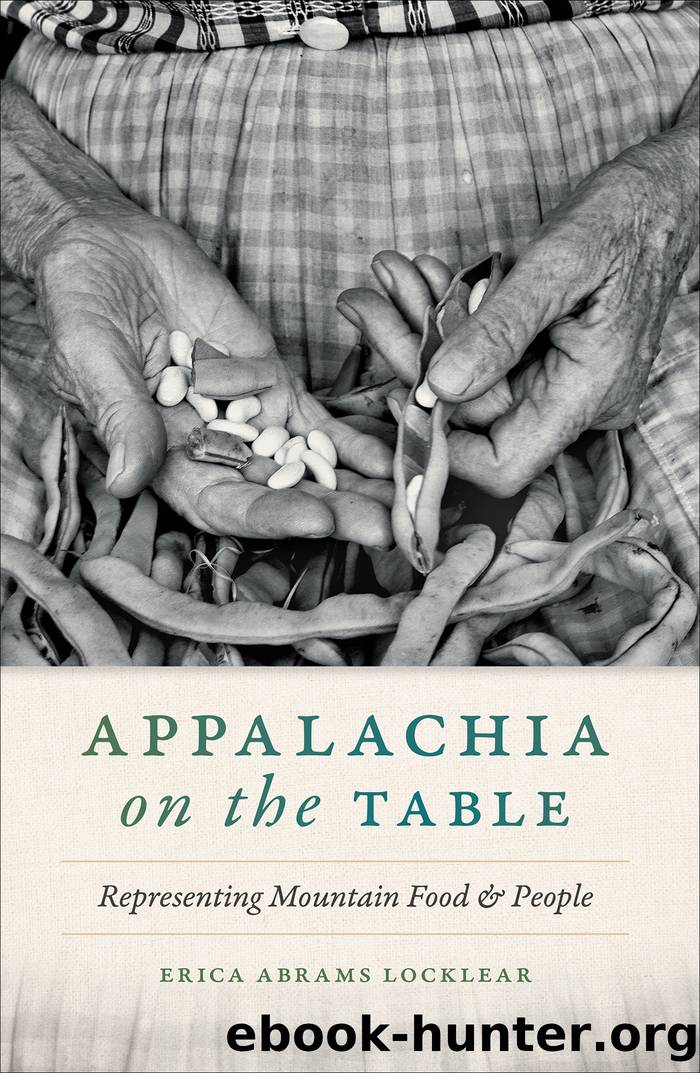
Author:Erica Abrams Locklear;
Language: eng
Format: epub
Publisher: Lightning Source Inc. (Tier 3)
Published: 2023-05-15T00:00:00+00:00
Imagining: Burley Tobacco, Madison County, Cooperative Extension Agents, and Culinary Consequences
In her 2016 novel, Over the Plain Houses, Julia Franks fictionalizes what happens when one cash cropâin this case, tobaccoâreplaces subsistence farming, especially when that transition is encouraged by the U.S. Department of Agriculture (USDA) and its home extension agents. But the novelâs statement about reliance on cash cropsâif such a statement may even be deducedâis complexly rendered. The novel is set in 1939 in Western North Carolina and chronicles the oppressive, abusive relationship between Brodis Lambey and his wife, Irenie Raines Lambey. Franks casts Brodis as a fundamentalist preacher whose domination over his wife is troubling from the start, and by the novelâs end, so unbearable for Irenie that she leaves him to seek an abortion for a rape-induced pregnancy. While describing the constant power struggle between Brodis and Irenie, Franks also weaves in the back-story of USDA extension workers Roger and Virginia (Ginny) Furman, a historically accurate addition since the first farm agent began work in Madison County in 1925.27 In my conversations with Franks, she said that she did not use Virginiaâs last name to remind readers of Hindman Settlement School worker Lucy Furman, but for those schooled in Progressive Era history, the comparison is difficult to ignore. Virginia Furman functions as a role model for Irenie, demonstrating a brand of confident independence that was initially inconceivable to Irenie. While Roger Furman reaches out to farmers in hopes of increasing their tobacco yields, Virginia holds classes for women in the community that cover topics ranging from âThe Efficient Kitchenâ to âThe Science of Nutritionâ to âCooking with Electricityâ (99). Yet despite Irenieâs admiration for Mrs. Furman, much of Irenieâs agency is bound up not in modern kitchens but instead in tending the earth and overseeing food production on her family farm, though as the narrator points out, technically only Brodis owns the land.
Franks uses limited third-person point of view to narrate the novel, revealing both the beginning and the violent ending of the USDA presence in the county on the first page: âIt was the week before Easter when the lady agent first showed up to church. . . . [before] the agent and her husband were dead and the Department of Agriculture had closed its extension office for good . . .â (3). Right away, Franks alerts readers to two things: first, that this government intervention will not have a happy ending, and second, that Brodis and Irenie have very different views of the extension work offered to them. Even so, what unites them is their shared loathing of the way that tobacco has taken over their farming practices in the three years they have been growing it.
Thanks to the novelâs point of view, at times readers are aligned with Irenieâs perspective, while at other times we are uncomfortably close to Brodisâs. Such character alignment reveals perceptions that would otherwise be inaccessible unless spoken directly. These shifts are sometimes clear and sometimes subtle, but after the narrator explains that âFrom the get-go [in 1934] theyâd been selling the idea of tobacco.
Download
This site does not store any files on its server. We only index and link to content provided by other sites. Please contact the content providers to delete copyright contents if any and email us, we'll remove relevant links or contents immediately.
Cecilia; Or, Memoirs of an Heiress — Volume 1 by Fanny Burney(32548)
Cecilia; Or, Memoirs of an Heiress — Volume 2 by Fanny Burney(31947)
Cecilia; Or, Memoirs of an Heiress — Volume 3 by Fanny Burney(31932)
The Great Music City by Andrea Baker(31917)
We're Going to Need More Wine by Gabrielle Union(19035)
All the Missing Girls by Megan Miranda(15962)
Pimp by Iceberg Slim(14489)
Bombshells: Glamour Girls of a Lifetime by Sullivan Steve(14058)
For the Love of Europe by Rick Steves(13933)
Talking to Strangers by Malcolm Gladwell(13350)
Norse Mythology by Gaiman Neil(13349)
Fifty Shades Freed by E L James(13233)
Mindhunter: Inside the FBI's Elite Serial Crime Unit by John E. Douglas & Mark Olshaker(9324)
Crazy Rich Asians by Kevin Kwan(9280)
The Lost Art of Listening by Michael P. Nichols(7494)
Enlightenment Now: The Case for Reason, Science, Humanism, and Progress by Steven Pinker(7306)
The Four Agreements by Don Miguel Ruiz(6745)
Bad Blood by John Carreyrou(6611)
Weapons of Math Destruction by Cathy O'Neil(6267)
