American Empire by Hopkins A. G.;
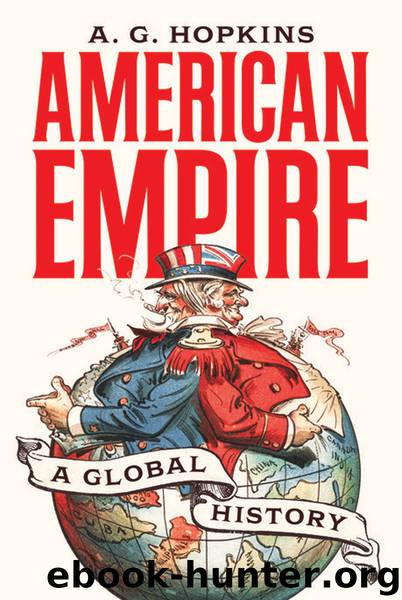
Author:Hopkins, A. G.;
Language: eng
Format: epub
Publisher: Princeton University Press
Published: 2018-05-24T04:00:00+00:00
CHAPTER 12
CARIBBEAN CARNIVAL
PLEASURE ISLANDS
It is remarkable that the Caribbean, so long a home to slavery, should have succeeded in acquiring an image of sunshine, carnivals, calypsos, and happy-go-lucky natives. The triumph of art over artifact was a feature of the twentieth century, as it was in the Pacific, and was primarily the work of the tourist industry, ably assisted by the music industry. At the turn of the century, however, the United States saw little sunshine in Cuba and Puerto Rico and few happy-go-lucky natives. In 1900, Major-General Leonard Wood, the military governor of Cuba, prepared for a long and demanding assignment: “We are dealing with a race that has steadily been going down for a hundred years, and into which we have to infuse new life, new principles and new methods of doing things.”1 Elihu Root, the Secretary of War, took a similar view of Puerto Rico. The fact that the majority of the population was white did not compensate for the island’s Latin, Roman Catholic inheritance or for the debilitating influence of what Senator Albert Beveridge called “the weak, corrupt, cruel, and capricious rule of Spain.”2 As Root saw it, the United States was obliged to become the benign but firm guardian of the island’s inhabitants, who required “a course of tuition under a strong and guiding hand.”3
The transformation of Cuba’s image dates from the 1920s, by which time the Maine, though still remembered, had ceased to stir warlike passions. Prohibition and proximity combined to make Havana an international center of high living, a “paradise of cocktails” that included gambling and prostitution.4 The mainland’s rediscovery of the island featured music, dance, and carnivals, which magnified Cuba’s image as a site of perpetual indulgence. Popular manifestations of island culture were appropriated and adapted for mainland consumption, as images of the Philippines and Hawai‘i were, too.5 The Havana Casino Orchestra had its first big hit in 1930, when it took the song, “El Manisero” (The Peanut Vendor), to the United States. The lyrics were reassuringly banal:
If you haven’t got bananas don’t be blue
Peanuts in a little bag are calling you.6
Representations of Puerto Rico never reached the levels of extravagance associated with Cuba, partly because its status as an unincorporated territory imposed controls that did not apply to an independent country, and partly because it had escaped the extreme turbulence that had loosened the bonds of Cuban society in the late nineteenth century. Nevertheless, Puerto Rico acquired a “stylish mystique” from visiting celebrities, and had its own distinctive cultural expressions that contributed to its aura as a tropical haven.7
Beyond either the reach or the comprehension of foreign recipients and tourists, however, original idioms retained their independence and vigor in the Caribbean, as they did in the Pacific. What became known, generically, as “Latin American” dance conveyed messages that derived from distinctive local origins. Rumba and salsa enjoyed popularity in Puerto Rico and Cuba not only as statements of social engagement but also as expressions of liberation.8 Puerto Rico perpetuated long-standing forms
Download
This site does not store any files on its server. We only index and link to content provided by other sites. Please contact the content providers to delete copyright contents if any and email us, we'll remove relevant links or contents immediately.
| Africa | Americas |
| Arctic & Antarctica | Asia |
| Australia & Oceania | Europe |
| Middle East | Russia |
| United States | World |
| Ancient Civilizations | Military |
| Historical Study & Educational Resources |
Cat's cradle by Kurt Vonnegut(15363)
Pimp by Iceberg Slim(14520)
4 3 2 1: A Novel by Paul Auster(12400)
Underground: A Human History of the Worlds Beneath Our Feet by Will Hunt(12101)
The Radium Girls by Kate Moore(12035)
Wiseguy by Nicholas Pileggi(5793)
The Fire Next Time by James Baldwin(5452)
Perfect Rhythm by Jae(5410)
American History Stories, Volume III (Yesterday's Classics) by Pratt Mara L(5310)
Paper Towns by Green John(5195)
Pale Blue Dot by Carl Sagan(5012)
A Higher Loyalty: Truth, Lies, and Leadership by James Comey(4966)
The Mayflower and the Pilgrims' New World by Nathaniel Philbrick(4507)
The Doomsday Machine by Daniel Ellsberg(4492)
Killers of the Flower Moon: The Osage Murders and the Birth of the FBI by David Grann(4449)
The Sympathizer by Viet Thanh Nguyen(4396)
Too Much and Not the Mood by Durga Chew-Bose(4351)
The Borden Murders by Sarah Miller(4330)
Sticky Fingers by Joe Hagan(4204)
