Agricola and Germany by Tacitus; Tacitus Cornelius;
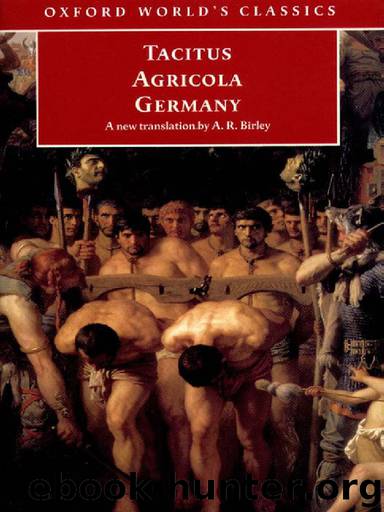
Author:Tacitus; Tacitus, Cornelius;
Language: eng
Format: epub
Publisher: Oxford University Press, UK
Published: 1999-01-01T05:00:00+00:00
ON THE ORIGIN AND LAND OF THE GERMANS
The above was apparently the proper title of the work, Germania or Germany simply being a convenient short form: Anderson, 33; Lund, 17.
1 Germany as a whole: the phrase, ‘Germania omnis’ inevitably recalls the opening of Caesar’s Gallic War, ‘Gallia omnis’, also used by Pliny, NH 4. 105, but it was a stock formula in ethnographic writings, cf. Herodotus 4. 17. 1, ‘Scythia as a whole’.
the Gauls, Raetians, and Pannonians: as Germany’s neighbours, peoples rather than Roman provinces are named. Tacitus’ list omits the Celtic peoples of Noricum, mentioned in ch. 5 below, where two provinces are named. The Latin Gallus, Gallicus, etc., being equivalent to ‘Celt, Celtic’, etc., ‘Gallis’ here was perhaps intended to cover the Celtic inhabitants of Noricum. A small province, Raetia, mentioned in ch. 3, occupying much of present Bavaria, took its name from the Raeti, but this people, who evidently spoke a pre-Indo-European language (Livy (5. 33) thought that they were of Etruscan origin), extended as far as Lake Como and South Tirol, while the province of Raetia (cf. on this in ch. 41 below) included several Celtic peoples. The Pannonians were Illyrian-speaking, but the Roman province Pannonia (chs. 5 and 28), like Raetia, also included several Celtic peoples. In ch. 29, cf. n. on frontier line there, it is clear that Tacitus was aware that the boundary between Rome and Germany was no longer formed along their entire course ‘by the Rhine and Danube rivers’, but he preferred to avoid complicating the picture at the outset. ‘Germany’ as so defined excludes the two Roman provinces constituted by Domitian in the 80s, formerly military districts, Germania Superior and Germania Inferior. Part of the population of both provinces is none the less treated in part II: the Upper German Vangiones, Triboci, Nemetes (ch. 28), and Mattiaci (ch. 29); the Lower German Ubii (ch. 28) are the exception that proves the rule, having been moved from the right to the left bank of the Rhine by Rome, while the Batavians lived on the Rhine island (ch. 29). Some other Germanic or supposedly Germanic peoples well to the west of the Rhine are mentioned but not treated in any detail: the Treveri and Nervii of Gallia Belgica (ch. 28); and the Tungri, supposedly the original ‘Germani’, who belonged either to Belgica or to Germania Inferior, crop up in ch. 4.
Sarmatians: a general name for peoples of Iranian descent who had begun moving from central Asia to the lands north of the Black Sea in the second century BC. The Romans were principally concerned with the westernmost group, the Jazyges, who occupied the Hungarian plain between the rivers Theiss and Danube c. AD 50, and the Roxolani, whose territory stretched from the river Dnieper to the Danube, cf. below on the Bastarnae and Sarmatians in ch. 46, with accompanying notes. The Roxolani and Jazyges were divided from one another by the Dacians.
Dacians: this large and powerful people, related to the Thracians of the Balkans, occupied the Transylvanian plateau and territory to the west and south of it.
Download
This site does not store any files on its server. We only index and link to content provided by other sites. Please contact the content providers to delete copyright contents if any and email us, we'll remove relevant links or contents immediately.
| Africa | Americas |
| Arctic & Antarctica | Asia |
| Australia & Oceania | Europe |
| Middle East | Russia |
| United States | World |
| Ancient Civilizations | Military |
| Historical Study & Educational Resources |
Room 212 by Kate Stewart(5130)
The Crown by Robert Lacey(4820)
Endurance: Shackleton's Incredible Voyage by Alfred Lansing(4788)
The Iron Duke by The Iron Duke(4367)
The Rape of Nanking by Iris Chang(4224)
Joan of Arc by Mary Gordon(4117)
Killing England by Bill O'Reilly(4008)
Say Nothing by Patrick Radden Keefe(3991)
I'll Give You the Sun by Jandy Nelson(3451)
Shadow of Night by Deborah Harkness(3376)
Hitler's Monsters by Eric Kurlander(3348)
Mary, Queen of Scots, and the Murder of Lord Darnley by Alison Weir(3215)
Blood and Sand by Alex Von Tunzelmann(3207)
Eleanor & Park by Rainbow Rowell(3185)
Darkest Hour by Anthony McCarten(3135)
Margaret Thatcher: The Autobiography by Thatcher Margaret(3087)
Book of Life by Deborah Harkness(2943)
Red Famine: Stalin's War on Ukraine by Anne Applebaum(2940)
The One Memory of Flora Banks by Emily Barr(2870)
