A New World of Animals by Asúa Miguel de; French Roger;
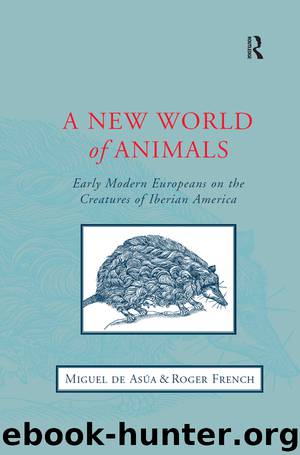
Author:Asúa, Miguel de; French, Roger;
Language: eng
Format: epub
Publisher: Routledge
Useful and Strategic Knowledge on Animals of the New World
All the authors, patrons and publishers considered in this chapter had at least one thing in common: they were anxious to exploit whatever joyful and profitable news could come from the New World. From the perspective of the initial ‘natural histories of the Indies’ written by Oviedo and Acosta, Hernández’s expedition and the systematic inquiry into Brazilian nature accomplished by Markgraf and Piso can be seen as a second stage in the process of European assimilation of knowledge about animals of the New World. Although Acosta’s Natural and Moral History was published almost two decades after Hernández started on his journey, it belongs to an earlier phase in the development of the genres of writing about New World nature. Some significant differences can be recognized between the first comprehensive natural histories of the Indies and the more complex and ambitious undertakings of Hernández, Markgraf and Piso. To begin with, Acosta’s work was not illustrated and Oviedo’s General and Natural History had just a few images of animals, while it could be argued that the lost pictures which accompanied Hernández’s manuscript were as significant as the text itself. In the same way the more than 400 pictures of the Historia naturalis Brasiliae conveyed almost as much information about the tropical fauna as Markgraf’s careful descriptions. After the publication of the works of Belon, Rondelet, Salviani and Gesner during the sixteenth century (authors we shall examine in our final chapter), natural history could hardly be conceived as anything but an amalgam of text and images. Second, Oviedo and Acosta understood their descriptions of New World nature as the opening part of a more comprehensive account of the Indies: natural history was one of the tablets in a diptych embracing ‘natural and moral’ history; it was the first element within a dual historical discourse integrating nature and the actions of human beings. Hernández and Piso – physicians both of them – wrote something different. Hernández endeavoured to articulate his interests in natural history with the survey of medical botany he was supposed to carry out, while Piso would have liked to situate Markgraf’s natural historical inquiry under the aegis of his own medical concerns. The former belonged to the sixteenth century and had been educated in the best traditions of Spanish humanist medicine, while the latter was a product of the seventeenth-century flourishing medical school of Leiden. But although separated by three-quarters of a century, they shared an analogous training in the sciences, anatomy, pharmacopoeia and natural history. Far from being the vocational account of a talented descriptor of nature like the ‘royal chronicler’ Oviedo or the philosophically oriented inquiry of the missionary Acosta, the works of Hernández and the Dutch were the result of systematic undertakings. They were conducted with the backing of the Spanish crown and the powerful DWIC, which hoped to obtain from their investments some kind of profit or future revenue in the form of useful knowledge about drugs, the country and its creatures.
Download
This site does not store any files on its server. We only index and link to content provided by other sites. Please contact the content providers to delete copyright contents if any and email us, we'll remove relevant links or contents immediately.
| Africa | Americas |
| Arctic & Antarctica | Asia |
| Australia & Oceania | Europe |
| Middle East | Russia |
| United States | World |
| Ancient Civilizations | Military |
| Historical Study & Educational Resources |
Cat's cradle by Kurt Vonnegut(15335)
Pimp by Iceberg Slim(14488)
4 3 2 1: A Novel by Paul Auster(12375)
Underground: A Human History of the Worlds Beneath Our Feet by Will Hunt(12090)
The Radium Girls by Kate Moore(12018)
Wiseguy by Nicholas Pileggi(5770)
The Fire Next Time by James Baldwin(5431)
Perfect Rhythm by Jae(5398)
American History Stories, Volume III (Yesterday's Classics) by Pratt Mara L(5300)
Paper Towns by Green John(5179)
Pale Blue Dot by Carl Sagan(4996)
A Higher Loyalty: Truth, Lies, and Leadership by James Comey(4954)
The Mayflower and the Pilgrims' New World by Nathaniel Philbrick(4494)
The Doomsday Machine by Daniel Ellsberg(4484)
Killers of the Flower Moon: The Osage Murders and the Birth of the FBI by David Grann(4435)
The Sympathizer by Viet Thanh Nguyen(4384)
Too Much and Not the Mood by Durga Chew-Bose(4338)
The Borden Murders by Sarah Miller(4313)
Sticky Fingers by Joe Hagan(4188)
